Leticia Arrington, Sven C. van Dijkman, Elodie L. Plan, Mats O. Karlsson
{"title":"Item Response Modeling and Artificial Neural Network for Differentiation of Parkinson's Patients and Subjects Without Evidence of Dopaminergic Deficit","authors":"Leticia Arrington, Sven C. van Dijkman, Elodie L. Plan, Mats O. Karlsson","doi":"10.1002/psp4.70000","DOIUrl":null,"url":null,"abstract":"<p>Approximately 15% of patients suspected of having Parkinson's disease (PD) present dopamine active transporter (DaT) scans without evidence of dopaminergic deficits (SWEDD), most of which will never develop PD. Leveraging Movement Disorders Society Unified Parkinson's Disease Rating Scale (MDS-UPDRS) scores from the Parkinson's Progression Markers Initiative, three different models of varying complexity, (total score, item response theory (IRT) and artificial neural network (ANN)) were evaluated to determine their ability to differentiate between PD and SWEDDs. Each of the models provided as output a predicted probability of having PD (P<sub>DeNoPD</sub>). Both the IRT and ANN methods performed well as classifiers; ROC AUC > 80%, sensitivity > 93%, and precision ~90% when assuming a probability cutoff of P<sub>DeNoPD</sub> ≥ 50%. Specificity was 43% and 38% for IRT and ANN respectively. Matthews correlation coefficient (MCC) was also evaluated as a metric to address potential bias of majority positive class. At all cutoffs at or above 50%, the IRT and ANN model performed similarly and achieved a MCC of at least 0.3, indicating at least a moderate positive relationship for classifier performance. In contrast, the total score model was a poor classifier, for all metrics and cutoffs. Using item-level data the proposed methodologies differentiated PD patients from SWEDDs with a degree of sensitivity and specificity that may compete with clinical examination and could aid in selecting DaTscan candidates. The choice of cutoff criteria, quality metric, and classifier model are contingent upon specific clinical needs.</p>","PeriodicalId":10774,"journal":{"name":"CPT: Pharmacometrics & Systems Pharmacology","volume":"14 5","pages":"881-890"},"PeriodicalIF":3.0000,"publicationDate":"2025-03-05","publicationTypes":"Journal Article","fieldsOfStudy":null,"isOpenAccess":false,"openAccessPdf":"https://onlinelibrary.wiley.com/doi/epdf/10.1002/psp4.70000","citationCount":"0","resultStr":null,"platform":"Semanticscholar","paperid":null,"PeriodicalName":"CPT: Pharmacometrics & Systems Pharmacology","FirstCategoryId":"3","ListUrlMain":"https://ascpt.onlinelibrary.wiley.com/doi/10.1002/psp4.70000","RegionNum":3,"RegionCategory":"医学","ArticlePicture":[],"TitleCN":null,"AbstractTextCN":null,"PMCID":null,"EPubDate":"","PubModel":"","JCR":"Q2","JCRName":"PHARMACOLOGY & PHARMACY","Score":null,"Total":0}
引用次数: 0
Abstract
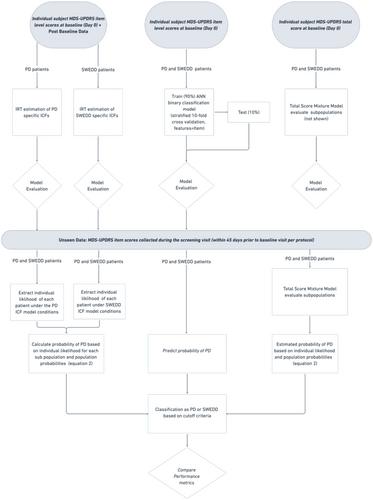
Approximately 15% of patients suspected of having Parkinson's disease (PD) present dopamine active transporter (DaT) scans without evidence of dopaminergic deficits (SWEDD), most of which will never develop PD. Leveraging Movement Disorders Society Unified Parkinson's Disease Rating Scale (MDS-UPDRS) scores from the Parkinson's Progression Markers Initiative, three different models of varying complexity, (total score, item response theory (IRT) and artificial neural network (ANN)) were evaluated to determine their ability to differentiate between PD and SWEDDs. Each of the models provided as output a predicted probability of having PD (PDeNoPD). Both the IRT and ANN methods performed well as classifiers; ROC AUC > 80%, sensitivity > 93%, and precision ~90% when assuming a probability cutoff of PDeNoPD ≥ 50%. Specificity was 43% and 38% for IRT and ANN respectively. Matthews correlation coefficient (MCC) was also evaluated as a metric to address potential bias of majority positive class. At all cutoffs at or above 50%, the IRT and ANN model performed similarly and achieved a MCC of at least 0.3, indicating at least a moderate positive relationship for classifier performance. In contrast, the total score model was a poor classifier, for all metrics and cutoffs. Using item-level data the proposed methodologies differentiated PD patients from SWEDDs with a degree of sensitivity and specificity that may compete with clinical examination and could aid in selecting DaTscan candidates. The choice of cutoff criteria, quality metric, and classifier model are contingent upon specific clinical needs.





 京公网安备 11010802042870号
京ICP备2023020795号-1
京公网安备 11010802042870号
京ICP备2023020795号-1

 分享
分享
 求助内容:
求助内容: 应助结果提醒方式:
 扫码关注我们
