Adrianne K Griebel-Thompson, Scott Sands, Lynn Chollet-Hinton, Danielle Christifano, Debra K Sullivan, Holly Hull, Juliana Teruel Camargo, Susan E Carlson
{"title":"Maternal Urinary Fluoride Levels of a Large Pregnancy Cohort in the United States: Findings from the ADORE Study.","authors":"Adrianne K Griebel-Thompson, Scott Sands, Lynn Chollet-Hinton, Danielle Christifano, Debra K Sullivan, Holly Hull, Juliana Teruel Camargo, Susan E Carlson","doi":"10.1289/EHP14711","DOIUrl":null,"url":null,"abstract":"<p><strong>Background: </strong>Emerging evidence has suggested negative associations between maternal urinary fluoride adjusted for specific gravity (MUFsg) and offspring intelligence quotient (IQ). Two prior studies report the MUFsg of pregnant women in the US, both in California, and more information is needed on population levels of MUFsg.</p><p><strong>Objectives: </strong>The primary objective was to measure MUFsg in a large pregnancy cohort of women recruited from health departments and academic hospitals in Ohio and Kansas. A secondary objective was to compare associations between water fluoridation level and estimated fluoride intake from tap water and MUFsg.</p><p><strong>Methods: </strong>Pregnant women (<math><mrow><mi>n</mi><mo>=</mo><mn>965</mn></mrow></math>) from the ADORE (Assessment of DHA on Reducing Early Preterm Birth) cohort provided a urine sample and dietary assessment at enrollment between 14 and 20 wk gestation. MUFsg was measured by fluoride-sensitive electrode and corrected for specific gravity. Water fluoridation levels were obtained for public water systems (PWS), matched to participant residence and multiplied by their tap water intake from dietary assessment. The association between MUFsg and water fluoridation level was estimated using a generalized linear model with gamma distribution and log link.</p><p><strong>Results: </strong>MUFsg (median: <math><mrow><mn>1.0</mn><mspace></mspace><mi>mg</mi><mo>/</mo><mi>L</mi></mrow></math>; Q1, Q3: 0.6, 1.5) was correlated with PWS fluoridation (<math><mrow><mrow><msub><mrow><mi>r</mi></mrow><mrow><mi>s</mi></mrow></msub></mrow><mo>=</mo><mn>0.30</mn></mrow></math>; <math><mrow><mi>p</mi><mo><</mo><mn>0.01</mn></mrow></math>) and self-reported tap water consumption (<math><mrow><mrow><msub><mrow><mi>r</mi></mrow><mrow><mi>s</mi></mrow></msub></mrow><mo>=</mo><mn>0.29</mn></mrow></math>; <math><mrow><mi>p</mi><mo><</mo><mn>0.01</mn></mrow></math>). For 87% of the cohort, MUFsg was above the <math><mrow><mn>0.45</mn><mspace></mspace><mi>mg</mi><mo>/</mo><mi>L</mi></mrow></math> safety benchmark for pregnancy proposed in a previous study. Similarly, 76.7% lived in areas with PWS fluoridation <math><mrow><mo>≥</mo><mn>0.7</mn><mspace></mspace><mi>mg</mi><mo>/</mo><mi>L</mi></mrow></math>. The median MUFsg (<math><mrow><mn>1.0</mn><mspace></mspace><mi>mg</mi><mo>/</mo><mi>L</mi></mrow></math>; Q1, Q3: 0.7, 1.5) of those living in areas with a PWS fluoridation level <math><mrow><mo>≥</mo><mn>0.7</mn><mspace></mspace><mi>mg</mi><mo>/</mo><mi>L</mi></mrow></math> was higher than the median MUFsg (<math><mrow><mn>0.8</mn><mspace></mspace><mi>mg</mi><mo>/</mo><mi>L</mi></mrow></math>; Q1, Q3: 0.5, 1.2) of women living in areas with PWS fluoridation <math><mrow><mo><</mo><mn>0.7</mn><mspace></mspace><mi>mg</mi><mo>/</mo><mi>L</mi></mrow></math> (<math><mrow><mi>p</mi><mo><</mo><mn>0.01</mn></mrow></math>).</p><p><strong>Discussion: </strong>MUFsg in this population of midwestern US women exceeds the safety benchmark for pregnancy. While we cannot account for all sources of fluoride, MUFsg was correlated to PWS fluoridation. Because so many exceeded the safety benchmark for MUFsg, there is a need for MUFsg evaluation in other US regions, especially where the PWS fluoridation exceeds US Department of Health and Human Services recommendations (<math><mrow><mo>≥</mo><mn>0.7</mn><mspace></mspace><mi>mg</mi><mo>/</mo><mi>L</mi></mrow></math>). https://doi.org/10.1289/EHP14711.</p>","PeriodicalId":11862,"journal":{"name":"Environmental Health Perspectives","volume":" ","pages":"47001"},"PeriodicalIF":9.8000,"publicationDate":"2025-04-01","publicationTypes":"Journal Article","fieldsOfStudy":null,"isOpenAccess":false,"openAccessPdf":"https://www.ncbi.nlm.nih.gov/pmc/articles/PMC11980916/pdf/","citationCount":"0","resultStr":null,"platform":"Semanticscholar","paperid":null,"PeriodicalName":"Environmental Health Perspectives","FirstCategoryId":"93","ListUrlMain":"https://doi.org/10.1289/EHP14711","RegionNum":1,"RegionCategory":"环境科学与生态学","ArticlePicture":[],"TitleCN":null,"AbstractTextCN":null,"PMCID":null,"EPubDate":"2025/4/4 0:00:00","PubModel":"Epub","JCR":"Q1","JCRName":"ENVIRONMENTAL SCIENCES","Score":null,"Total":0}
引用次数: 0
Abstract
Background: Emerging evidence has suggested negative associations between maternal urinary fluoride adjusted for specific gravity (MUFsg) and offspring intelligence quotient (IQ). Two prior studies report the MUFsg of pregnant women in the US, both in California, and more information is needed on population levels of MUFsg.
Objectives: The primary objective was to measure MUFsg in a large pregnancy cohort of women recruited from health departments and academic hospitals in Ohio and Kansas. A secondary objective was to compare associations between water fluoridation level and estimated fluoride intake from tap water and MUFsg.
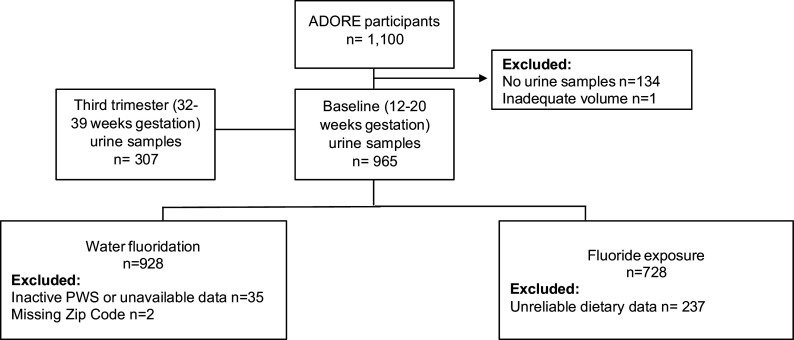
Methods: Pregnant women () from the ADORE (Assessment of DHA on Reducing Early Preterm Birth) cohort provided a urine sample and dietary assessment at enrollment between 14 and 20 wk gestation. MUFsg was measured by fluoride-sensitive electrode and corrected for specific gravity. Water fluoridation levels were obtained for public water systems (PWS), matched to participant residence and multiplied by their tap water intake from dietary assessment. The association between MUFsg and water fluoridation level was estimated using a generalized linear model with gamma distribution and log link.
Results: MUFsg (median: ; Q1, Q3: 0.6, 1.5) was correlated with PWS fluoridation (; ) and self-reported tap water consumption (; ). For 87% of the cohort, MUFsg was above the safety benchmark for pregnancy proposed in a previous study. Similarly, 76.7% lived in areas with PWS fluoridation . The median MUFsg (; Q1, Q3: 0.7, 1.5) of those living in areas with a PWS fluoridation level was higher than the median MUFsg (; Q1, Q3: 0.5, 1.2) of women living in areas with PWS fluoridation ().
Discussion: MUFsg in this population of midwestern US women exceeds the safety benchmark for pregnancy. While we cannot account for all sources of fluoride, MUFsg was correlated to PWS fluoridation. Because so many exceeded the safety benchmark for MUFsg, there is a need for MUFsg evaluation in other US regions, especially where the PWS fluoridation exceeds US Department of Health and Human Services recommendations (). https://doi.org/10.1289/EHP14711.
期刊介绍:
Environmental Health Perspectives (EHP) is a monthly peer-reviewed journal supported by the National Institute of Environmental Health Sciences, part of the National Institutes of Health under the U.S. Department of Health and Human Services. Its mission is to facilitate discussions on the connections between the environment and human health by publishing top-notch research and news. EHP ranks third in Public, Environmental, and Occupational Health, fourth in Toxicology, and fifth in Environmental Sciences.






 京公网安备 11010802042870号
京ICP备2023020795号-1
京公网安备 11010802042870号
京ICP备2023020795号-1

 分享
分享
 求助内容:
求助内容: 应助结果提醒方式:
 扫码关注我们
