Shenhong Ma, Weisheng Zhuang, Xu Wang, Di Zhang, Heling Wang, Qiaohua Han, Qixin Ding, Yuefang Li, Wanyue Li, Tianshu Li
{"title":"Efficacy of transcranial direct current stimulation on cognitive function in patients with Parkinson's disease: a systematic review and meta-analysis.","authors":"Shenhong Ma, Weisheng Zhuang, Xu Wang, Di Zhang, Heling Wang, Qiaohua Han, Qixin Ding, Yuefang Li, Wanyue Li, Tianshu Li","doi":"10.3389/fnagi.2025.1495492","DOIUrl":null,"url":null,"abstract":"<p><strong>Objective: </strong>To assess the therapeutic effect of tDCS on cognitive function in patients with Parkinson's disease.</p><p><strong>Methods: </strong>From the start of the library's construction until June 24, 2024, we searched the following databases for literature: PubMed, Embase, Web of Science, Cochrane Library, China National Knowledge Infrastructure (CNKI), Wanfang, China Science and Technology Journal Database (VIP), and China Biomedical Literature Database (CBM). We also looked through the references in the articles. The improvement of overall cognition in patients with Parkinson's disease with tDCS was the primary outcome indicator. The improvement of executive function, memory, attention, language, quality of life, and depression with tDCS were the secondary outcome indicators. Two researchers extracted data independently, with a third researcher mediating in the event of a dispute. The Cochrane risk of bias tool was used to evaluate the quality of the included literature.</p><p><strong>Results: </strong>A total of 23 articles encompassing 874 subjects were included. tDCS has shown significant efficacy on overall cognition (SMD = 0.73, 95% CI = 0.57 to 0.89, I<sup>2</sup> = 0%, <i>P</i> < 0.00001), particularly in the areas of executive function (SMD = -0.32, 95% CI = -0.56 to -0.07, I<sup>2</sup> = 0%, <i>P</i> = 0.01) and language function (SMD = 0.5, 95% CI = 0.2 to 0.8, I<sup>2</sup> = 0%, P = 0.001). Furthermore, the clinical efficacy of tDCS was enhanced with a stimulation intensity of 2 mA (SMD = 0.76, 95% CI = 0.58 to 0.93, I<sup>2</sup> = 7%, <i>P</i> < 0.00001), a stimulation duration of ≥25 min (SMD = 0.70, 95% CI = 0.49 to 0.91, I<sup>2</sup> = 6%, <i>P</i> < 0.00001), and a minimum of 10 stimulation sessions (SMD = 0.74, 95% CI = 0.56 to 0.92, I<sup>2</sup> = 0%, <i>P</i> < 0.00001). Furthermore, tDCS has shown efficacy in alleviating depressive mood (SMD = -0.46, 95% CI = -0.79 to -0.13, I<sup>2</sup> = 0%, <i>P</i> = 0.006).</p><p><strong>Conclusion: </strong>tDCS demonstrated substantial efficacy in enhancing overall cognition in patients with PD. The efficacy of tDCS was obvious in executive function, language, and depressive mood. Nonetheless, a substantial quantity of rigorous clinical trials on tDCS for cognitive function in patients with PD remains necessary in the future.</p>","PeriodicalId":12450,"journal":{"name":"Frontiers in Aging Neuroscience","volume":"17 ","pages":"1495492"},"PeriodicalIF":4.5000,"publicationDate":"2025-02-19","publicationTypes":"Journal Article","fieldsOfStudy":null,"isOpenAccess":false,"openAccessPdf":"https://www.ncbi.nlm.nih.gov/pmc/articles/PMC11880240/pdf/","citationCount":"0","resultStr":null,"platform":"Semanticscholar","paperid":null,"PeriodicalName":"Frontiers in Aging Neuroscience","FirstCategoryId":"3","ListUrlMain":"https://doi.org/10.3389/fnagi.2025.1495492","RegionNum":2,"RegionCategory":"医学","ArticlePicture":[],"TitleCN":null,"AbstractTextCN":null,"PMCID":null,"EPubDate":"2025/1/1 0:00:00","PubModel":"eCollection","JCR":"Q2","JCRName":"GERIATRICS & GERONTOLOGY","Score":null,"Total":0}
引用次数: 0
Abstract
Objective: To assess the therapeutic effect of tDCS on cognitive function in patients with Parkinson's disease.
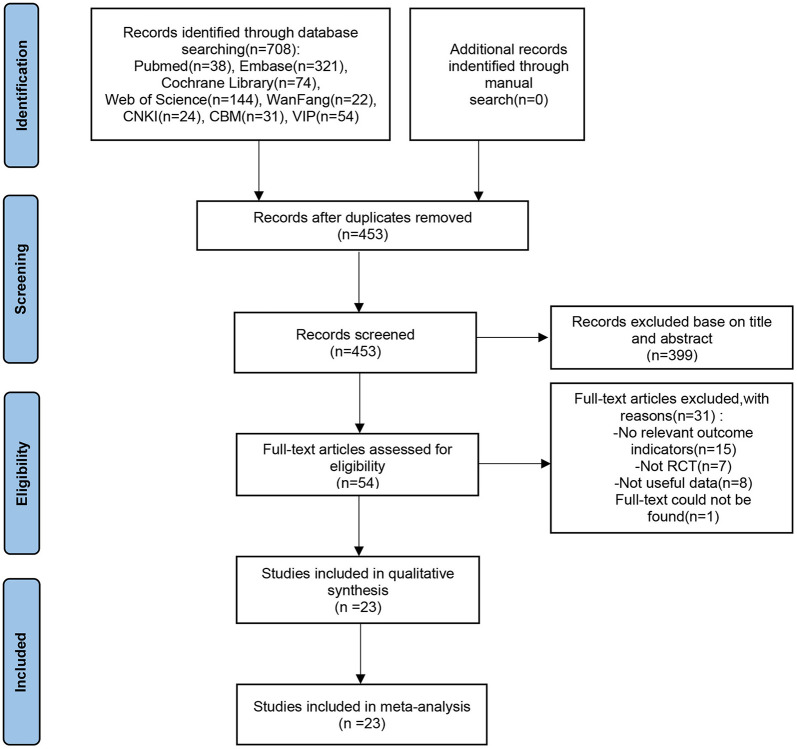
Methods: From the start of the library's construction until June 24, 2024, we searched the following databases for literature: PubMed, Embase, Web of Science, Cochrane Library, China National Knowledge Infrastructure (CNKI), Wanfang, China Science and Technology Journal Database (VIP), and China Biomedical Literature Database (CBM). We also looked through the references in the articles. The improvement of overall cognition in patients with Parkinson's disease with tDCS was the primary outcome indicator. The improvement of executive function, memory, attention, language, quality of life, and depression with tDCS were the secondary outcome indicators. Two researchers extracted data independently, with a third researcher mediating in the event of a dispute. The Cochrane risk of bias tool was used to evaluate the quality of the included literature.
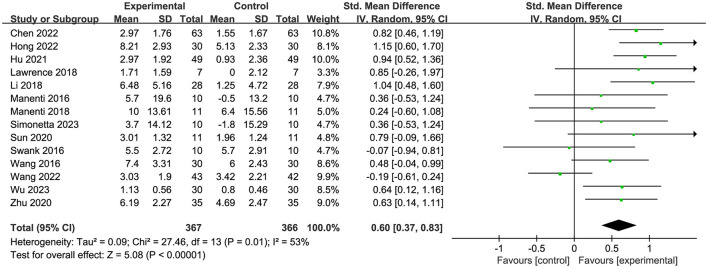
Results: A total of 23 articles encompassing 874 subjects were included. tDCS has shown significant efficacy on overall cognition (SMD = 0.73, 95% CI = 0.57 to 0.89, I2 = 0%, P < 0.00001), particularly in the areas of executive function (SMD = -0.32, 95% CI = -0.56 to -0.07, I2 = 0%, P = 0.01) and language function (SMD = 0.5, 95% CI = 0.2 to 0.8, I2 = 0%, P = 0.001). Furthermore, the clinical efficacy of tDCS was enhanced with a stimulation intensity of 2 mA (SMD = 0.76, 95% CI = 0.58 to 0.93, I2 = 7%, P < 0.00001), a stimulation duration of ≥25 min (SMD = 0.70, 95% CI = 0.49 to 0.91, I2 = 6%, P < 0.00001), and a minimum of 10 stimulation sessions (SMD = 0.74, 95% CI = 0.56 to 0.92, I2 = 0%, P < 0.00001). Furthermore, tDCS has shown efficacy in alleviating depressive mood (SMD = -0.46, 95% CI = -0.79 to -0.13, I2 = 0%, P = 0.006).
Conclusion: tDCS demonstrated substantial efficacy in enhancing overall cognition in patients with PD. The efficacy of tDCS was obvious in executive function, language, and depressive mood. Nonetheless, a substantial quantity of rigorous clinical trials on tDCS for cognitive function in patients with PD remains necessary in the future.
期刊介绍:
Frontiers in Aging Neuroscience is a leading journal in its field, publishing rigorously peer-reviewed research that advances our understanding of the mechanisms of Central Nervous System aging and age-related neural diseases. Specialty Chief Editor Thomas Wisniewski at the New York University School of Medicine is supported by an outstanding Editorial Board of international researchers. This multidisciplinary open-access journal is at the forefront of disseminating and communicating scientific knowledge and impactful discoveries to researchers, academics, clinicians and the public worldwide.





 京公网安备 11010802042870号
京ICP备2023020795号-1
京公网安备 11010802042870号
京ICP备2023020795号-1

 分享
分享
 求助内容:
求助内容: 应助结果提醒方式:
 扫码关注我们
