Dandan Guo, Tao Li, Qingchao Yang, Chenlu Yang, Yang Yang, Fuchen Liu, Jun Ma, Jun Tu, Xianjia Ning, Jinghua Wang, Chengyuan Song, Yiming Liu
{"title":"Relationship between Body Roundness Index and cognitive impairment in middle-aged and older adults: a population-based cross-sectional study.","authors":"Dandan Guo, Tao Li, Qingchao Yang, Chenlu Yang, Yang Yang, Fuchen Liu, Jun Ma, Jun Tu, Xianjia Ning, Jinghua Wang, Chengyuan Song, Yiming Liu","doi":"10.3389/fnagi.2025.1522989","DOIUrl":null,"url":null,"abstract":"<p><strong>Background: </strong>Cognitive impairment is a growing public health concern, particularly in aging populations. Obesity, as measured by various indices, has been linked to cognitive decline, but the relationship between Body Roundness Index (BRI) and cognitive impairment remains unclear. This study aims to evaluate the association between BRI and cognitive impairment in a rural, low-income, low-education population in China and to determine if BRI can be used as an independent predictor of cognitive decline.</p><p><strong>Methods: </strong>This cross-sectional study included the participants aged 35-95 years from rural Tianjin, China. The mean age of the study population was 64.35 ± 7.58 years. Data were collected through face-to-face interviews, physical examinations, and laboratory tests. Cognitive function was assessed using the Mini-Mental State Examination (MMSE), and BRI was calculated and grouped into quartiles. Univariate and multivariate logistic regression analyses were performed to examine the relationship between BRI and cognitive impairment. Subgroup analyses were conducted to explore interactions between BRI, age, gender, and hypertension. The dose-response relationship was analyzed using restricted cubic spline models.</p><p><strong>Results: </strong>Of the participants, 36.5% had cognitive impairment. Multivariate analysis showed that women, individuals aged 65 and over, and those with hypertension had a higher risk of cognitive impairment. Participants in the second quartile of BRI had a 31% lower risk of cognitive impairment compared to the first quartile (OR: 0.69, 95% CI: 0.51-0.94, <i>p</i> = 0.017). Subgroup analysis revealed that BRI was significantly associated with cognitive impairment in individuals under 65, but not in older participants. The dose-response relationship between BRI and MMSE score showed an inverted U-shaped curve, with the weakest association observed around a BRI of 4.49.</p><p><strong>Conclusion: </strong>Body Roundness Index, in conjunction with age, gender, and hypertension, can serve as a useful predictor of cognitive impairment, particularly in younger populations. Early identification of individuals at risk through BRI may facilitate timely interventions, reducing the burden of cognitive decline on patients and healthcare systems.</p>","PeriodicalId":12450,"journal":{"name":"Frontiers in Aging Neuroscience","volume":"17 ","pages":"1522989"},"PeriodicalIF":4.5000,"publicationDate":"2025-02-19","publicationTypes":"Journal Article","fieldsOfStudy":null,"isOpenAccess":false,"openAccessPdf":"https://www.ncbi.nlm.nih.gov/pmc/articles/PMC11879953/pdf/","citationCount":"0","resultStr":null,"platform":"Semanticscholar","paperid":null,"PeriodicalName":"Frontiers in Aging Neuroscience","FirstCategoryId":"3","ListUrlMain":"https://doi.org/10.3389/fnagi.2025.1522989","RegionNum":2,"RegionCategory":"医学","ArticlePicture":[],"TitleCN":null,"AbstractTextCN":null,"PMCID":null,"EPubDate":"2025/1/1 0:00:00","PubModel":"eCollection","JCR":"Q2","JCRName":"GERIATRICS & GERONTOLOGY","Score":null,"Total":0}
引用次数: 0
Abstract
Background: Cognitive impairment is a growing public health concern, particularly in aging populations. Obesity, as measured by various indices, has been linked to cognitive decline, but the relationship between Body Roundness Index (BRI) and cognitive impairment remains unclear. This study aims to evaluate the association between BRI and cognitive impairment in a rural, low-income, low-education population in China and to determine if BRI can be used as an independent predictor of cognitive decline.
Methods: This cross-sectional study included the participants aged 35-95 years from rural Tianjin, China. The mean age of the study population was 64.35 ± 7.58 years. Data were collected through face-to-face interviews, physical examinations, and laboratory tests. Cognitive function was assessed using the Mini-Mental State Examination (MMSE), and BRI was calculated and grouped into quartiles. Univariate and multivariate logistic regression analyses were performed to examine the relationship between BRI and cognitive impairment. Subgroup analyses were conducted to explore interactions between BRI, age, gender, and hypertension. The dose-response relationship was analyzed using restricted cubic spline models.
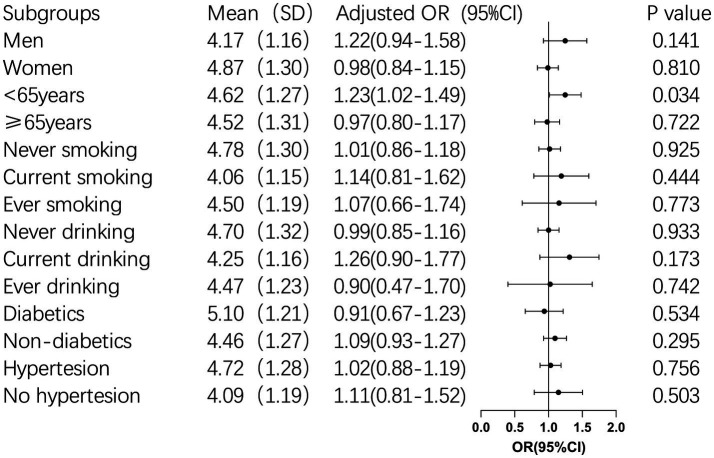
Results: Of the participants, 36.5% had cognitive impairment. Multivariate analysis showed that women, individuals aged 65 and over, and those with hypertension had a higher risk of cognitive impairment. Participants in the second quartile of BRI had a 31% lower risk of cognitive impairment compared to the first quartile (OR: 0.69, 95% CI: 0.51-0.94, p = 0.017). Subgroup analysis revealed that BRI was significantly associated with cognitive impairment in individuals under 65, but not in older participants. The dose-response relationship between BRI and MMSE score showed an inverted U-shaped curve, with the weakest association observed around a BRI of 4.49.
Conclusion: Body Roundness Index, in conjunction with age, gender, and hypertension, can serve as a useful predictor of cognitive impairment, particularly in younger populations. Early identification of individuals at risk through BRI may facilitate timely interventions, reducing the burden of cognitive decline on patients and healthcare systems.
期刊介绍:
Frontiers in Aging Neuroscience is a leading journal in its field, publishing rigorously peer-reviewed research that advances our understanding of the mechanisms of Central Nervous System aging and age-related neural diseases. Specialty Chief Editor Thomas Wisniewski at the New York University School of Medicine is supported by an outstanding Editorial Board of international researchers. This multidisciplinary open-access journal is at the forefront of disseminating and communicating scientific knowledge and impactful discoveries to researchers, academics, clinicians and the public worldwide.






 京公网安备 11010802042870号
京ICP备2023020795号-1
京公网安备 11010802042870号
京ICP备2023020795号-1

 分享
分享
 求助内容:
求助内容: 应助结果提醒方式:
 扫码关注我们
