{"title":"20 Hz temporal interference stimulation can more effectively enhance motor evoked potentials in the primary motor cortex.","authors":"Yajie Wang, Chunyue Zhu, Junhong Zhou, Tianli Fu, Jinlong Yan, Bangyu Wang, Jiaojiao Lü, Lingyan Huang, Yu Liu","doi":"10.3389/fnhum.2025.1524485","DOIUrl":null,"url":null,"abstract":"<p><strong>Objective: </strong>This study investigates the effects of temporal interference stimulation (TI) with different envelope frequencies on the cortical excitability of the primary motor cortex (M1).</p><p><strong>Methods: </strong>In this randomized, double-blind, crossover study, 26 participants completed four separate study visits. During these visits, they received 20 min of three types of TI (10, 20, and 40 Hz envelope frequency) and sham stimulation applied over M1 in a randomized order. Transcranial magnetic stimulation (TMS) was employed to assess motor-evoked potentials (MEP) and resting motor threshold (RMT) over the left M1 (ipsilateral area) and right M1 (contralateral area) before, immediately after, and 30 and 60 min after stimulation.</p><p><strong>Results: </strong>The blinding efficacy was excellent, and no severe side effects were reported. TI stimulation with varying envelope frequencies affected MEP differently; 20 Hz TI stimulation enhanced the MEP of the ipsilateral M1 with after-effects appearing at 60 min, and no significant differences were observed between the 10 or 20 Hz TI stimulation with sham groups. However, no significant changes in RMT were observed under any of the TI conditions.</p><p><strong>Conclusion: </strong>20 Hz TI stimulation increased the cortical excitability of the ipsilateral M1, highlighting that frequency is an important factor in the modulatory effect of TI.</p>","PeriodicalId":12536,"journal":{"name":"Frontiers in Human Neuroscience","volume":"19 ","pages":"1524485"},"PeriodicalIF":2.7000,"publicationDate":"2025-02-19","publicationTypes":"Journal Article","fieldsOfStudy":null,"isOpenAccess":false,"openAccessPdf":"https://www.ncbi.nlm.nih.gov/pmc/articles/PMC11880235/pdf/","citationCount":"0","resultStr":null,"platform":"Semanticscholar","paperid":null,"PeriodicalName":"Frontiers in Human Neuroscience","FirstCategoryId":"3","ListUrlMain":"https://doi.org/10.3389/fnhum.2025.1524485","RegionNum":3,"RegionCategory":"医学","ArticlePicture":[],"TitleCN":null,"AbstractTextCN":null,"PMCID":null,"EPubDate":"2025/1/1 0:00:00","PubModel":"eCollection","JCR":"Q3","JCRName":"NEUROSCIENCES","Score":null,"Total":0}
引用次数: 0
Abstract
Objective: This study investigates the effects of temporal interference stimulation (TI) with different envelope frequencies on the cortical excitability of the primary motor cortex (M1).
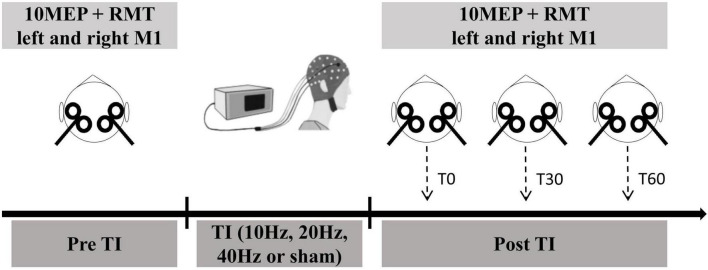
Methods: In this randomized, double-blind, crossover study, 26 participants completed four separate study visits. During these visits, they received 20 min of three types of TI (10, 20, and 40 Hz envelope frequency) and sham stimulation applied over M1 in a randomized order. Transcranial magnetic stimulation (TMS) was employed to assess motor-evoked potentials (MEP) and resting motor threshold (RMT) over the left M1 (ipsilateral area) and right M1 (contralateral area) before, immediately after, and 30 and 60 min after stimulation.
Results: The blinding efficacy was excellent, and no severe side effects were reported. TI stimulation with varying envelope frequencies affected MEP differently; 20 Hz TI stimulation enhanced the MEP of the ipsilateral M1 with after-effects appearing at 60 min, and no significant differences were observed between the 10 or 20 Hz TI stimulation with sham groups. However, no significant changes in RMT were observed under any of the TI conditions.
Conclusion: 20 Hz TI stimulation increased the cortical excitability of the ipsilateral M1, highlighting that frequency is an important factor in the modulatory effect of TI.
期刊介绍:
Frontiers in Human Neuroscience is a first-tier electronic journal devoted to understanding the brain mechanisms supporting cognitive and social behavior in humans, and how these mechanisms might be altered in disease states. The last 25 years have seen an explosive growth in both the methods and the theoretical constructs available to study the human brain. Advances in electrophysiological, neuroimaging, neuropsychological, psychophysical, neuropharmacological and computational approaches have provided key insights into the mechanisms of a broad range of human behaviors in both health and disease. Work in human neuroscience ranges from the cognitive domain, including areas such as memory, attention, language and perception to the social domain, with this last subject addressing topics, such as interpersonal interactions, social discourse and emotional regulation. How these processes unfold during development, mature in adulthood and often decline in aging, and how they are altered in a host of developmental, neurological and psychiatric disorders, has become increasingly amenable to human neuroscience research approaches. Work in human neuroscience has influenced many areas of inquiry ranging from social and cognitive psychology to economics, law and public policy. Accordingly, our journal will provide a forum for human research spanning all areas of human cognitive, social, developmental and translational neuroscience using any research approach.



 京公网安备 11010802042870号
京ICP备2023020795号-1
京公网安备 11010802042870号
京ICP备2023020795号-1

 分享
分享
 求助内容:
求助内容: 应助结果提醒方式:
 扫码关注我们
