Mariana Castanheira, Lalitagauri M Deshpande, John H Kimbrough, Marisa Winkler
{"title":"Activity of Rezafungin Against Echinocandin Non-wild type <i>Candida glabrata</i> Clinical Isolates From a Global Surveillance Program.","authors":"Mariana Castanheira, Lalitagauri M Deshpande, John H Kimbrough, Marisa Winkler","doi":"10.1093/ofid/ofae702","DOIUrl":null,"url":null,"abstract":"<p><p>Among 1463 <i>Candida glabrata</i> isolates collected in 39 US hospitals, 91 (6.2%) were non-wild type to ≥1 echinocandins (ECH-NWT) when tested by the Clinical and Laboratory Standards Institute (CLSI) reference broth microdilution method and interpretative criteria. Rezafungin breakpoints established by the US Food and Drug Administration (FDA) were also applied. ECH-NWT isolates were noted in all US census divisions, and 71 (79.0% of ECH-NWT) carried FKS hot spot (HS) alterations. S663P in FKS2 HS1 (31 isolates) was the most common alteration, followed by substitutions/deletions in position F659 in FKS2 HS1 (14 isolates) and S629P in FKS1 HS1 (9 isolates). Six isolates had substitutions in the HSs of FKS1 and FKS2, and 8 other alterations were noted in the 11 remaining isolates. When CLSI/FDA breakpoints were applied, rezafungin was active against 97.5%/95.3% and 59.3%/23.9% of the overall <i>C glabrata</i> and ECH-NWT isolates, respectively. Anidulafungin, caspofungin, and micafungin inhibited 93.9%/13.2%, 95.7%/33.0%, and 95.6%/29.7% of the overall <i>C glabrata</i>/ECH-NWT isolates. Isolates that did not harbor FKS HS substitutions were more susceptible to echinocandins when compared with isolates with substitutions (47.4%-100% and 4.2%-49.3%; lowest for anidulafungin and highest for rezafungin per the CLSI breakpoint). Isolates harboring the FKS2 HS1 S663P alterations were more resistant to echinocandins-3.2% susceptible (anidulafungin) to 35.5% (rezafungin CLSI breakpoint)-when compared with other single alterations. Rezafungin dosing and pharmacokinetic/pharmacodynamic characteristics allow for coverage of higher minimum inhibitory concentration values, making this agent an attractive option for some isolates that carry FKS alterations and still demonstrate rezafungin-susceptible minimum inhibitory concentration values.</p>","PeriodicalId":19517,"journal":{"name":"Open Forum Infectious Diseases","volume":"12 3","pages":"ofae702"},"PeriodicalIF":3.8000,"publicationDate":"2025-03-03","publicationTypes":"Journal Article","fieldsOfStudy":null,"isOpenAccess":false,"openAccessPdf":"https://www.ncbi.nlm.nih.gov/pmc/articles/PMC11879162/pdf/","citationCount":"0","resultStr":null,"platform":"Semanticscholar","paperid":null,"PeriodicalName":"Open Forum Infectious Diseases","FirstCategoryId":"3","ListUrlMain":"https://doi.org/10.1093/ofid/ofae702","RegionNum":4,"RegionCategory":"医学","ArticlePicture":[],"TitleCN":null,"AbstractTextCN":null,"PMCID":null,"EPubDate":"2025/3/1 0:00:00","PubModel":"eCollection","JCR":"Q2","JCRName":"IMMUNOLOGY","Score":null,"Total":0}
引用次数: 0
Abstract
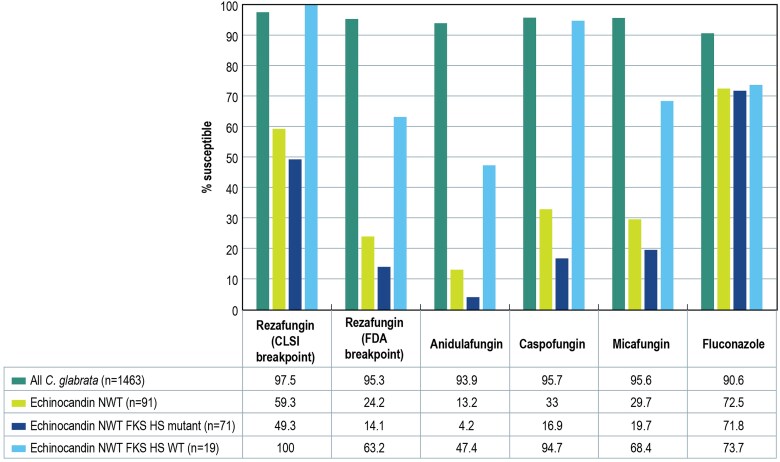
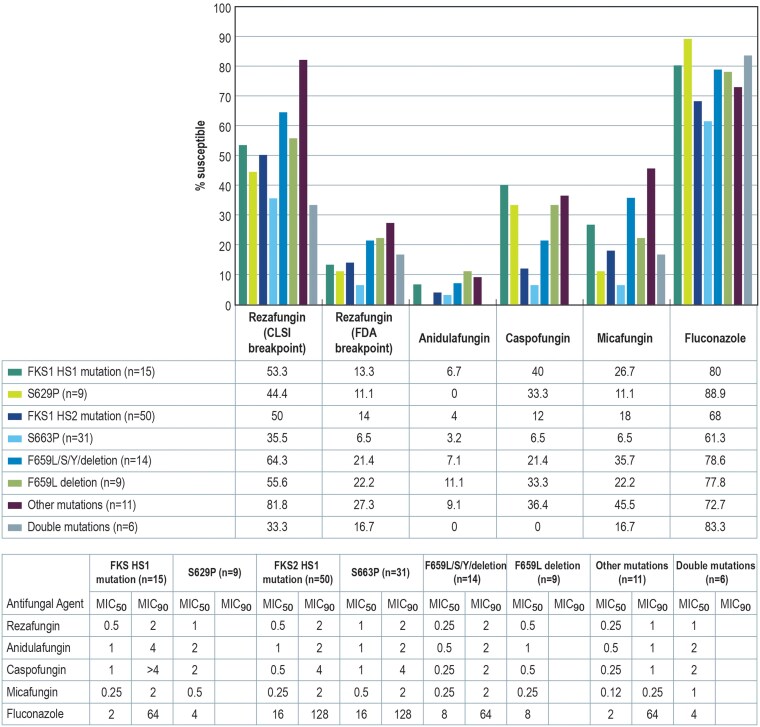
Among 1463 Candida glabrata isolates collected in 39 US hospitals, 91 (6.2%) were non-wild type to ≥1 echinocandins (ECH-NWT) when tested by the Clinical and Laboratory Standards Institute (CLSI) reference broth microdilution method and interpretative criteria. Rezafungin breakpoints established by the US Food and Drug Administration (FDA) were also applied. ECH-NWT isolates were noted in all US census divisions, and 71 (79.0% of ECH-NWT) carried FKS hot spot (HS) alterations. S663P in FKS2 HS1 (31 isolates) was the most common alteration, followed by substitutions/deletions in position F659 in FKS2 HS1 (14 isolates) and S629P in FKS1 HS1 (9 isolates). Six isolates had substitutions in the HSs of FKS1 and FKS2, and 8 other alterations were noted in the 11 remaining isolates. When CLSI/FDA breakpoints were applied, rezafungin was active against 97.5%/95.3% and 59.3%/23.9% of the overall C glabrata and ECH-NWT isolates, respectively. Anidulafungin, caspofungin, and micafungin inhibited 93.9%/13.2%, 95.7%/33.0%, and 95.6%/29.7% of the overall C glabrata/ECH-NWT isolates. Isolates that did not harbor FKS HS substitutions were more susceptible to echinocandins when compared with isolates with substitutions (47.4%-100% and 4.2%-49.3%; lowest for anidulafungin and highest for rezafungin per the CLSI breakpoint). Isolates harboring the FKS2 HS1 S663P alterations were more resistant to echinocandins-3.2% susceptible (anidulafungin) to 35.5% (rezafungin CLSI breakpoint)-when compared with other single alterations. Rezafungin dosing and pharmacokinetic/pharmacodynamic characteristics allow for coverage of higher minimum inhibitory concentration values, making this agent an attractive option for some isolates that carry FKS alterations and still demonstrate rezafungin-susceptible minimum inhibitory concentration values.
期刊介绍:
Open Forum Infectious Diseases provides a global forum for the publication of clinical, translational, and basic research findings in a fully open access, online journal environment. The journal reflects the broad diversity of the field of infectious diseases, and focuses on the intersection of biomedical science and clinical practice, with a particular emphasis on knowledge that holds the potential to improve patient care in populations around the world. Fully peer-reviewed, OFID supports the international community of infectious diseases experts by providing a venue for articles that further the understanding of all aspects of infectious diseases.




 京公网安备 11010802042870号
京ICP备2023020795号-1
京公网安备 11010802042870号
京ICP备2023020795号-1

 分享
分享
 求助内容:
求助内容: 应助结果提醒方式:
 扫码关注我们
