Suzie Kamps, Hugo L Hempel, Suzan van Amerongen, Hannah de Bruin, Fleur H C van der Linden, Vikram Venkatraghavan, Wiesje M van der Flier, Yolande A L Pijnenburg, Frederik Barkhof, Philip Scheltens, Rik Ossenkoppele, Everard G B Vijverberg
{"title":"Enlarged cavum septum pellucidum as a neuroimaging signature of head impact exposure.","authors":"Suzie Kamps, Hugo L Hempel, Suzan van Amerongen, Hannah de Bruin, Fleur H C van der Linden, Vikram Venkatraghavan, Wiesje M van der Flier, Yolande A L Pijnenburg, Frederik Barkhof, Philip Scheltens, Rik Ossenkoppele, Everard G B Vijverberg","doi":"10.1093/braincomms/fcaf085","DOIUrl":null,"url":null,"abstract":"<p><p>Cavum septum pellucidum (CSP) is commonly observed upon neuroimaging examination in individuals exposed to repetitive head impacts (RHI) and post-mortem in cases with chronic traumatic encephalopathy. Consequently, CSP has been proposed as a potential biomarker for RHI-related neurodegeneration, yet prevalence estimates of CSP across other neurodegenerative diseases and its clinical implications are largely unknown. We assessed CSP prevalence and clinical correlates in individuals with RHI exposure, a history of traumatic brain injury (TBI), a neurodegenerative disease (i.e. Alzheimer's disease or frontotemporal dementia) and normal cognition. The primary group of interest, i.e. individuals exposed to RHI in contact sports or military service <i>(n</i> = 65; mean exposure 21.58 years), was compared against age- and sex-matched participants with TBI (<i>n</i> = 57; number of TBI range: 1-5) and non-exposed participants of the Amsterdam Dementia Cohort (Alzheimer's disease, <i>n</i> = 30; frontotemporal dementia, <i>n</i> = 24; normal cognition, <i>n</i> = 27). Structural 3D brain MRI scans were visually rated for CSP grade (ranging 0-4) by two raters blinded to the clinical information. A CSP of at least Grade 2 was considered enlarged/abnormal. Inter-rater reliability was assessed with Cohens' weighted Kappa (<i>κ</i>). We investigated whether prevalence of enlarged CSP differed between groups and assessed associations with neuropsychological outcomes (verbal memory, processing speed, mental flexibility and semantic fluency), neuropsychiatric symptoms (neuropsychiatric inventory), ventricular enlargement as measured with Evan's index and MRI volumes of composite regions (limbic, temporal-meta regions and the whole brain). Inter-rater reliability was substantial [<i>κ</i> = 0.734 (95% confidence interval 0.67-0.80)]. An enlarged CSP was more often observed in the RHI group (44.6%) compared with individuals with Alzheimer's disease [13.3%, odds ratio (OR) = 5.24 (1.79-19.26)], frontotemporal dementia [16.7%, OR = 4.03 (1.35-15.02)] and normal cognition [18.5%, OR = 3.54 (1.27-11.62)], all <i>P</i> <sub>FDR</sub> < 0.05, but not compared with the TBI group [29.8%, OR = 1.90 (0.90-4.06), <i>P</i> <sub>FDR</sub> <i>=</i> 0.094]. In those with RHI, enlarged CSP was associated with lower outcomes on verbal memory learning (<i>η²</i> = 0.09, <i>P</i> <sub>FDR</sub> = 0.023) and recall (<i>η</i>² <i>=</i> 0.08, <i>P</i> <sub>FDR</sub> = 0.030). For TBI, enlarged CSP was associated with lower performance on verbal memory learning; however, this lost significance after multiple comparison correction (<i>η²</i> = 0.014, <i>P</i> <sub>FDR</sub> = 0.09). Enlarged CSP was not associated with the composite MRI volumes, ventricular enlargement or neuropsychiatric symptoms. In summary, enlarged CSP was more prevalent in RHI-exposed individuals compared with individuals with a neurodegenerative disease or normal cognition, but not compared with TBI, and was associated with lower verbal memory performance in the RHI group. Our study highlights enlarged CSP as a potential consequence of long-term head impact exposure and, to a lesser extent, TBI, rather than a general consequence of neurodegeneration.</p>","PeriodicalId":93915,"journal":{"name":"Brain communications","volume":"7 2","pages":"fcaf085"},"PeriodicalIF":4.5000,"publicationDate":"2025-02-21","publicationTypes":"Journal Article","fieldsOfStudy":null,"isOpenAccess":false,"openAccessPdf":"https://www.ncbi.nlm.nih.gov/pmc/articles/PMC11879415/pdf/","citationCount":"0","resultStr":null,"platform":"Semanticscholar","paperid":null,"PeriodicalName":"Brain communications","FirstCategoryId":"1085","ListUrlMain":"https://doi.org/10.1093/braincomms/fcaf085","RegionNum":0,"RegionCategory":null,"ArticlePicture":[],"TitleCN":null,"AbstractTextCN":null,"PMCID":null,"EPubDate":"2025/1/1 0:00:00","PubModel":"eCollection","JCR":"Q1","JCRName":"CLINICAL NEUROLOGY","Score":null,"Total":0}
引用次数: 0
Abstract
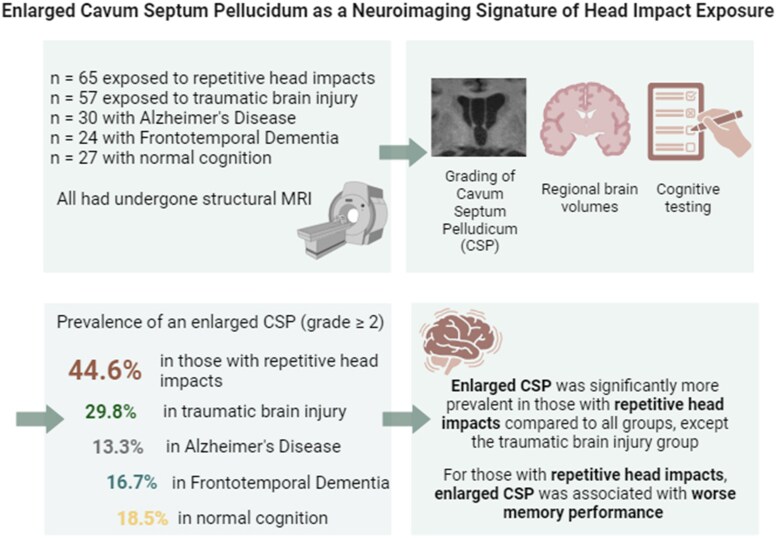
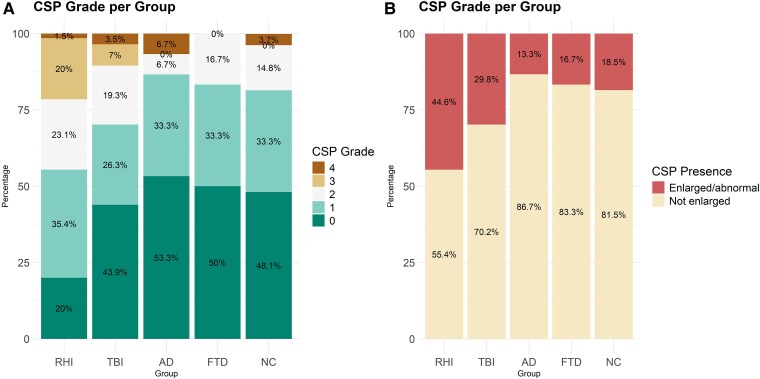
Cavum septum pellucidum (CSP) is commonly observed upon neuroimaging examination in individuals exposed to repetitive head impacts (RHI) and post-mortem in cases with chronic traumatic encephalopathy. Consequently, CSP has been proposed as a potential biomarker for RHI-related neurodegeneration, yet prevalence estimates of CSP across other neurodegenerative diseases and its clinical implications are largely unknown. We assessed CSP prevalence and clinical correlates in individuals with RHI exposure, a history of traumatic brain injury (TBI), a neurodegenerative disease (i.e. Alzheimer's disease or frontotemporal dementia) and normal cognition. The primary group of interest, i.e. individuals exposed to RHI in contact sports or military service (n = 65; mean exposure 21.58 years), was compared against age- and sex-matched participants with TBI (n = 57; number of TBI range: 1-5) and non-exposed participants of the Amsterdam Dementia Cohort (Alzheimer's disease, n = 30; frontotemporal dementia, n = 24; normal cognition, n = 27). Structural 3D brain MRI scans were visually rated for CSP grade (ranging 0-4) by two raters blinded to the clinical information. A CSP of at least Grade 2 was considered enlarged/abnormal. Inter-rater reliability was assessed with Cohens' weighted Kappa (κ). We investigated whether prevalence of enlarged CSP differed between groups and assessed associations with neuropsychological outcomes (verbal memory, processing speed, mental flexibility and semantic fluency), neuropsychiatric symptoms (neuropsychiatric inventory), ventricular enlargement as measured with Evan's index and MRI volumes of composite regions (limbic, temporal-meta regions and the whole brain). Inter-rater reliability was substantial [κ = 0.734 (95% confidence interval 0.67-0.80)]. An enlarged CSP was more often observed in the RHI group (44.6%) compared with individuals with Alzheimer's disease [13.3%, odds ratio (OR) = 5.24 (1.79-19.26)], frontotemporal dementia [16.7%, OR = 4.03 (1.35-15.02)] and normal cognition [18.5%, OR = 3.54 (1.27-11.62)], all PFDR < 0.05, but not compared with the TBI group [29.8%, OR = 1.90 (0.90-4.06), PFDR= 0.094]. In those with RHI, enlarged CSP was associated with lower outcomes on verbal memory learning (η² = 0.09, PFDR = 0.023) and recall (η² = 0.08, PFDR = 0.030). For TBI, enlarged CSP was associated with lower performance on verbal memory learning; however, this lost significance after multiple comparison correction (η² = 0.014, PFDR = 0.09). Enlarged CSP was not associated with the composite MRI volumes, ventricular enlargement or neuropsychiatric symptoms. In summary, enlarged CSP was more prevalent in RHI-exposed individuals compared with individuals with a neurodegenerative disease or normal cognition, but not compared with TBI, and was associated with lower verbal memory performance in the RHI group. Our study highlights enlarged CSP as a potential consequence of long-term head impact exposure and, to a lesser extent, TBI, rather than a general consequence of neurodegeneration.




 京公网安备 11010802042870号
京ICP备2023020795号-1
京公网安备 11010802042870号
京ICP备2023020795号-1

 分享
分享

 求助内容:
求助内容: 应助结果提醒方式:
 扫码关注我们
