Nabin Koirala, Jacy Manning, Sara Neumann, Chelsea Anderson, Mickael L D Deroche, Jace Wolfe, Kenneth Pugh, Nicole Landi, Muthuraman Muthuraman, Vincent L Gracco
{"title":"The neural characteristics influencing literacy outcome in children with cochlear implants.","authors":"Nabin Koirala, Jacy Manning, Sara Neumann, Chelsea Anderson, Mickael L D Deroche, Jace Wolfe, Kenneth Pugh, Nicole Landi, Muthuraman Muthuraman, Vincent L Gracco","doi":"10.1093/braincomms/fcaf086","DOIUrl":null,"url":null,"abstract":"<p><p>Early hearing intervention in children with congenital hearing loss is critical for improving auditory development, speech recognition and both expressive and receptive language, which translates into better educational outcomes and quality of life. In children receiving hearing aids or cochlear implants, both adaptive and potentially maladaptive neural reorganization can mitigate higher-level functions that impact reading. The focus of the present study was to dissect the neural underpinnings of the reading networks in children with cochlear implants and assess how these networks mediate the reading ability in children with cochlear implants. Cortical activity was obtained using naturalistic stimuli from 75 children (50 cochlear implant recipients, aged 7-17, and 25 age-matched children with typical hearing) using functional near-infrared spectroscopy. Assessment of basic reading skill was completed using the Reading Inventory and Scholastic Evaluation. We computed directed functional connectivity of the haemodynamic activity in reading-associated anterior and posterior brain regions using the time-frequency causality estimation method known as temporal partial directed coherence. The influence of the cochlear implant-related clinical measures on reading outcome and the extent to which neural connectivity mediated these effects were examined using structural equation modelling. Our findings reveal that the timing of intervention (e.g. age of first cochlear implants, age of first hearing aid) in children with cochlear implants significantly influenced their reading ability. Furthermore, reading-related processes (word recognition and decoding, vocabulary, morphology and sentence processing) were substantially mediated by the directed functional connectivity within reading-related neural circuits. Notably, the impact of these effects differed across various reading skills. Hearing age, defined as the age at which a participant received adequate access to sound, and age of initial implantation emerged as robust predictors of reading proficiency. The current study is one of the first to identify the influence of neural characteristics on reading outcomes for children with cochlear implants. The findings emphasize the importance of the duration of deafness and early intervention for enhancing outcomes and strengthening neural network connections. However, the neural evidence further suggested that such positive influences cannot fully offset the detrimental impact of early auditory deprivation. Consequently, additional, perhaps more specialized, interventions might be necessary to maximize the benefits of early prosthetic hearing intervention.</p>","PeriodicalId":93915,"journal":{"name":"Brain communications","volume":"7 2","pages":"fcaf086"},"PeriodicalIF":4.5000,"publicationDate":"2025-02-21","publicationTypes":"Journal Article","fieldsOfStudy":null,"isOpenAccess":false,"openAccessPdf":"https://www.ncbi.nlm.nih.gov/pmc/articles/PMC11881800/pdf/","citationCount":"0","resultStr":null,"platform":"Semanticscholar","paperid":null,"PeriodicalName":"Brain communications","FirstCategoryId":"1085","ListUrlMain":"https://doi.org/10.1093/braincomms/fcaf086","RegionNum":0,"RegionCategory":null,"ArticlePicture":[],"TitleCN":null,"AbstractTextCN":null,"PMCID":null,"EPubDate":"2025/1/1 0:00:00","PubModel":"eCollection","JCR":"Q1","JCRName":"CLINICAL NEUROLOGY","Score":null,"Total":0}
引用次数: 0
Abstract
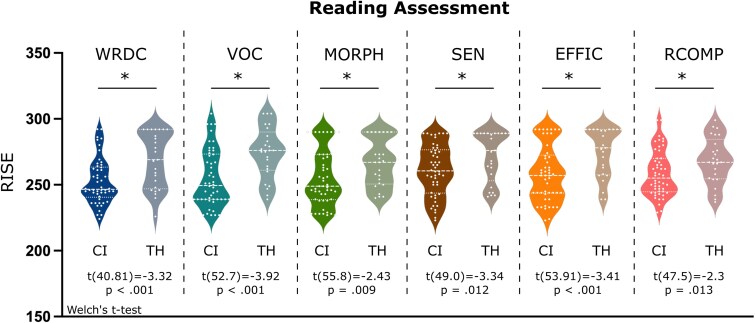
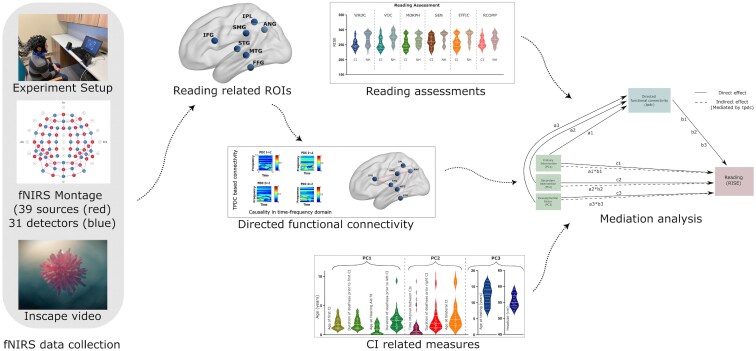
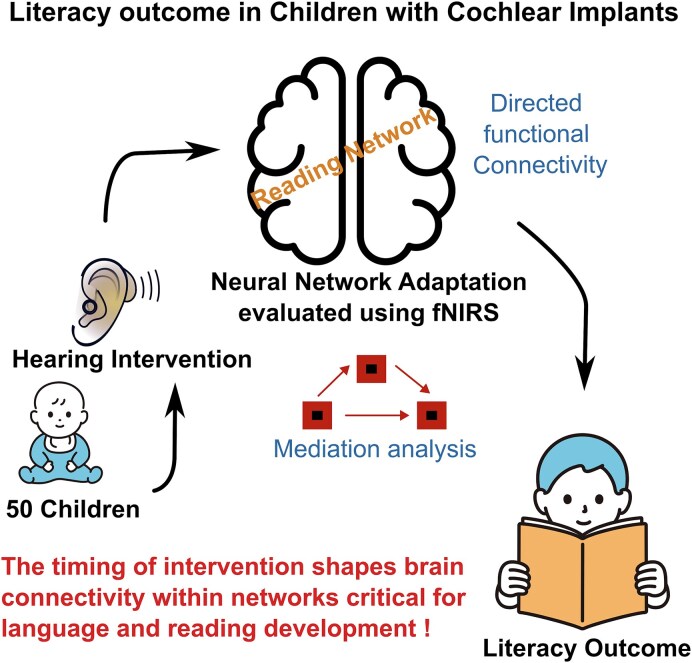
Early hearing intervention in children with congenital hearing loss is critical for improving auditory development, speech recognition and both expressive and receptive language, which translates into better educational outcomes and quality of life. In children receiving hearing aids or cochlear implants, both adaptive and potentially maladaptive neural reorganization can mitigate higher-level functions that impact reading. The focus of the present study was to dissect the neural underpinnings of the reading networks in children with cochlear implants and assess how these networks mediate the reading ability in children with cochlear implants. Cortical activity was obtained using naturalistic stimuli from 75 children (50 cochlear implant recipients, aged 7-17, and 25 age-matched children with typical hearing) using functional near-infrared spectroscopy. Assessment of basic reading skill was completed using the Reading Inventory and Scholastic Evaluation. We computed directed functional connectivity of the haemodynamic activity in reading-associated anterior and posterior brain regions using the time-frequency causality estimation method known as temporal partial directed coherence. The influence of the cochlear implant-related clinical measures on reading outcome and the extent to which neural connectivity mediated these effects were examined using structural equation modelling. Our findings reveal that the timing of intervention (e.g. age of first cochlear implants, age of first hearing aid) in children with cochlear implants significantly influenced their reading ability. Furthermore, reading-related processes (word recognition and decoding, vocabulary, morphology and sentence processing) were substantially mediated by the directed functional connectivity within reading-related neural circuits. Notably, the impact of these effects differed across various reading skills. Hearing age, defined as the age at which a participant received adequate access to sound, and age of initial implantation emerged as robust predictors of reading proficiency. The current study is one of the first to identify the influence of neural characteristics on reading outcomes for children with cochlear implants. The findings emphasize the importance of the duration of deafness and early intervention for enhancing outcomes and strengthening neural network connections. However, the neural evidence further suggested that such positive influences cannot fully offset the detrimental impact of early auditory deprivation. Consequently, additional, perhaps more specialized, interventions might be necessary to maximize the benefits of early prosthetic hearing intervention.



 京公网安备 11010802042870号
京ICP备2023020795号-1
京公网安备 11010802042870号
京ICP备2023020795号-1

 分享
分享

 求助内容:
求助内容: 应助结果提醒方式:
 扫码关注我们
