Wenhao Sun, Shuwei Ye, Yu Wang, Huifeng Chen, Ping Che, Jingshan Chen, Nan Zhang
{"title":"Plasma biomarkers for diagnosis and differentiation and their cognitive correlations in patients with Alzheimer's disease.","authors":"Wenhao Sun, Shuwei Ye, Yu Wang, Huifeng Chen, Ping Che, Jingshan Chen, Nan Zhang","doi":"10.1093/braincomms/fcaf094","DOIUrl":null,"url":null,"abstract":"<p><p>Increasing evidence has shown the potential value of plasma biomarkers in Alzheimer's disease diagnosis. This study aimed to determine the diagnostic and differential values of emerging plasma biomarkers for different types of dementia in a Chinese population and to explore their cognitive correlations. One hundred twenty patients with dementia, including 51 Alzheimer's disease patients, 54 subcortical ischaemic vascular dementia (SIVD) patients and 15 frontotemporal lobar degeneration (FTLD) patients were recruited alongside 27 cognitively unimpaired (CU) control subjects. Global and domain-specific cognition was assessed in all participants by a battery of neuropsychological tests. Plasma amyloid-beta (Αβ)42, Aβ40 and total tau (in CU controls and Alzheimer's disease patients) and phosphorylated tau at threonine-181 (<i>P</i>-tau181), neurofilament light (NfL) and glial fibrillar acidic protein (GFAP) levels (in all participants) were measured using the single-molecule array platform. The levels of all biomarkers differed between Alzheimer's disease patients and CU controls, with <i>P</i>-tau181 and GFAP levels and the Aβ42/P-tau181 ratio best differentiating the two groups [area under the curve (AUC) = 0.966, 0.932 and 0.927, respectively]. P-tau181 and GFAP levels were greater in the Alzheimer's disease group than in the other two patient groups and showed the best performance in distinguishing Alzheimer's disease patients from SIVD (AUC = 0.922) and FTLD patients (AUC = 0.894), respectively. Moreover, compared with that in the CU group, the GFAP level was elevated in the SIVD group, and the NfL level was elevated in all patient groups. Compared with other single biomarkers, the plasma Aβ42/P-tau181 ratio correlated with broader cognitive domains, including global cognition [Mini-Mental Status Examination (MMSE), <i>r</i> = 0.314, <i>P</i> = 0.027; Montreal Cognitive Assessment (MoCA), <i>r</i> = 0.313, <i>P</i> = 0.043], memory (<i>r</i> = 0.339, <i>P</i> = 0.016), language (<i>r</i> = 0.333, <i>P</i> = 0.020), attention and information processing speed (<i>r</i> = 0.369, <i>P</i> = 0.008), executive function (<i>r</i> = 0.305, <i>P</i> = 0.031) and visuospatial function memory (<i>r</i> = 0.453, <i>P</i> = 0.001). P-tau181 was an optimal plasma biomarker for identifying Alzheimer's disease patients and differentiating Alzheimer's disease patients from SIVD and FTLD patients. Moreover, the GFAP level and the Aβ42/P-tau181 ratio showed potential diagnostic and progression monitoring value, respectively, for Alzheimer's disease patients.</p>","PeriodicalId":93915,"journal":{"name":"Brain communications","volume":"7 2","pages":"fcaf094"},"PeriodicalIF":4.5000,"publicationDate":"2025-02-25","publicationTypes":"Journal Article","fieldsOfStudy":null,"isOpenAccess":false,"openAccessPdf":"https://www.ncbi.nlm.nih.gov/pmc/articles/PMC11881799/pdf/","citationCount":"0","resultStr":null,"platform":"Semanticscholar","paperid":null,"PeriodicalName":"Brain communications","FirstCategoryId":"1085","ListUrlMain":"https://doi.org/10.1093/braincomms/fcaf094","RegionNum":0,"RegionCategory":null,"ArticlePicture":[],"TitleCN":null,"AbstractTextCN":null,"PMCID":null,"EPubDate":"2025/1/1 0:00:00","PubModel":"eCollection","JCR":"Q1","JCRName":"CLINICAL NEUROLOGY","Score":null,"Total":0}
引用次数: 0
Abstract
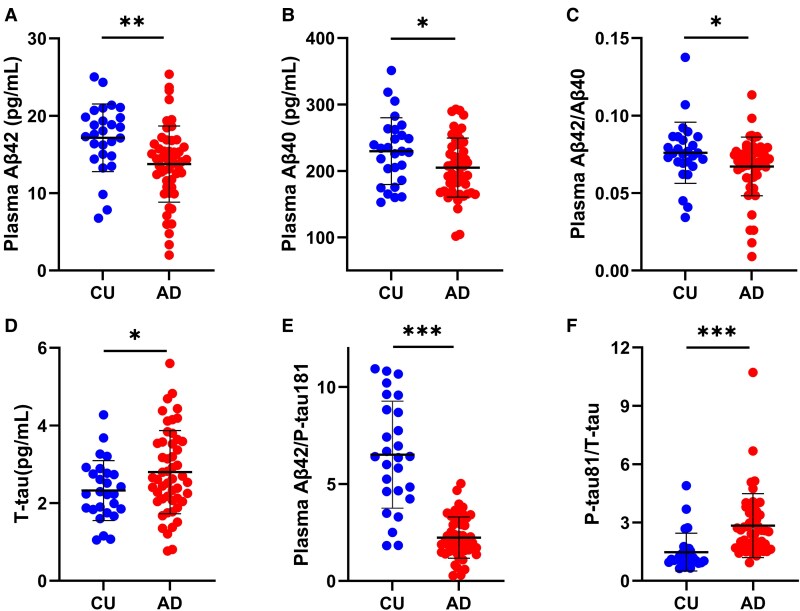
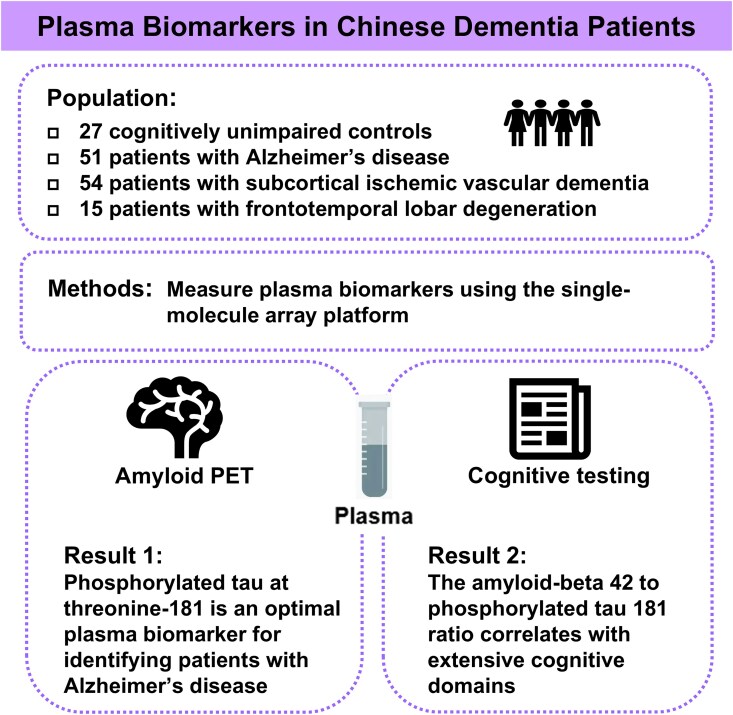
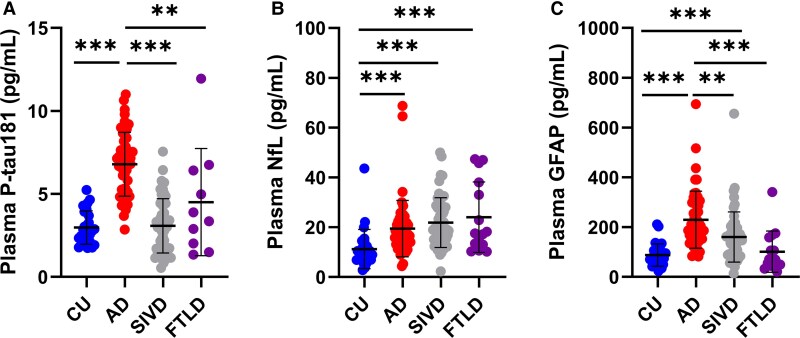
Increasing evidence has shown the potential value of plasma biomarkers in Alzheimer's disease diagnosis. This study aimed to determine the diagnostic and differential values of emerging plasma biomarkers for different types of dementia in a Chinese population and to explore their cognitive correlations. One hundred twenty patients with dementia, including 51 Alzheimer's disease patients, 54 subcortical ischaemic vascular dementia (SIVD) patients and 15 frontotemporal lobar degeneration (FTLD) patients were recruited alongside 27 cognitively unimpaired (CU) control subjects. Global and domain-specific cognition was assessed in all participants by a battery of neuropsychological tests. Plasma amyloid-beta (Αβ)42, Aβ40 and total tau (in CU controls and Alzheimer's disease patients) and phosphorylated tau at threonine-181 (P-tau181), neurofilament light (NfL) and glial fibrillar acidic protein (GFAP) levels (in all participants) were measured using the single-molecule array platform. The levels of all biomarkers differed between Alzheimer's disease patients and CU controls, with P-tau181 and GFAP levels and the Aβ42/P-tau181 ratio best differentiating the two groups [area under the curve (AUC) = 0.966, 0.932 and 0.927, respectively]. P-tau181 and GFAP levels were greater in the Alzheimer's disease group than in the other two patient groups and showed the best performance in distinguishing Alzheimer's disease patients from SIVD (AUC = 0.922) and FTLD patients (AUC = 0.894), respectively. Moreover, compared with that in the CU group, the GFAP level was elevated in the SIVD group, and the NfL level was elevated in all patient groups. Compared with other single biomarkers, the plasma Aβ42/P-tau181 ratio correlated with broader cognitive domains, including global cognition [Mini-Mental Status Examination (MMSE), r = 0.314, P = 0.027; Montreal Cognitive Assessment (MoCA), r = 0.313, P = 0.043], memory (r = 0.339, P = 0.016), language (r = 0.333, P = 0.020), attention and information processing speed (r = 0.369, P = 0.008), executive function (r = 0.305, P = 0.031) and visuospatial function memory (r = 0.453, P = 0.001). P-tau181 was an optimal plasma biomarker for identifying Alzheimer's disease patients and differentiating Alzheimer's disease patients from SIVD and FTLD patients. Moreover, the GFAP level and the Aβ42/P-tau181 ratio showed potential diagnostic and progression monitoring value, respectively, for Alzheimer's disease patients.



 京公网安备 11010802042870号
京ICP备2023020795号-1
京公网安备 11010802042870号
京ICP备2023020795号-1

 分享
分享

 求助内容:
求助内容: 应助结果提醒方式:
 扫码关注我们
