Associational resistance in the milpa: herbivore-induced maize volatiles enhance extrafloral nectar-mediated defenses in common bean via shared parasitoids
Patrick Grof-Tisza, Yulisa Patiño Moreno, Clarisse Erb, Gaston Nobel, Mary V. Clancy, Betty Benrey
{"title":"Associational resistance in the milpa: herbivore-induced maize volatiles enhance extrafloral nectar-mediated defenses in common bean via shared parasitoids","authors":"Patrick Grof-Tisza, Yulisa Patiño Moreno, Clarisse Erb, Gaston Nobel, Mary V. Clancy, Betty Benrey","doi":"10.1111/nph.70029","DOIUrl":null,"url":null,"abstract":"<div>\n \n <p>\n </p><ul>\n \n <li>Mixed cropping systems typically provide better natural pest control compared with monocultures, although the success varies depending on the crop and cultivar combinations. Understanding trait interactions that confer associational resistance (AR) to companion plants is key to optimizing these benefits. The Mesoamerican milpa system, known for its pest resistance, provides a model for studying these interactions.</li>\n \n <li>We tested two hypotheses to investigate whether access to extrafloral nectar (EFN) produced by <i>Phaseolus vulgaris</i> (common bean) can protect companion <i>Zea mays</i> (maize): (1) access to EFN enhances the survival and performance of a parasitoid wasp, leading to increased parasitism of fall armyworm (FAW) caterpillars on accompanying maize and reduced herbivory, and (2) bean plants can detect maize herbivore-induced plant volatiles (HIPVs) and respond by increasing EFN secretion.</li>\n \n <li>Controlled experiments demonstrated that wasps with access to EFN from bean plants lived longer, had higher fecundity, and parasitized more caterpillars on companion maize, thereby reducing herbivore damage. Additionally, caterpillar-damaged maize primed EFN secretion in companion bean plants via HIPVs.</li>\n \n <li>Our findings reveal a potentially important AR mechanism in the milpa, contributing to its reputed pest resistance. This understanding could inform the design of sustainable mixed cropping systems that enhance natural pest control.</li>\n </ul>\n </div>","PeriodicalId":214,"journal":{"name":"New Phytologist","volume":"246 3","pages":"1319-1332"},"PeriodicalIF":8.1000,"publicationDate":"2025-03-06","publicationTypes":"Journal Article","fieldsOfStudy":null,"isOpenAccess":false,"openAccessPdf":"","citationCount":"0","resultStr":null,"platform":"Semanticscholar","paperid":null,"PeriodicalName":"New Phytologist","FirstCategoryId":"99","ListUrlMain":"https://nph.onlinelibrary.wiley.com/doi/10.1111/nph.70029","RegionNum":1,"RegionCategory":"生物学","ArticlePicture":[],"TitleCN":null,"AbstractTextCN":null,"PMCID":null,"EPubDate":"","PubModel":"","JCR":"Q1","JCRName":"PLANT SCIENCES","Score":null,"Total":0}
引用次数: 0
Abstract
Mixed cropping systems typically provide better natural pest control compared with monocultures, although the success varies depending on the crop and cultivar combinations. Understanding trait interactions that confer associational resistance (AR) to companion plants is key to optimizing these benefits. The Mesoamerican milpa system, known for its pest resistance, provides a model for studying these interactions.
We tested two hypotheses to investigate whether access to extrafloral nectar (EFN) produced by Phaseolus vulgaris (common bean) can protect companion Zea mays (maize): (1) access to EFN enhances the survival and performance of a parasitoid wasp, leading to increased parasitism of fall armyworm (FAW) caterpillars on accompanying maize and reduced herbivory, and (2) bean plants can detect maize herbivore-induced plant volatiles (HIPVs) and respond by increasing EFN secretion.
Controlled experiments demonstrated that wasps with access to EFN from bean plants lived longer, had higher fecundity, and parasitized more caterpillars on companion maize, thereby reducing herbivore damage. Additionally, caterpillar-damaged maize primed EFN secretion in companion bean plants via HIPVs.
Our findings reveal a potentially important AR mechanism in the milpa, contributing to its reputed pest resistance. This understanding could inform the design of sustainable mixed cropping systems that enhance natural pest control.
期刊介绍:
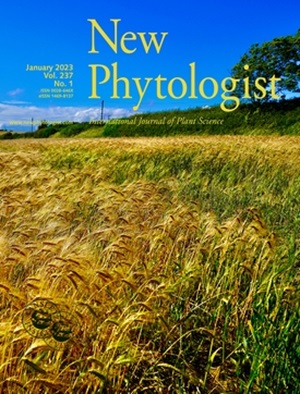
New Phytologist is an international electronic journal published 24 times a year. It is owned by the New Phytologist Foundation, a non-profit-making charitable organization dedicated to promoting plant science. The journal publishes excellent, novel, rigorous, and timely research and scholarship in plant science and its applications. The articles cover topics in five sections: Physiology & Development, Environment, Interaction, Evolution, and Transformative Plant Biotechnology. These sections encompass intracellular processes, global environmental change, and encourage cross-disciplinary approaches. The journal recognizes the use of techniques from molecular and cell biology, functional genomics, modeling, and system-based approaches in plant science. Abstracting and Indexing Information for New Phytologist includes Academic Search, AgBiotech News & Information, Agroforestry Abstracts, Biochemistry & Biophysics Citation Index, Botanical Pesticides, CAB Abstracts®, Environment Index, Global Health, and Plant Breeding Abstracts, and others.




 京公网安备 11010802042870号
京ICP备2023020795号-1
京公网安备 11010802042870号
京ICP备2023020795号-1

 分享
分享
 求助内容:
求助内容: 应助结果提醒方式:
 扫码关注我们
