Boyang Shen , Zhengcheng He , Haitao Huang , Feng He , Yao Chen , Pengyuan Wu , Mingfeng Li , Oleksiy V. Penkov , Hongwei Wu
{"title":"Improved biocompatibility of durable Si-DLC periodical nanocomposite coatings modified by plasma treatment for medical implants","authors":"Boyang Shen , Zhengcheng He , Haitao Huang , Feng He , Yao Chen , Pengyuan Wu , Mingfeng Li , Oleksiy V. Penkov , Hongwei Wu","doi":"10.1016/j.apsusc.2025.162907","DOIUrl":null,"url":null,"abstract":"<div><div>Diamond-like carbon (DLC) coatings are increasingly favored for dental implants, artificial joints, etc. However, they still have limitations, such as high internal stress and poor adhesion. In addition, while increasing the sp<sup>3</sup> content promoted the mechanical properties, it decreased the biological properties. To overcome this effect, further surface modifications could be used. In this study, periodically stacked DLC and amorphous silicon nanocomposite coatings (PNCs) were deposited via a magnetron sputtering system. A quick and inexpensive surface modification method for coatings using anode membrane circular ion sources was proposed to increase the biocompatibility of the surface. A hardness of 18 GPa and a low wear rate of 9 × 10<sup>−11</sup> <!-->mm<sup>3</sup>/N·mm were achieved. The results demonstrated that appropriate plasma treatment did not significantly change the mechanical properties but did decrease the sp<sup>3</sup> content of the coating surface and altered surface hydrophilicity, thus optimizing the coating’s surface properties and surface stress. This improvement was conducive to cell adhesion and proliferation, resulting in a significant increase in biological performance. Both the nitrogen- and argon-plasma-treated coatings exhibited a pronounced capacity to facilitate cell adhesion and spreading. In addition, nitrogen-plasma treatment significantly increased the biocompatibility and cell proliferation capacity, and argon-plasma treatment resulted in superior osteogenic differentiation potential. Thus, Si-DLC PNCs with anode membrane plasma treatment exhibit great potential for application in the orthopedic implant industry.</div></div>","PeriodicalId":247,"journal":{"name":"Applied Surface Science","volume":"695 ","pages":"Article 162907"},"PeriodicalIF":6.9000,"publicationDate":"2025-06-30","publicationTypes":"Journal Article","fieldsOfStudy":null,"isOpenAccess":false,"openAccessPdf":"","citationCount":"0","resultStr":null,"platform":"Semanticscholar","paperid":null,"PeriodicalName":"Applied Surface Science","FirstCategoryId":"88","ListUrlMain":"https://www.sciencedirect.com/science/article/pii/S016943322500621X","RegionNum":2,"RegionCategory":"材料科学","ArticlePicture":[],"TitleCN":null,"AbstractTextCN":null,"PMCID":null,"EPubDate":"2025/3/7 0:00:00","PubModel":"Epub","JCR":"Q2","JCRName":"CHEMISTRY, PHYSICAL","Score":null,"Total":0}
引用次数: 0
Abstract
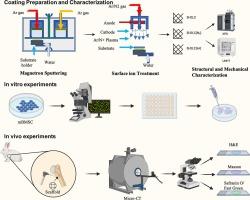
Diamond-like carbon (DLC) coatings are increasingly favored for dental implants, artificial joints, etc. However, they still have limitations, such as high internal stress and poor adhesion. In addition, while increasing the sp3 content promoted the mechanical properties, it decreased the biological properties. To overcome this effect, further surface modifications could be used. In this study, periodically stacked DLC and amorphous silicon nanocomposite coatings (PNCs) were deposited via a magnetron sputtering system. A quick and inexpensive surface modification method for coatings using anode membrane circular ion sources was proposed to increase the biocompatibility of the surface. A hardness of 18 GPa and a low wear rate of 9 × 10⁻¹¹ mm3/N·mm were achieved. The results demonstrated that appropriate plasma treatment did not significantly change the mechanical properties but did decrease the sp3 content of the coating surface and altered surface hydrophilicity, thus optimizing the coating’s surface properties and surface stress. This improvement was conducive to cell adhesion and proliferation, resulting in a significant increase in biological performance. Both the nitrogen- and argon-plasma-treated coatings exhibited a pronounced capacity to facilitate cell adhesion and spreading. In addition, nitrogen-plasma treatment significantly increased the biocompatibility and cell proliferation capacity, and argon-plasma treatment resulted in superior osteogenic differentiation potential. Thus, Si-DLC PNCs with anode membrane plasma treatment exhibit great potential for application in the orthopedic implant industry.
期刊介绍:
Applied Surface Science covers topics contributing to a better understanding of surfaces, interfaces, nanostructures and their applications. The journal is concerned with scientific research on the atomic and molecular level of material properties determined with specific surface analytical techniques and/or computational methods, as well as the processing of such structures.




 京公网安备 11010802042870号
京ICP备2023020795号-1
京公网安备 11010802042870号
京ICP备2023020795号-1

 分享
分享
 求助内容:
求助内容: 应助结果提醒方式:
 扫码关注我们
