Yingjie Wang , Dai Cheng , Jingjing He , Sijia Liu , Xinlu Wang , Meng Wang
{"title":"Magnolol protects C6 glioma cells against neurotoxicity of FB1 via modulating PI3K/Akt and mitochondria-associated apoptosis signaling pathways","authors":"Yingjie Wang , Dai Cheng , Jingjing He , Sijia Liu , Xinlu Wang , Meng Wang","doi":"10.1016/j.envpol.2025.126017","DOIUrl":null,"url":null,"abstract":"<div><div>Fumonisin B1 (FB1) is a contaminant commonly occurring in crops and food. Mycotoxin contamination, including FB1, has been progressively shown to be an important risk factor in mediating neurotoxicity and neurodegenerative diseases. Studies have found that magnolol (MAG) exhibits favorable pharmacological effects in the central nervous system. However, the protective effects of MAG against FB1-induced neurotoxicity and the molecular pathways involved have not been fully elucidated. Our study aimed to investigate the neuroprotective effects of MAG on FB1-exposed C6 cells and to identify the underlying mechanisms. A model of FB1-induced cytotoxicity in C6 glial cells was established. C6 cells were treated with MAG (40, 80 and 160 μM) in the presence/absence of FB1 (15 μM) and then assessed for cell viability, cellular and mitochondrial morphology and oxidative stress. The mechanism of action of MAG was revealed using a variety of means including RNA-seq, qRT-PCR, Western blot, immunofluorescence, scanning electron microscopy analysis and agonist validation experiments. Our results indicated that MAG significantly alleviated AFB1-induced C6 astroglial cytotoxicity, as evidenced by elevated cell viability and restoration of overall cellular and mitochondrial morphology. Meanwhile, MAG also alleviated oxidative stress in FB1-exposed C6 cells, with 80 μM MAG showing the best effect. Transcriptome analysis showed that PI3K/Akt and apoptosis involved in it might be the key pathway for MAG to treat FB1 neurotoxicity. MAG suppressed FB1-induced mitochondria-dependent apoptosis in C6 cells, primarily manifested by reduced apoptosis rate and reversal of apoptosis-associated protein expression. It was verified that MAG restored the expression of p-PI3K and p-Akt in FB1-treated cells and reversed the downstream effectors IKKα and NF-κB via measurement of related protein levels. The rescue experiment using Akt pathway activator (SC79) was further confirmed that activation of the PI3K/Akt signaling pathway is an effective strategy for MAG to mitigate FB1-induced cytotoxicity in C6 astroglial cells.</div></div>","PeriodicalId":311,"journal":{"name":"Environmental Pollution","volume":"372 ","pages":"Article 126017"},"PeriodicalIF":7.3000,"publicationDate":"2025-03-06","publicationTypes":"Journal Article","fieldsOfStudy":null,"isOpenAccess":false,"openAccessPdf":"","citationCount":"0","resultStr":null,"platform":"Semanticscholar","paperid":null,"PeriodicalName":"Environmental Pollution","FirstCategoryId":"93","ListUrlMain":"https://www.sciencedirect.com/science/article/pii/S0269749125003902","RegionNum":2,"RegionCategory":"环境科学与生态学","ArticlePicture":[],"TitleCN":null,"AbstractTextCN":null,"PMCID":null,"EPubDate":"","PubModel":"","JCR":"Q1","JCRName":"ENVIRONMENTAL SCIENCES","Score":null,"Total":0}
引用次数: 0
Abstract
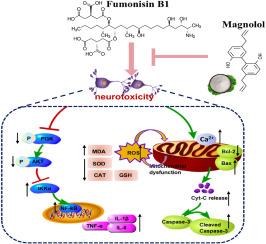
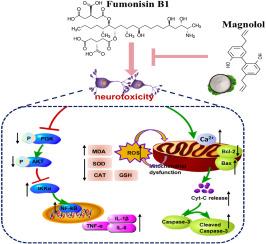
Fumonisin B1 (FB1) is a contaminant commonly occurring in crops and food. Mycotoxin contamination, including FB1, has been progressively shown to be an important risk factor in mediating neurotoxicity and neurodegenerative diseases. Studies have found that magnolol (MAG) exhibits favorable pharmacological effects in the central nervous system. However, the protective effects of MAG against FB1-induced neurotoxicity and the molecular pathways involved have not been fully elucidated. Our study aimed to investigate the neuroprotective effects of MAG on FB1-exposed C6 cells and to identify the underlying mechanisms. A model of FB1-induced cytotoxicity in C6 glial cells was established. C6 cells were treated with MAG (40, 80 and 160 μM) in the presence/absence of FB1 (15 μM) and then assessed for cell viability, cellular and mitochondrial morphology and oxidative stress. The mechanism of action of MAG was revealed using a variety of means including RNA-seq, qRT-PCR, Western blot, immunofluorescence, scanning electron microscopy analysis and agonist validation experiments. Our results indicated that MAG significantly alleviated AFB1-induced C6 astroglial cytotoxicity, as evidenced by elevated cell viability and restoration of overall cellular and mitochondrial morphology. Meanwhile, MAG also alleviated oxidative stress in FB1-exposed C6 cells, with 80 μM MAG showing the best effect. Transcriptome analysis showed that PI3K/Akt and apoptosis involved in it might be the key pathway for MAG to treat FB1 neurotoxicity. MAG suppressed FB1-induced mitochondria-dependent apoptosis in C6 cells, primarily manifested by reduced apoptosis rate and reversal of apoptosis-associated protein expression. It was verified that MAG restored the expression of p-PI3K and p-Akt in FB1-treated cells and reversed the downstream effectors IKKα and NF-κB via measurement of related protein levels. The rescue experiment using Akt pathway activator (SC79) was further confirmed that activation of the PI3K/Akt signaling pathway is an effective strategy for MAG to mitigate FB1-induced cytotoxicity in C6 astroglial cells.
期刊介绍:
Environmental Pollution is an international peer-reviewed journal that publishes high-quality research papers and review articles covering all aspects of environmental pollution and its impacts on ecosystems and human health.
Subject areas include, but are not limited to:
• Sources and occurrences of pollutants that are clearly defined and measured in environmental compartments, food and food-related items, and human bodies;
• Interlinks between contaminant exposure and biological, ecological, and human health effects, including those of climate change;
• Contaminants of emerging concerns (including but not limited to antibiotic resistant microorganisms or genes, microplastics/nanoplastics, electronic wastes, light, and noise) and/or their biological, ecological, or human health effects;
• Laboratory and field studies on the remediation/mitigation of environmental pollution via new techniques and with clear links to biological, ecological, or human health effects;
• Modeling of pollution processes, patterns, or trends that is of clear environmental and/or human health interest;
• New techniques that measure and examine environmental occurrences, transport, behavior, and effects of pollutants within the environment or the laboratory, provided that they can be clearly used to address problems within regional or global environmental compartments.



 京公网安备 11010802042870号
京ICP备2023020795号-1
京公网安备 11010802042870号
京ICP备2023020795号-1

 分享
分享
 求助内容:
求助内容: 应助结果提醒方式:
 扫码关注我们
