{"title":"Advanced modeling of plastic recycling supply chain networks for emission reduction and sustainability","authors":"Jaepil Cheon, Yuchan Ahn","doi":"10.1016/j.jclepro.2025.145231","DOIUrl":null,"url":null,"abstract":"<div><div>Plastic products are rising in demand due to their beneficial properties, increasing plastic waste emissions. Historically, China imported plastic waste; however, stringent bans after 2018 have shifted the burden to producing countries like Korea. International agreements such as the United Nations Framework Convention on Climate Change, Kyoto Protocol, Paris Agreement, and Intergovernmental Panel on Climate Change guidelines emphasize greenhouse gas emission reduction. By 2030, Korea aims to cut emissions by over 35% and achieve a plastic waste recycling rate of 70%. Limited land area necessitates sustainable waste management beyond landfills and incineration. Effective management can reduce environmental impact and generate carbon credits. Thus, this study constructs an optimal supply chain network for recycling plastic waste in Korea using a multi-period model based on the Organization for Economic Co-operation and Development statistics. The model integrates collection, sorting, transportation, and recycling, focusing on material recycling, chemical recycling, and energy recovery. It addresses Korea's waste management challenges while targeting national emission reduction and recycling rate goals. Expected outcomes include optimal recycling strategies, policy recommendations, and industry practices to implement this supply chain network, contributing to Korea's environmental goals and global efforts to mitigate plastic waste impacts. The proposed model provides a scalable, adaptable framework for sustainable waste management globally.</div></div>","PeriodicalId":349,"journal":{"name":"Journal of Cleaner Production","volume":"499 ","pages":"Article 145231"},"PeriodicalIF":10.0000,"publicationDate":"2025-03-07","publicationTypes":"Journal Article","fieldsOfStudy":null,"isOpenAccess":false,"openAccessPdf":"","citationCount":"0","resultStr":null,"platform":"Semanticscholar","paperid":null,"PeriodicalName":"Journal of Cleaner Production","FirstCategoryId":"93","ListUrlMain":"https://www.sciencedirect.com/science/article/pii/S0959652625005815","RegionNum":1,"RegionCategory":"环境科学与生态学","ArticlePicture":[],"TitleCN":null,"AbstractTextCN":null,"PMCID":null,"EPubDate":"","PubModel":"","JCR":"Q1","JCRName":"ENGINEERING, ENVIRONMENTAL","Score":null,"Total":0}
引用次数: 0
Abstract
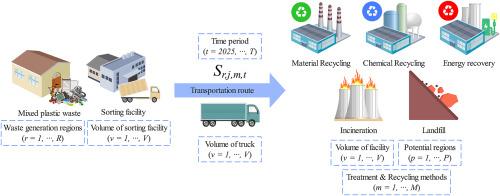
Plastic products are rising in demand due to their beneficial properties, increasing plastic waste emissions. Historically, China imported plastic waste; however, stringent bans after 2018 have shifted the burden to producing countries like Korea. International agreements such as the United Nations Framework Convention on Climate Change, Kyoto Protocol, Paris Agreement, and Intergovernmental Panel on Climate Change guidelines emphasize greenhouse gas emission reduction. By 2030, Korea aims to cut emissions by over 35% and achieve a plastic waste recycling rate of 70%. Limited land area necessitates sustainable waste management beyond landfills and incineration. Effective management can reduce environmental impact and generate carbon credits. Thus, this study constructs an optimal supply chain network for recycling plastic waste in Korea using a multi-period model based on the Organization for Economic Co-operation and Development statistics. The model integrates collection, sorting, transportation, and recycling, focusing on material recycling, chemical recycling, and energy recovery. It addresses Korea's waste management challenges while targeting national emission reduction and recycling rate goals. Expected outcomes include optimal recycling strategies, policy recommendations, and industry practices to implement this supply chain network, contributing to Korea's environmental goals and global efforts to mitigate plastic waste impacts. The proposed model provides a scalable, adaptable framework for sustainable waste management globally.
期刊介绍:
The Journal of Cleaner Production is an international, transdisciplinary journal that addresses and discusses theoretical and practical Cleaner Production, Environmental, and Sustainability issues. It aims to help societies become more sustainable by focusing on the concept of 'Cleaner Production', which aims at preventing waste production and increasing efficiencies in energy, water, resources, and human capital use. The journal serves as a platform for corporations, governments, education institutions, regions, and societies to engage in discussions and research related to Cleaner Production, environmental, and sustainability practices.




 京公网安备 11010802042870号
京ICP备2023020795号-1
京公网安备 11010802042870号
京ICP备2023020795号-1

 分享
分享
 求助内容:
求助内容: 应助结果提醒方式:
 扫码关注我们
