Kelvin J.Y. Wu , Elena V. Aleksandrova , Paul J. Robinson , Amy E. Benedetto , Meiyi Yu , Ben I.C. Tresco , Dominic N.Y. See , Tong Jiang , Antonio Ramkissoon , Clémence F. Dunand , Maxim S. Svetlov , Joonho Lee , Yury S. Polikanov , Andrew G. Myers
{"title":"Why sulfur is important in lincosamide antibiotics","authors":"Kelvin J.Y. Wu , Elena V. Aleksandrova , Paul J. Robinson , Amy E. Benedetto , Meiyi Yu , Ben I.C. Tresco , Dominic N.Y. See , Tong Jiang , Antonio Ramkissoon , Clémence F. Dunand , Maxim S. Svetlov , Joonho Lee , Yury S. Polikanov , Andrew G. Myers","doi":"10.1016/j.chempr.2025.102480","DOIUrl":null,"url":null,"abstract":"<div><div>We recently reported the conception and synthesis of cresomycin (CRM), a fully synthetic lincosamide antibiotic effective <em>in vitro</em> and <em>in vivo</em> against multidrug-resistant Gram-positive and Gram-negative bacteria. In this work, we describe the chemical synthesis and characterization of CRM sulfur atom replacement analogs C-CRM (S → CH<sub>2</sub>), O-CRM (S → O), and Se-CRM (S → Se). Comparison of high-resolution co-crystal structures showed that all four analogs adopted identical conformations when bound to the bacterial ribosome, but due to variations of ≤1 Å in the bond lengths between the anomeric carbon and the varied atoms, only the S and Se heteroatoms of CRM and Se-CRM, respectively, were positioned to interact with the π-face of nucleobase G2505. C-CRM and O-CRM did not benefit from such stabilizations, with correspondingly negative consequences in both target engagement and antibacterial activities. We therefore conclude that the sulfur atom of the lincosamides is important in ribosomal binding.</div></div>","PeriodicalId":268,"journal":{"name":"Chem","volume":"11 7","pages":"Article 102480"},"PeriodicalIF":19.6000,"publicationDate":"2025-07-10","publicationTypes":"Journal Article","fieldsOfStudy":null,"isOpenAccess":false,"openAccessPdf":"","citationCount":"0","resultStr":null,"platform":"Semanticscholar","paperid":null,"PeriodicalName":"Chem","FirstCategoryId":"92","ListUrlMain":"https://www.sciencedirect.com/science/article/pii/S2451929425000701","RegionNum":1,"RegionCategory":"化学","ArticlePicture":[],"TitleCN":null,"AbstractTextCN":null,"PMCID":null,"EPubDate":"","PubModel":"","JCR":"Q1","JCRName":"CHEMISTRY, MULTIDISCIPLINARY","Score":null,"Total":0}
引用次数: 0
Abstract
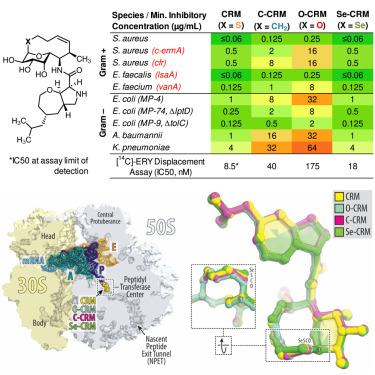
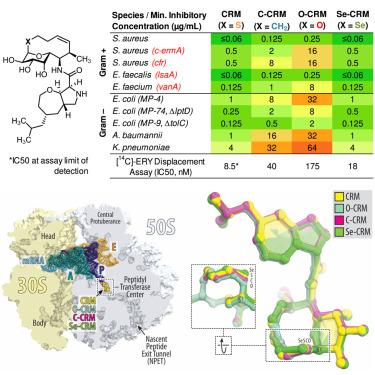
We recently reported the conception and synthesis of cresomycin (CRM), a fully synthetic lincosamide antibiotic effective in vitro and in vivo against multidrug-resistant Gram-positive and Gram-negative bacteria. In this work, we describe the chemical synthesis and characterization of CRM sulfur atom replacement analogs C-CRM (S → CH2), O-CRM (S → O), and Se-CRM (S → Se). Comparison of high-resolution co-crystal structures showed that all four analogs adopted identical conformations when bound to the bacterial ribosome, but due to variations of ≤1 Å in the bond lengths between the anomeric carbon and the varied atoms, only the S and Se heteroatoms of CRM and Se-CRM, respectively, were positioned to interact with the π-face of nucleobase G2505. C-CRM and O-CRM did not benefit from such stabilizations, with correspondingly negative consequences in both target engagement and antibacterial activities. We therefore conclude that the sulfur atom of the lincosamides is important in ribosomal binding.
期刊介绍:
Chem, affiliated with Cell as its sister journal, serves as a platform for groundbreaking research and illustrates how fundamental inquiries in chemistry and its related fields can contribute to addressing future global challenges. It was established in 2016, and is currently edited by Robert Eagling.



 京公网安备 11010802042870号
京ICP备2023020795号-1
京公网安备 11010802042870号
京ICP备2023020795号-1

 分享
分享
 求助内容:
求助内容: 应助结果提醒方式:
 扫码关注我们
