Bo Dong , Junyuan Hua , Jintao He , Jiahui Du , Jian Xiao , Jianxin Li
{"title":"A hollow fiber supported ionic liquid membrane contactor for continuous extraction of lithium from high magnesium/lithium ratio brine","authors":"Bo Dong , Junyuan Hua , Jintao He , Jiahui Du , Jian Xiao , Jianxin Li","doi":"10.1016/j.watres.2025.123451","DOIUrl":null,"url":null,"abstract":"<div><div>High-efficiency lithium (Li<sup>+</sup>) extraction from a salt-lake brine with a low Li concentration and a high Mg/Li mass ratio poses a great challenge owing to the great physical and chemical similarities between Mg<sup>2+</sup> and Li<sup>+</sup>. In this study, a hollow fiber (HF) membrane with an inside diameter of 0.872 mm and an outside diameter of 1.228 mm was fabricated using nonsolvent induce phase separation method with 14-crown-4 ether functionalized polyimide (14C4PI) as a polymer matrix. The organic phase, a solution of tributyl phosphate and sodium bis(trifluoromethylsulfonyl)imide (NaNTf<sub>2</sub>) was filled into porous membranes as the solid phase using an impregnation method to construct a supported ionic liquid membranes (SILMs) contactor for lithium extraction from simulated salt-lake brine. The feed and stripping phases of the contactor were a mixed Mg/Li solution and 0.5 mol/L HCl, respectively. The contactor operated continuously for 120 h. The results showed an HF membrane with an average pore size of 20.1 nm, porosity of 73.6 % and a breaking strength of 5.64 MPa. When the Mg/Li mass ratio in the feed was approximately 3.5, the mass transfer rate of Li<sup>+</sup> and the separation factor (SF<sub>Li−Mg</sub>) obtained from the contactor with a packing density of 1.5 % were 0.468 μm/s and 15.86, respectively. After further increasing the mass ratio of the Mg/Li solution to 35 in the feed and the membrane packing density to 15 %, the mass transfer rate of Li<sup>+</sup> and the SF<sub>Li−Mg</sub> increased to 0.623 μm/s and 30.8, respectively. This implies that the SILMs contactor with a high packing density of HF membrane showed good operating stability and enhanced ion extraction efficiency. The high performance was ascribed to the crown ether groups in 14C4PI achieving specific recognition of Li<sup>+</sup> through the size-sieving effect. Specifically, the inter-molecular interaction between crown ether and ionic liquids (ILs) improved the stability of the filled ILs. Meanwhile, ILs provided ionic transfer channels and promoted the dehydration process of Li<sup>+</sup>, leading to a high SF<sub>Li−Mg</sub>. In addition, NaNTf<sub>2</sub> adopted to replace traditional ILs prevented cation loss and provided an efficient and continuous method for extracting lithium from salt-lake. The above advantages are expected to achieve large-scale extraction of lithium ions.</div></div>","PeriodicalId":443,"journal":{"name":"Water Research","volume":"279 ","pages":"Article 123451"},"PeriodicalIF":12.4000,"publicationDate":"2025-07-01","publicationTypes":"Journal Article","fieldsOfStudy":null,"isOpenAccess":false,"openAccessPdf":"","citationCount":"0","resultStr":null,"platform":"Semanticscholar","paperid":null,"PeriodicalName":"Water Research","FirstCategoryId":"93","ListUrlMain":"https://www.sciencedirect.com/science/article/pii/S0043135425003641","RegionNum":1,"RegionCategory":"环境科学与生态学","ArticlePicture":[],"TitleCN":null,"AbstractTextCN":null,"PMCID":null,"EPubDate":"2025/3/7 0:00:00","PubModel":"Epub","JCR":"Q1","JCRName":"ENGINEERING, ENVIRONMENTAL","Score":null,"Total":0}
引用次数: 0
Abstract
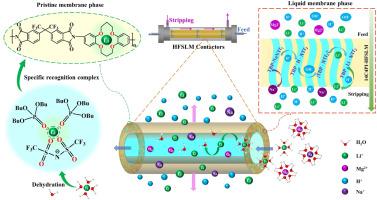
High-efficiency lithium (Li+) extraction from a salt-lake brine with a low Li concentration and a high Mg/Li mass ratio poses a great challenge owing to the great physical and chemical similarities between Mg2+ and Li+. In this study, a hollow fiber (HF) membrane with an inside diameter of 0.872 mm and an outside diameter of 1.228 mm was fabricated using nonsolvent induce phase separation method with 14-crown-4 ether functionalized polyimide (14C4PI) as a polymer matrix. The organic phase, a solution of tributyl phosphate and sodium bis(trifluoromethylsulfonyl)imide (NaNTf2) was filled into porous membranes as the solid phase using an impregnation method to construct a supported ionic liquid membranes (SILMs) contactor for lithium extraction from simulated salt-lake brine. The feed and stripping phases of the contactor were a mixed Mg/Li solution and 0.5 mol/L HCl, respectively. The contactor operated continuously for 120 h. The results showed an HF membrane with an average pore size of 20.1 nm, porosity of 73.6 % and a breaking strength of 5.64 MPa. When the Mg/Li mass ratio in the feed was approximately 3.5, the mass transfer rate of Li+ and the separation factor (SFLi−Mg) obtained from the contactor with a packing density of 1.5 % were 0.468 μm/s and 15.86, respectively. After further increasing the mass ratio of the Mg/Li solution to 35 in the feed and the membrane packing density to 15 %, the mass transfer rate of Li+ and the SFLi−Mg increased to 0.623 μm/s and 30.8, respectively. This implies that the SILMs contactor with a high packing density of HF membrane showed good operating stability and enhanced ion extraction efficiency. The high performance was ascribed to the crown ether groups in 14C4PI achieving specific recognition of Li+ through the size-sieving effect. Specifically, the inter-molecular interaction between crown ether and ionic liquids (ILs) improved the stability of the filled ILs. Meanwhile, ILs provided ionic transfer channels and promoted the dehydration process of Li+, leading to a high SFLi−Mg. In addition, NaNTf2 adopted to replace traditional ILs prevented cation loss and provided an efficient and continuous method for extracting lithium from salt-lake. The above advantages are expected to achieve large-scale extraction of lithium ions.
期刊介绍:
Water Research, along with its open access companion journal Water Research X, serves as a platform for publishing original research papers covering various aspects of the science and technology related to the anthropogenic water cycle, water quality, and its management worldwide. The audience targeted by the journal comprises biologists, chemical engineers, chemists, civil engineers, environmental engineers, limnologists, and microbiologists. The scope of the journal include:
•Treatment processes for water and wastewaters (municipal, agricultural, industrial, and on-site treatment), including resource recovery and residuals management;
•Urban hydrology including sewer systems, stormwater management, and green infrastructure;
•Drinking water treatment and distribution;
•Potable and non-potable water reuse;
•Sanitation, public health, and risk assessment;
•Anaerobic digestion, solid and hazardous waste management, including source characterization and the effects and control of leachates and gaseous emissions;
•Contaminants (chemical, microbial, anthropogenic particles such as nanoparticles or microplastics) and related water quality sensing, monitoring, fate, and assessment;
•Anthropogenic impacts on inland, tidal, coastal and urban waters, focusing on surface and ground waters, and point and non-point sources of pollution;
•Environmental restoration, linked to surface water, groundwater and groundwater remediation;
•Analysis of the interfaces between sediments and water, and between water and atmosphere, focusing specifically on anthropogenic impacts;
•Mathematical modelling, systems analysis, machine learning, and beneficial use of big data related to the anthropogenic water cycle;
•Socio-economic, policy, and regulations studies.




 京公网安备 11010802042870号
京ICP备2023020795号-1
京公网安备 11010802042870号
京ICP备2023020795号-1

 分享
分享
 求助内容:
求助内容: 应助结果提醒方式:
 扫码关注我们
