Wenyu Yang , Christian Schmidt , Shixue Wu , Ziyong Zhao , Ruifei Li , Zhenyu Wang , Haijun Wang , Pei Hua , Peter Krebs , Jin Zhang
{"title":"Exacerbated anthropogenic water pollution under climate change and urbanization","authors":"Wenyu Yang , Christian Schmidt , Shixue Wu , Ziyong Zhao , Ruifei Li , Zhenyu Wang , Haijun Wang , Pei Hua , Peter Krebs , Jin Zhang","doi":"10.1016/j.watres.2025.123449","DOIUrl":null,"url":null,"abstract":"<div><div>Anthropogenic water pollution severely threatens human society worldwide, yet the water pollution induced by combined sewer overflow (CSO) remains unclear within climate change and urbanization. Hence, this study integrated the general circulation model (GCM) and shared socioeconomic pathway (SSP) projections with water quality modeling, to analyze spatiotemporal patterns and future trends of CSO-induced water pollution under changing environments. Results demonstrated that the given area (Dresden, Germany) encountered significant CSO-induced pollution, with 14,860 kg (95 % confidence interval, CI: 9,040–15,630 kg) of particulate matter (SS), organic compounds (COD, TN, TP), and pharmaceuticals (Carbamazepine, Gabapentin, Ciprofloxacin, Sulfamethoxazole) being discharged annually. Climate change and urbanization exacerbated the severity of CSO-induced pollution, causing the discharged pollutants to reach a maximum annual load of 34,900 kg (CI: 21,400–44,100 kg), with up to 82.19 % of organic compounds and 75.28 % of pharmaceuticals being discharged by the top 25 % of extreme CSOs. GIS-based spatial analysis indicated the regional heterogeneities of CSO-induced pollution, the high-frequency CSOs were predominantly located in highly-impervious areas, while the high-load discharges mainly occurred in densely-populated areas. Scenario analysis revealed stronger temporal variabilities of CSO-induced pollution in the future, with the seasonal anomalies of discharged loads ranging from -86.18 % to 76.89 %. In addition, pharmaceutical pollution exhibited significant uncertainties under changing environments, and the CI of discharged load expanded by up to 131.71 %. The methods and findings herein yielded further insights into water quality management in response to changing environments.</div></div>","PeriodicalId":443,"journal":{"name":"Water Research","volume":"280 ","pages":"Article 123449"},"PeriodicalIF":12.4000,"publicationDate":"2025-03-06","publicationTypes":"Journal Article","fieldsOfStudy":null,"isOpenAccess":false,"openAccessPdf":"","citationCount":"0","resultStr":null,"platform":"Semanticscholar","paperid":null,"PeriodicalName":"Water Research","FirstCategoryId":"93","ListUrlMain":"https://www.sciencedirect.com/science/article/pii/S0043135425003628","RegionNum":1,"RegionCategory":"环境科学与生态学","ArticlePicture":[],"TitleCN":null,"AbstractTextCN":null,"PMCID":null,"EPubDate":"","PubModel":"","JCR":"Q1","JCRName":"ENGINEERING, ENVIRONMENTAL","Score":null,"Total":0}
引用次数: 0
Abstract
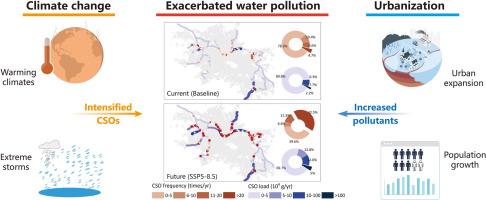
Anthropogenic water pollution severely threatens human society worldwide, yet the water pollution induced by combined sewer overflow (CSO) remains unclear within climate change and urbanization. Hence, this study integrated the general circulation model (GCM) and shared socioeconomic pathway (SSP) projections with water quality modeling, to analyze spatiotemporal patterns and future trends of CSO-induced water pollution under changing environments. Results demonstrated that the given area (Dresden, Germany) encountered significant CSO-induced pollution, with 14,860 kg (95 % confidence interval, CI: 9,040–15,630 kg) of particulate matter (SS), organic compounds (COD, TN, TP), and pharmaceuticals (Carbamazepine, Gabapentin, Ciprofloxacin, Sulfamethoxazole) being discharged annually. Climate change and urbanization exacerbated the severity of CSO-induced pollution, causing the discharged pollutants to reach a maximum annual load of 34,900 kg (CI: 21,400–44,100 kg), with up to 82.19 % of organic compounds and 75.28 % of pharmaceuticals being discharged by the top 25 % of extreme CSOs. GIS-based spatial analysis indicated the regional heterogeneities of CSO-induced pollution, the high-frequency CSOs were predominantly located in highly-impervious areas, while the high-load discharges mainly occurred in densely-populated areas. Scenario analysis revealed stronger temporal variabilities of CSO-induced pollution in the future, with the seasonal anomalies of discharged loads ranging from -86.18 % to 76.89 %. In addition, pharmaceutical pollution exhibited significant uncertainties under changing environments, and the CI of discharged load expanded by up to 131.71 %. The methods and findings herein yielded further insights into water quality management in response to changing environments.
期刊介绍:
Water Research, along with its open access companion journal Water Research X, serves as a platform for publishing original research papers covering various aspects of the science and technology related to the anthropogenic water cycle, water quality, and its management worldwide. The audience targeted by the journal comprises biologists, chemical engineers, chemists, civil engineers, environmental engineers, limnologists, and microbiologists. The scope of the journal include:
•Treatment processes for water and wastewaters (municipal, agricultural, industrial, and on-site treatment), including resource recovery and residuals management;
•Urban hydrology including sewer systems, stormwater management, and green infrastructure;
•Drinking water treatment and distribution;
•Potable and non-potable water reuse;
•Sanitation, public health, and risk assessment;
•Anaerobic digestion, solid and hazardous waste management, including source characterization and the effects and control of leachates and gaseous emissions;
•Contaminants (chemical, microbial, anthropogenic particles such as nanoparticles or microplastics) and related water quality sensing, monitoring, fate, and assessment;
•Anthropogenic impacts on inland, tidal, coastal and urban waters, focusing on surface and ground waters, and point and non-point sources of pollution;
•Environmental restoration, linked to surface water, groundwater and groundwater remediation;
•Analysis of the interfaces between sediments and water, and between water and atmosphere, focusing specifically on anthropogenic impacts;
•Mathematical modelling, systems analysis, machine learning, and beneficial use of big data related to the anthropogenic water cycle;
•Socio-economic, policy, and regulations studies.




 京公网安备 11010802042870号
京ICP备2023020795号-1
京公网安备 11010802042870号
京ICP备2023020795号-1

 分享
分享
 求助内容:
求助内容: 应助结果提醒方式:
 扫码关注我们
