Yongrong Li, Denghao Ouyang, Xi Liu, Yichen Zhang, Zhiqiang Niu, J. Y. Zhu, Xuejun Pan and Xuebing Zhao
{"title":"Self-powered electrochemical synthesis of hydrogen peroxide from air and lignin†","authors":"Yongrong Li, Denghao Ouyang, Xi Liu, Yichen Zhang, Zhiqiang Niu, J. Y. Zhu, Xuejun Pan and Xuebing Zhao","doi":"10.1039/D4EE06106C","DOIUrl":null,"url":null,"abstract":"<p >Lignin, which is typically available as a by-product of the pulping process and biomass biorefinery, is a sustainable feedstock for production of carbon fuels and materials. Here, we report a novel coupled electrochemical system to achieve efficient production of H<small><sub>2</sub></small>O<small><sub>2</sub></small> with air as the oxygen source and lignin as a carbon-based catalyst precursor and electron donor (fuel). By using a direct lignin fuel cell to power a paired electrolytic cell, the endogenous electrons of lignin can be transferred to air, resulting in the formation of H<small><sub>2</sub></small>O<small><sub>2</sub></small><em>via</em> a two-electron oxygen reduction reaction. A facile and efficient approach to synthesizing a B,O-doped carbonaceous catalyst was developed with lignin as a carbon precursor, achieving a H<small><sub>2</sub></small>O<small><sub>2</sub></small> productivity of 11 812 mmol g<small><sup>−1</sup></small> h<small><sup>−1</sup></small> and a faradaic efficiency of 95.7%. Moreover, by using the [Fe(CN)<small><sub>6</sub></small>]<small><sup>3−</sup></small>/[Fe(CN)<small><sub>6</sub></small>]<small><sup>4−</sup></small> redox couple as the electron mediator for oxidation of lignin on the anode instead of the oxygen evolution reaction, the energy consumption of the electrolytic cell could be decreased by 11.4%. The self-powered system could obtain 93.7% of total electron transfer efficiency and avoid using external electricity. Therefore, this work provides a novel technical route for lignin utilization and production of H<small><sub>2</sub></small>O<small><sub>2</sub></small> and biomass-based chemicals in a sustainable way.</p>","PeriodicalId":72,"journal":{"name":"Energy & Environmental Science","volume":" 8","pages":" 3633-3646"},"PeriodicalIF":30.8000,"publicationDate":"2025-03-07","publicationTypes":"Journal Article","fieldsOfStudy":null,"isOpenAccess":false,"openAccessPdf":"","citationCount":"0","resultStr":null,"platform":"Semanticscholar","paperid":null,"PeriodicalName":"Energy & Environmental Science","FirstCategoryId":"88","ListUrlMain":"https://pubs.rsc.org/en/content/articlelanding/2025/ee/d4ee06106c","RegionNum":1,"RegionCategory":"材料科学","ArticlePicture":[],"TitleCN":null,"AbstractTextCN":null,"PMCID":null,"EPubDate":"","PubModel":"","JCR":"Q1","JCRName":"CHEMISTRY, MULTIDISCIPLINARY","Score":null,"Total":0}
引用次数: 0
Abstract
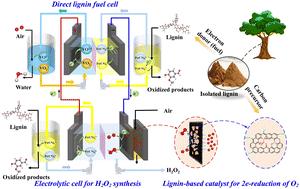
Lignin, which is typically available as a by-product of the pulping process and biomass biorefinery, is a sustainable feedstock for production of carbon fuels and materials. Here, we report a novel coupled electrochemical system to achieve efficient production of H2O2 with air as the oxygen source and lignin as a carbon-based catalyst precursor and electron donor (fuel). By using a direct lignin fuel cell to power a paired electrolytic cell, the endogenous electrons of lignin can be transferred to air, resulting in the formation of H2O2via a two-electron oxygen reduction reaction. A facile and efficient approach to synthesizing a B,O-doped carbonaceous catalyst was developed with lignin as a carbon precursor, achieving a H2O2 productivity of 11 812 mmol g−1 h−1 and a faradaic efficiency of 95.7%. Moreover, by using the [Fe(CN)6]3−/[Fe(CN)6]4− redox couple as the electron mediator for oxidation of lignin on the anode instead of the oxygen evolution reaction, the energy consumption of the electrolytic cell could be decreased by 11.4%. The self-powered system could obtain 93.7% of total electron transfer efficiency and avoid using external electricity. Therefore, this work provides a novel technical route for lignin utilization and production of H2O2 and biomass-based chemicals in a sustainable way.
期刊介绍:
Energy & Environmental Science, a peer-reviewed scientific journal, publishes original research and review articles covering interdisciplinary topics in the (bio)chemical and (bio)physical sciences, as well as chemical engineering disciplines. Published monthly by the Royal Society of Chemistry (RSC), a not-for-profit publisher, Energy & Environmental Science is recognized as a leading journal. It boasts an impressive impact factor of 8.500 as of 2009, ranking 8th among 140 journals in the category "Chemistry, Multidisciplinary," second among 71 journals in "Energy & Fuels," second among 128 journals in "Engineering, Chemical," and first among 181 scientific journals in "Environmental Sciences."
Energy & Environmental Science publishes various types of articles, including Research Papers (original scientific work), Review Articles, Perspectives, and Minireviews (feature review-type articles of broad interest), Communications (original scientific work of an urgent nature), Opinions (personal, often speculative viewpoints or hypotheses on current topics), and Analysis Articles (in-depth examination of energy-related issues).



 京公网安备 11010802042870号
京ICP备2023020795号-1
京公网安备 11010802042870号
京ICP备2023020795号-1

 分享
分享
 求助内容:
求助内容: 应助结果提醒方式:
 扫码关注我们
