Tina Birkeskov Axelsen, Charlotte Arp Sørensen, Anders Lindelof, Mette Spliid Ludvigsen
{"title":"Shared medication coordination in a social psychiatric residence: adaptation to meet local requirements.","authors":"Tina Birkeskov Axelsen, Charlotte Arp Sørensen, Anders Lindelof, Mette Spliid Ludvigsen","doi":"10.1186/s12888-025-06653-2","DOIUrl":null,"url":null,"abstract":"<p><strong>Background: </strong>Shared medication coordination (MedCo) is vital yet difficult to manage for residents living with severe mental disorders in residential care, where multidisciplinary teams provide support. A successful Shared MedCo model in one residence included three core components: \"shared decision-making,\" \"patient involvement\" and \"MedCo\". This model was effective but transfer to other residential settings needed implementation adaptation. The aim of this study was to meet local MedCo requirements by achieving a good fit between a Shared MedCo intervention core components and a social psychiatric residential context.</p><p><strong>Methods: </strong>The methodology was guided by a complex intervention adaptation framework involving co-creation with stakeholders to gather iterative feedback. The intervention was adapted through a systematic four-phase process and tested through shared consultations. Ten residents took part in the test, and the intervention's feasibility and acceptability were assessed.</p><p><strong>Findings: </strong>The adaptation process ensured a good fit between the intervention's core components and the new context. Stakeholder input provided crucial content and contextual insights, while planned adaptations laid the foundation for modulating the individual residence Shared MedCo model. Iterative adaptations during the test phase refined the intervention, leading to near-routine performance by the tenth consultation. Residents gained a stronger voice in their healthcare, and all ten had their medication coordinated and optimised. The intervention was found feasible and acceptable.</p><p><strong>Conclusion: </strong>For effective implementation, complex multidisciplinary Shared MedCo interventions require contextual adaptation and active stakeholder involvement. The shared MedCo intervention offers a guideline for achieving a good fit between the intervention core components and diverse residential contexts, ensuring successful medication coordination for residents living with severe mental disorders.</p>","PeriodicalId":9029,"journal":{"name":"BMC Psychiatry","volume":"25 1","pages":"209"},"PeriodicalIF":3.4000,"publicationDate":"2025-03-06","publicationTypes":"Journal Article","fieldsOfStudy":null,"isOpenAccess":false,"openAccessPdf":"https://www.ncbi.nlm.nih.gov/pmc/articles/PMC11887218/pdf/","citationCount":"0","resultStr":null,"platform":"Semanticscholar","paperid":null,"PeriodicalName":"BMC Psychiatry","FirstCategoryId":"3","ListUrlMain":"https://doi.org/10.1186/s12888-025-06653-2","RegionNum":2,"RegionCategory":"医学","ArticlePicture":[],"TitleCN":null,"AbstractTextCN":null,"PMCID":null,"EPubDate":"","PubModel":"","JCR":"Q2","JCRName":"PSYCHIATRY","Score":null,"Total":0}
引用次数: 0
Abstract
Background: Shared medication coordination (MedCo) is vital yet difficult to manage for residents living with severe mental disorders in residential care, where multidisciplinary teams provide support. A successful Shared MedCo model in one residence included three core components: "shared decision-making," "patient involvement" and "MedCo". This model was effective but transfer to other residential settings needed implementation adaptation. The aim of this study was to meet local MedCo requirements by achieving a good fit between a Shared MedCo intervention core components and a social psychiatric residential context.
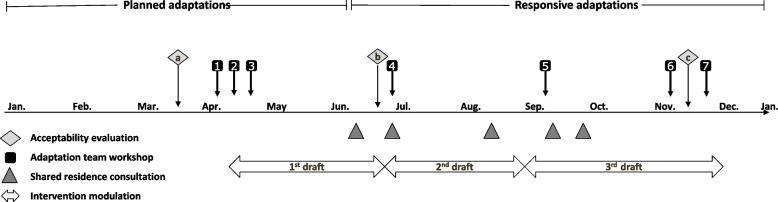
Methods: The methodology was guided by a complex intervention adaptation framework involving co-creation with stakeholders to gather iterative feedback. The intervention was adapted through a systematic four-phase process and tested through shared consultations. Ten residents took part in the test, and the intervention's feasibility and acceptability were assessed.
Findings: The adaptation process ensured a good fit between the intervention's core components and the new context. Stakeholder input provided crucial content and contextual insights, while planned adaptations laid the foundation for modulating the individual residence Shared MedCo model. Iterative adaptations during the test phase refined the intervention, leading to near-routine performance by the tenth consultation. Residents gained a stronger voice in their healthcare, and all ten had their medication coordinated and optimised. The intervention was found feasible and acceptable.
Conclusion: For effective implementation, complex multidisciplinary Shared MedCo interventions require contextual adaptation and active stakeholder involvement. The shared MedCo intervention offers a guideline for achieving a good fit between the intervention core components and diverse residential contexts, ensuring successful medication coordination for residents living with severe mental disorders.
期刊介绍:
BMC Psychiatry is an open access, peer-reviewed journal that considers articles on all aspects of the prevention, diagnosis and management of psychiatric disorders, as well as related molecular genetics, pathophysiology, and epidemiology.






 京公网安备 11010802042870号
京ICP备2023020795号-1
京公网安备 11010802042870号
京ICP备2023020795号-1

 分享
分享
 求助内容:
求助内容: 应助结果提醒方式:
 扫码关注我们
