Association of uric acid to high-density lipoprotein cholesterol ratio with the presence or absence of hypertensive kidney function: results from the China Health and Retirement Longitudinal Study (CHARLS).
{"title":"Association of uric acid to high-density lipoprotein cholesterol ratio with the presence or absence of hypertensive kidney function: results from the China Health and Retirement Longitudinal Study (CHARLS).","authors":"Siying Li, Zhen Liu, Chen Lu","doi":"10.1186/s12882-024-03939-7","DOIUrl":null,"url":null,"abstract":"<p><strong>Objective: </strong>Some studies have shown that uric acid (UA) to high-density lipoprotein (HDL-C) ratio (UHR), as an indicator of inflammation, is associated with metabolic syndrome and hypertension, but its relationship with decreased renal function is unclear. This study intends to analyze the relationship between UHR and decline in renal function.</p><p><strong>Methods: </strong>Data were obtained from the 2011-2015 data of the China Health and Aging Tracking Survey (CHARLS) of Peking University, and 7,198 study participants were included and followed up until 2015. The eGFR (Total glomerular filtration rate) was estimated according to the CKD-EPI [1] creatinine equation. eGFR ≥ 60mL/min/1.73 m² at baseline renal function was defined as normal renal function, and eGFR < 60mL/min/1.73 m² at baseline renal function was defined as chronic kidney disease; new-onset eGFR < 60mL/min/1.73 m² was defined as the occurrence of decline in renal function; in the chronic kidney disease population decrease in eGFR ≥ 5mL/min/1.73 m²/year or 30% from baseline or admission to dialysis was defined as rapid progression of chronic kidney disease. eGFR slope was defined as the ratio of the difference between the final eGFR and the baseline eGFR over 4 years of follow-up. Binary logistic regression was used to analyze the relationship between UHR and renal function decline or progression, as well as linear regression and non-linear regression to clarify the relationship between UHR and GFR slope in hypertensive patients, and the correlation between UHR and CRP, and to assess the relationship between UHR levels and the risk of renal function decline in hypertensive people.</p><p><strong>Results: </strong>(1) Hypertension was a risk factor for the decline of renal function (OR: 1.34, P = 0.03); (2) UHR was a risk factor for the decline of renal function in the hypertensive population (OR: 1.32, P = 0.02), and with the increasing level of UHR, the risk of developing CKD (Chronic Kidney Disease) in hypertension was higher (P for trend = 0.03); (3) The subgroup analyses showed that there was no interaction between hypertension and age, cystatin C and hemoglobin did not interact with each other; (4), In the hypertensive population, the slope of UHR and eGFR showed a J-shaped correlation, with UHR > 7.6% as the cut-off point, and the slope of eGFR tended to increase with increasing UHR; in the non-hypertensive population UHR and eGFR showed a linear correlation, and the slope of the decline in eGFR was smaller than that of the hypertensive population; (5), After adjusting for confounders, UHR and CRP were positive correlation (t = 3.56, P < 0.05); (6) In the hypertensive population with normal CRP, the risk of decline in renal function increased accordingly with increasing UHR (P = 0.003). UHR did not show a correlation with CRP in the hypertensive population with abnormal CRP (P = 0.24).</p><p><strong>Conclusion: </strong>In the hypertensive population, elevated UHR is associated with an increased risk of decline in renal function; with UHR > 7.6% as the cut-off point, the slope of eGFR tended to increase with increasing UHR, and UHR can be used as an indicator for risk stratification of renal injury in the hypertensive population.</p>","PeriodicalId":9089,"journal":{"name":"BMC Nephrology","volume":"26 1","pages":"123"},"PeriodicalIF":2.4000,"publicationDate":"2025-03-06","publicationTypes":"Journal Article","fieldsOfStudy":null,"isOpenAccess":false,"openAccessPdf":"https://www.ncbi.nlm.nih.gov/pmc/articles/PMC11884189/pdf/","citationCount":"0","resultStr":null,"platform":"Semanticscholar","paperid":null,"PeriodicalName":"BMC Nephrology","FirstCategoryId":"3","ListUrlMain":"https://doi.org/10.1186/s12882-024-03939-7","RegionNum":4,"RegionCategory":"医学","ArticlePicture":[],"TitleCN":null,"AbstractTextCN":null,"PMCID":null,"EPubDate":"","PubModel":"","JCR":"Q2","JCRName":"UROLOGY & NEPHROLOGY","Score":null,"Total":0}
引用次数: 0
Abstract
Objective: Some studies have shown that uric acid (UA) to high-density lipoprotein (HDL-C) ratio (UHR), as an indicator of inflammation, is associated with metabolic syndrome and hypertension, but its relationship with decreased renal function is unclear. This study intends to analyze the relationship between UHR and decline in renal function.
Methods: Data were obtained from the 2011-2015 data of the China Health and Aging Tracking Survey (CHARLS) of Peking University, and 7,198 study participants were included and followed up until 2015. The eGFR (Total glomerular filtration rate) was estimated according to the CKD-EPI [1] creatinine equation. eGFR ≥ 60mL/min/1.73 m² at baseline renal function was defined as normal renal function, and eGFR < 60mL/min/1.73 m² at baseline renal function was defined as chronic kidney disease; new-onset eGFR < 60mL/min/1.73 m² was defined as the occurrence of decline in renal function; in the chronic kidney disease population decrease in eGFR ≥ 5mL/min/1.73 m²/year or 30% from baseline or admission to dialysis was defined as rapid progression of chronic kidney disease. eGFR slope was defined as the ratio of the difference between the final eGFR and the baseline eGFR over 4 years of follow-up. Binary logistic regression was used to analyze the relationship between UHR and renal function decline or progression, as well as linear regression and non-linear regression to clarify the relationship between UHR and GFR slope in hypertensive patients, and the correlation between UHR and CRP, and to assess the relationship between UHR levels and the risk of renal function decline in hypertensive people.
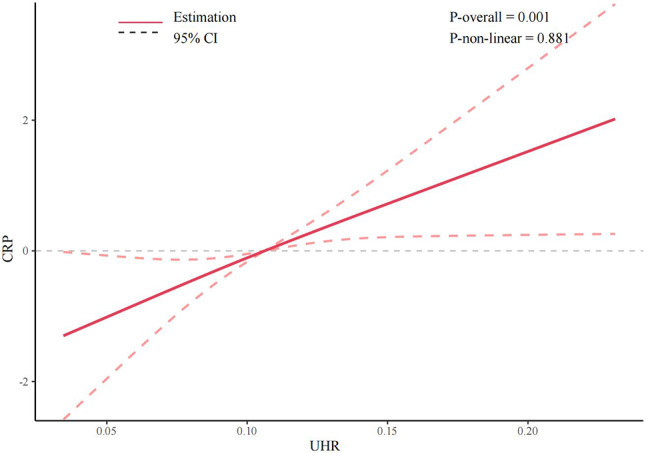
Results: (1) Hypertension was a risk factor for the decline of renal function (OR: 1.34, P = 0.03); (2) UHR was a risk factor for the decline of renal function in the hypertensive population (OR: 1.32, P = 0.02), and with the increasing level of UHR, the risk of developing CKD (Chronic Kidney Disease) in hypertension was higher (P for trend = 0.03); (3) The subgroup analyses showed that there was no interaction between hypertension and age, cystatin C and hemoglobin did not interact with each other; (4), In the hypertensive population, the slope of UHR and eGFR showed a J-shaped correlation, with UHR > 7.6% as the cut-off point, and the slope of eGFR tended to increase with increasing UHR; in the non-hypertensive population UHR and eGFR showed a linear correlation, and the slope of the decline in eGFR was smaller than that of the hypertensive population; (5), After adjusting for confounders, UHR and CRP were positive correlation (t = 3.56, P < 0.05); (6) In the hypertensive population with normal CRP, the risk of decline in renal function increased accordingly with increasing UHR (P = 0.003). UHR did not show a correlation with CRP in the hypertensive population with abnormal CRP (P = 0.24).
Conclusion: In the hypertensive population, elevated UHR is associated with an increased risk of decline in renal function; with UHR > 7.6% as the cut-off point, the slope of eGFR tended to increase with increasing UHR, and UHR can be used as an indicator for risk stratification of renal injury in the hypertensive population.
期刊介绍:
BMC Nephrology is an open access journal publishing original peer-reviewed research articles in all aspects of the prevention, diagnosis and management of kidney and associated disorders, as well as related molecular genetics, pathophysiology, and epidemiology.






 京公网安备 11010802042870号
京ICP备2023020795号-1
京公网安备 11010802042870号
京ICP备2023020795号-1

 分享
分享
 求助内容:
求助内容: 应助结果提醒方式:
 扫码关注我们
