Han-Qing Zhao, Jia-Le Lv, Yuan-Zhi Gao, Bo Hu, Zong-Da Du, Yan Wang, Mei-Lin Wang, Meng-Di Hou, Fang Li, Xue Xing, Ming-Hui Sun
{"title":"Association between inflammatory score, healthy lifestyle, and cardiovascular disease: a national cohort study.","authors":"Han-Qing Zhao, Jia-Le Lv, Yuan-Zhi Gao, Bo Hu, Zong-Da Du, Yan Wang, Mei-Lin Wang, Meng-Di Hou, Fang Li, Xue Xing, Ming-Hui Sun","doi":"10.3389/fnut.2025.1534458","DOIUrl":null,"url":null,"abstract":"<p><strong>Background: </strong>The inflammation score is currently regarded as a reliable composite index for comprehensive assessment of inflammatory status. However, the relationship between inflammation score and cardiovascular disease (CVD) is unclear. Thus, we aimed to explore the association of inflammatory score with CVD, as well as to evaluate whether adhering to a healthy lifestyle could alleviate this association.</p><p><strong>Methods: </strong>We analyzed 6,164 participants aged ≥45 years who entered a prospective cohort study of the China Longitudinal Study of Health and Retirement (CHARLS) between 2011 and 2012 and were followed up for CVD incidence untill 2018. The inflammatory score was measured by summing of the Z-scores for C-reactive protein and white blood cell count at baseline. The healthy lifestyle score was calculated by four factors, smoking status, alcohol consumption, body mass index, and sleep duration. Cox proportional hazard models were utilized to calculate the hazard ratios (HRs) and 95% confidence intervals (CIs) for the incidence of CVD.</p><p><strong>Results: </strong>During the 7-year follow-up period, there were 761 incident cases of CVD. Compared with the lowest tertiles, the highest inflammatory score was associated with an elevated risk of CVD (HR = 1.25, 95% CI = 1.04-1.49). Compared to the unhealthy lifestyle, participants adhered to a healthy lifestyle was inversely associated with CVD risk (HR = 0.74, 95% CI = 0.60-0.93). Of note, when participants adhered to a healthy lifestyle, the higher inflammatory score was no longer significantly correlated with CVD risk (HR = 1.00, 95% CI = 0.76-1.34). Additionally, a multiplicative interaction was detected between inflammatory score and healthy lifestyle score for CVD risk (<i>p</i> interaction <0.05).</p><p><strong>Conclusion: </strong>The inflammation score was associated with higher risk of CVD incidence, but adherence to a healthy lifestyle may mitigate the adverse association of inflammation score and CVD among the middle-aged and older participants.</p>","PeriodicalId":12473,"journal":{"name":"Frontiers in Nutrition","volume":"12 ","pages":"1534458"},"PeriodicalIF":4.0000,"publicationDate":"2025-02-20","publicationTypes":"Journal Article","fieldsOfStudy":null,"isOpenAccess":false,"openAccessPdf":"https://www.ncbi.nlm.nih.gov/pmc/articles/PMC11882400/pdf/","citationCount":"0","resultStr":null,"platform":"Semanticscholar","paperid":null,"PeriodicalName":"Frontiers in Nutrition","FirstCategoryId":"97","ListUrlMain":"https://doi.org/10.3389/fnut.2025.1534458","RegionNum":2,"RegionCategory":"农林科学","ArticlePicture":[],"TitleCN":null,"AbstractTextCN":null,"PMCID":null,"EPubDate":"2025/1/1 0:00:00","PubModel":"eCollection","JCR":"Q2","JCRName":"NUTRITION & DIETETICS","Score":null,"Total":0}
引用次数: 0
Abstract
Background: The inflammation score is currently regarded as a reliable composite index for comprehensive assessment of inflammatory status. However, the relationship between inflammation score and cardiovascular disease (CVD) is unclear. Thus, we aimed to explore the association of inflammatory score with CVD, as well as to evaluate whether adhering to a healthy lifestyle could alleviate this association.
Methods: We analyzed 6,164 participants aged ≥45 years who entered a prospective cohort study of the China Longitudinal Study of Health and Retirement (CHARLS) between 2011 and 2012 and were followed up for CVD incidence untill 2018. The inflammatory score was measured by summing of the Z-scores for C-reactive protein and white blood cell count at baseline. The healthy lifestyle score was calculated by four factors, smoking status, alcohol consumption, body mass index, and sleep duration. Cox proportional hazard models were utilized to calculate the hazard ratios (HRs) and 95% confidence intervals (CIs) for the incidence of CVD.
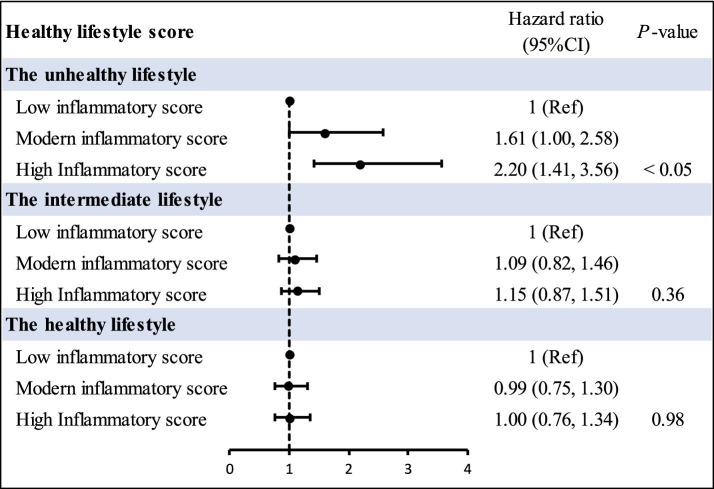
Results: During the 7-year follow-up period, there were 761 incident cases of CVD. Compared with the lowest tertiles, the highest inflammatory score was associated with an elevated risk of CVD (HR = 1.25, 95% CI = 1.04-1.49). Compared to the unhealthy lifestyle, participants adhered to a healthy lifestyle was inversely associated with CVD risk (HR = 0.74, 95% CI = 0.60-0.93). Of note, when participants adhered to a healthy lifestyle, the higher inflammatory score was no longer significantly correlated with CVD risk (HR = 1.00, 95% CI = 0.76-1.34). Additionally, a multiplicative interaction was detected between inflammatory score and healthy lifestyle score for CVD risk (p interaction <0.05).
Conclusion: The inflammation score was associated with higher risk of CVD incidence, but adherence to a healthy lifestyle may mitigate the adverse association of inflammation score and CVD among the middle-aged and older participants.
期刊介绍:
No subject pertains more to human life than nutrition. The aim of Frontiers in Nutrition is to integrate major scientific disciplines in this vast field in order to address the most relevant and pertinent questions and developments. Our ambition is to create an integrated podium based on original research, clinical trials, and contemporary reviews to build a reputable knowledge forum in the domains of human health, dietary behaviors, agronomy & 21st century food science. Through the recognized open-access Frontiers platform we welcome manuscripts to our dedicated sections relating to different areas in the field of nutrition with a focus on human health.
Specialty sections in Frontiers in Nutrition include, for example, Clinical Nutrition, Nutrition & Sustainable Diets, Nutrition and Food Science Technology, Nutrition Methodology, Sport & Exercise Nutrition, Food Chemistry, and Nutritional Immunology. Based on the publication of rigorous scientific research, we thrive to achieve a visible impact on the global nutrition agenda addressing the grand challenges of our time, including obesity, malnutrition, hunger, food waste, sustainability and consumer health.






 京公网安备 11010802042870号
京ICP备2023020795号-1
京公网安备 11010802042870号
京ICP备2023020795号-1

 分享
分享
 求助内容:
求助内容: 应助结果提醒方式:
 扫码关注我们
