Haochen Zhao, Xiao Liang, Chenliang Xie, Shaokai Wang
{"title":"AGPred: An End-to-End Deep Learning Model for Predicting Drug Approvals in Clinical Trials Based on Molecular Features.","authors":"Haochen Zhao, Xiao Liang, Chenliang Xie, Shaokai Wang","doi":"10.1109/JBHI.2025.3547315","DOIUrl":null,"url":null,"abstract":"<p><p>One of the major challenges in drug development is maintaining acceptable levels of efficacy and safety throughout the various stages of clinical trials and successfully bringing the drug to market. However, clinical trials are time-consuming and expensive. While there are computational methods designed to predict the likelihood of a drug passing clinical trials and reaching the market, these methods heavily rely on manual feature engineering and cannot automatically learn drug molecular representations, resulting in relatively low model performance. In this study, we propose AGPred, an attention-based deep Graph Neural Network (GNN) designed to predict drug approval rates in clinical trials accurately. Unlike the few existing studies on drug approval prediction, which only use predicted targets of compounds, our novel approach employs a GNN module to extract high-potential features of compounds based on their molecular graphs. Additionally, a cross-attention-based fusion module is utilized to learn molecular fingerprint features, enhancing the model's representation of chemical structures. Meanwhile, AGPred integrates the physicochemical properties of drugs to provide a comprehensive description of the molecules. Experimental results indicate that AGPred outperforms four state-of-the-art models on both benchmark and independent datasets. The study also includes several ablation experiments and visual analyses to demonstrate the effectiveness of our method in predicting drug approval during clinical trials.</p>","PeriodicalId":13073,"journal":{"name":"IEEE Journal of Biomedical and Health Informatics","volume":"PP ","pages":"7863-7872"},"PeriodicalIF":6.8000,"publicationDate":"2025-11-01","publicationTypes":"Journal Article","fieldsOfStudy":null,"isOpenAccess":false,"openAccessPdf":"","citationCount":"0","resultStr":null,"platform":"Semanticscholar","paperid":null,"PeriodicalName":"IEEE Journal of Biomedical and Health Informatics","FirstCategoryId":"5","ListUrlMain":"https://doi.org/10.1109/JBHI.2025.3547315","RegionNum":2,"RegionCategory":"医学","ArticlePicture":[],"TitleCN":null,"AbstractTextCN":null,"PMCID":null,"EPubDate":"","PubModel":"","JCR":"Q1","JCRName":"COMPUTER SCIENCE, INFORMATION SYSTEMS","Score":null,"Total":0}
引用次数: 0
Abstract
One of the major challenges in drug development is maintaining acceptable levels of efficacy and safety throughout the various stages of clinical trials and successfully bringing the drug to market. However, clinical trials are time-consuming and expensive. While there are computational methods designed to predict the likelihood of a drug passing clinical trials and reaching the market, these methods heavily rely on manual feature engineering and cannot automatically learn drug molecular representations, resulting in relatively low model performance. In this study, we propose AGPred, an attention-based deep Graph Neural Network (GNN) designed to predict drug approval rates in clinical trials accurately. Unlike the few existing studies on drug approval prediction, which only use predicted targets of compounds, our novel approach employs a GNN module to extract high-potential features of compounds based on their molecular graphs. Additionally, a cross-attention-based fusion module is utilized to learn molecular fingerprint features, enhancing the model's representation of chemical structures. Meanwhile, AGPred integrates the physicochemical properties of drugs to provide a comprehensive description of the molecules. Experimental results indicate that AGPred outperforms four state-of-the-art models on both benchmark and independent datasets. The study also includes several ablation experiments and visual analyses to demonstrate the effectiveness of our method in predicting drug approval during clinical trials.
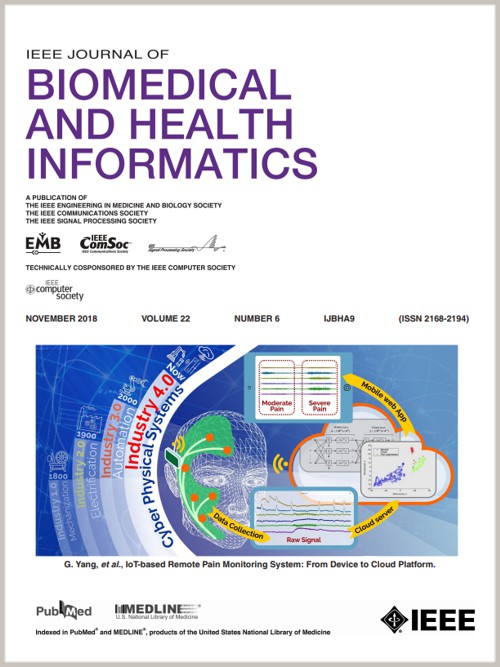
期刊介绍:
IEEE Journal of Biomedical and Health Informatics publishes original papers presenting recent advances where information and communication technologies intersect with health, healthcare, life sciences, and biomedicine. Topics include acquisition, transmission, storage, retrieval, management, and analysis of biomedical and health information. The journal covers applications of information technologies in healthcare, patient monitoring, preventive care, early disease diagnosis, therapy discovery, and personalized treatment protocols. It explores electronic medical and health records, clinical information systems, decision support systems, medical and biological imaging informatics, wearable systems, body area/sensor networks, and more. Integration-related topics like interoperability, evidence-based medicine, and secure patient data are also addressed.



 京公网安备 11010802042870号
京ICP备2023020795号-1
京公网安备 11010802042870号
京ICP备2023020795号-1

 分享
分享
 求助内容:
求助内容: 应助结果提醒方式:
 扫码关注我们
