{"title":"Genetic and antigenic characteristics of genotype VII.1.1 Newcastle disease viruses currently circulating in Ethiopian chickens.","authors":"Berihun Dires Mihiretu, Tatsufumi Usui, Tesfaye Rufael Chibssa, Tsuyoshi Yamaguchi","doi":"10.1186/s12985-025-02686-x","DOIUrl":null,"url":null,"abstract":"<p><strong>Background: </strong>Newcastle disease virus (NDV) is a causative agent of Newcastle disease (ND), a major infectious poultry disease associated with significant economic losses. Vaccination is usually effective at preventing the disease. However, in Ethiopia, ND is commonly detected in both unvaccinated and vaccinated chickens. In this study, we aimed to evaluate the pathogenicity of NDV isolated from both vaccinated and unvaccinated chickens, as well as to compare the antigenicity of the isolates with vaccine strains and genotyping by using the F-gene sequence.</p><p><strong>Methods: </strong>The partial F gene sequences of all isolates and the mean death times (MDTs) of representative isolates were used to determine genotype and pathogenicity of the isolates. Antigenicities were assayed with the hemagglutinin inhibition (HI) and virus neutralization (VN) tests using antiserum against the vaccine Hitchner B1 (HB1), which is the most commonly used NDV vaccine in Ethiopia. Thermostability was evaluated by incubating infected allantoic fluid at 56 °C.</p><p><strong>Results: </strong>Out of 231 samples tested, 10.8% (25/231) were positive for virus isolation. The F gene cleavage sites of all 25 isolates had <sup>112</sup>RRQKRF<sup>117</sup>, a characteristic of virulent NDVs. The MDTs of representative isolates were less than 60 h, indicating highly virulent (velogenic) pathotypes. The HI test revealed significant differences between our isolates and the HB1 vaccine strain, but the VN test showed no antigenic difference. Phylogenetic analysis based on the partial F gene sequences showed that all the isolates belonged to sub-genotype VII.1.1 of genotype VII, which is closely related to NDV strains from the Middle East and Eritrea. Thermostability test showed two of the 25 isolates were thermostable.</p><p><strong>Discussion: </strong>Although the HI test indicates antigenic differences between the velogenic Ethiopian isolates and the HB1 vaccine, the VN test showed that the vaccine could protect infections with these isolates. Phylogenetic analysis showed that all studied isolates belong to sub-genotype VII.1.1 of genotype VII, diverging from previously reported genotype XXI in Ethiopia.</p><p><strong>Conclusions: </strong>In Ethiopia, NDV genotype VII 1.1 is widely distributed. Since these viruses showed the same antigenicity as the HB1 vaccine in VN test, the occurrence of ND in vaccinated chickens may be due to vaccine failure caused by inadequate management or immunosuppression due to other infectious diseases.</p>","PeriodicalId":23616,"journal":{"name":"Virology Journal","volume":"22 1","pages":"63"},"PeriodicalIF":4.0000,"publicationDate":"2025-03-06","publicationTypes":"Journal Article","fieldsOfStudy":null,"isOpenAccess":false,"openAccessPdf":"https://www.ncbi.nlm.nih.gov/pmc/articles/PMC11887112/pdf/","citationCount":"0","resultStr":null,"platform":"Semanticscholar","paperid":null,"PeriodicalName":"Virology Journal","FirstCategoryId":"3","ListUrlMain":"https://doi.org/10.1186/s12985-025-02686-x","RegionNum":3,"RegionCategory":"医学","ArticlePicture":[],"TitleCN":null,"AbstractTextCN":null,"PMCID":null,"EPubDate":"","PubModel":"","JCR":"Q2","JCRName":"VIROLOGY","Score":null,"Total":0}
引用次数: 0
Abstract
Background: Newcastle disease virus (NDV) is a causative agent of Newcastle disease (ND), a major infectious poultry disease associated with significant economic losses. Vaccination is usually effective at preventing the disease. However, in Ethiopia, ND is commonly detected in both unvaccinated and vaccinated chickens. In this study, we aimed to evaluate the pathogenicity of NDV isolated from both vaccinated and unvaccinated chickens, as well as to compare the antigenicity of the isolates with vaccine strains and genotyping by using the F-gene sequence.
Methods: The partial F gene sequences of all isolates and the mean death times (MDTs) of representative isolates were used to determine genotype and pathogenicity of the isolates. Antigenicities were assayed with the hemagglutinin inhibition (HI) and virus neutralization (VN) tests using antiserum against the vaccine Hitchner B1 (HB1), which is the most commonly used NDV vaccine in Ethiopia. Thermostability was evaluated by incubating infected allantoic fluid at 56 °C.
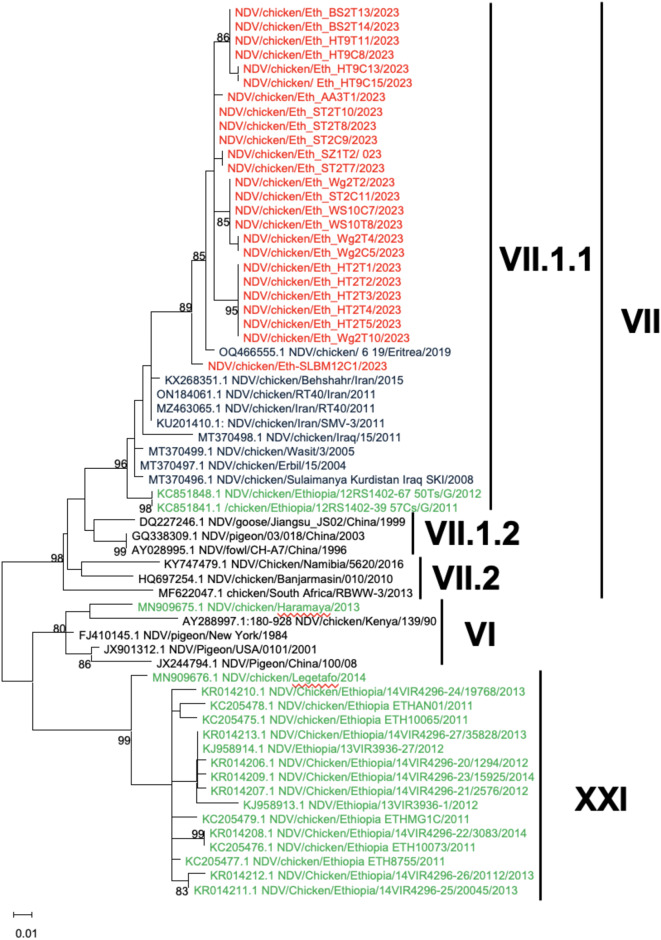
Results: Out of 231 samples tested, 10.8% (25/231) were positive for virus isolation. The F gene cleavage sites of all 25 isolates had 112RRQKRF117, a characteristic of virulent NDVs. The MDTs of representative isolates were less than 60 h, indicating highly virulent (velogenic) pathotypes. The HI test revealed significant differences between our isolates and the HB1 vaccine strain, but the VN test showed no antigenic difference. Phylogenetic analysis based on the partial F gene sequences showed that all the isolates belonged to sub-genotype VII.1.1 of genotype VII, which is closely related to NDV strains from the Middle East and Eritrea. Thermostability test showed two of the 25 isolates were thermostable.
Discussion: Although the HI test indicates antigenic differences between the velogenic Ethiopian isolates and the HB1 vaccine, the VN test showed that the vaccine could protect infections with these isolates. Phylogenetic analysis showed that all studied isolates belong to sub-genotype VII.1.1 of genotype VII, diverging from previously reported genotype XXI in Ethiopia.
Conclusions: In Ethiopia, NDV genotype VII 1.1 is widely distributed. Since these viruses showed the same antigenicity as the HB1 vaccine in VN test, the occurrence of ND in vaccinated chickens may be due to vaccine failure caused by inadequate management or immunosuppression due to other infectious diseases.
期刊介绍:
Virology Journal is an open access, peer reviewed journal that considers articles on all aspects of virology, including research on the viruses of animals, plants and microbes. The journal welcomes basic research as well as pre-clinical and clinical studies of novel diagnostic tools, vaccines and anti-viral therapies.
The Editorial policy of Virology Journal is to publish all research which is assessed by peer reviewers to be a coherent and sound addition to the scientific literature, and puts less emphasis on interest levels or perceived impact.






 京公网安备 11010802042870号
京ICP备2023020795号-1
京公网安备 11010802042870号
京ICP备2023020795号-1

 分享
分享
 求助内容:
求助内容: 应助结果提醒方式:
 扫码关注我们
