Keanna Rowchan, Daniel J Gale, Qasem Nick, Jason P Gallivan, Jeffrey D Wammes
{"title":"Visual Statistical Learning Alters Low-Dimensional Cortical Architecture.","authors":"Keanna Rowchan, Daniel J Gale, Qasem Nick, Jason P Gallivan, Jeffrey D Wammes","doi":"10.1523/JNEUROSCI.1932-24.2025","DOIUrl":null,"url":null,"abstract":"<p><p>Our brains are in a constant state of generating predictions, implicitly extracting environmental regularities to support later cognition and behavior, a process known as statistical learning (SL). While prior work investigating the neural basis of SL has focused on the activity of single brain regions in isolation, much less is known about how distributed brain areas coordinate their activity to support such learning. Using fMRI and a classic visual SL task, we investigated changes in whole-brain functional architecture as human female and male participants implicitly learned to associate pairs of images, and later, when predictions generated from learning were violated. By projecting individuals' patterns of cortical and subcortical functional connectivity onto a low-dimensional manifold space, we found that SL was associated with changes along a single neural dimension describing covariance across the visual-parietal and perirhinal cortex (PRC). During learning, we found regions within the visual cortex expanded along this dimension, reflecting their decreased communication with other networks, whereas regions within the dorsal attention network (DAN) contracted, reflecting their increased connectivity with higher-order cortex. Notably, when SL was interrupted, we found the PRC and entorhinal cortex, which did not initially show learning-related effects, now contracted along this dimension, reflecting their increased connectivity with the default mode and DAN, and decreased covariance with visual cortex. While prior research has linked SL to either broad cortical or medial temporal lobe changes, our findings suggest an integrative view, whereby cortical regions reorganize during association formation, while medial temporal lobe regions respond to their violation.</p>","PeriodicalId":50114,"journal":{"name":"Journal of Neuroscience","volume":" ","pages":""},"PeriodicalIF":4.0000,"publicationDate":"2025-04-23","publicationTypes":"Journal Article","fieldsOfStudy":null,"isOpenAccess":false,"openAccessPdf":"https://www.ncbi.nlm.nih.gov/pmc/articles/PMC12019107/pdf/","citationCount":"0","resultStr":null,"platform":"Semanticscholar","paperid":null,"PeriodicalName":"Journal of Neuroscience","FirstCategoryId":"3","ListUrlMain":"https://doi.org/10.1523/JNEUROSCI.1932-24.2025","RegionNum":2,"RegionCategory":"医学","ArticlePicture":[],"TitleCN":null,"AbstractTextCN":null,"PMCID":null,"EPubDate":"","PubModel":"","JCR":"Q1","JCRName":"NEUROSCIENCES","Score":null,"Total":0}
引用次数: 0
Abstract
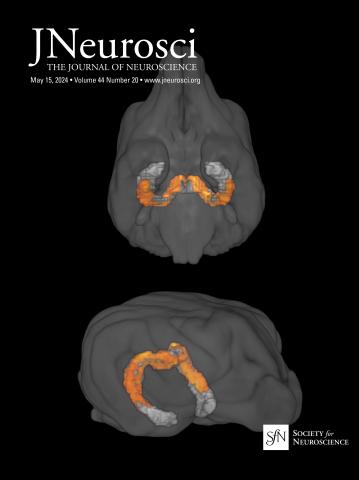
Our brains are in a constant state of generating predictions, implicitly extracting environmental regularities to support later cognition and behavior, a process known as statistical learning (SL). While prior work investigating the neural basis of SL has focused on the activity of single brain regions in isolation, much less is known about how distributed brain areas coordinate their activity to support such learning. Using fMRI and a classic visual SL task, we investigated changes in whole-brain functional architecture as human female and male participants implicitly learned to associate pairs of images, and later, when predictions generated from learning were violated. By projecting individuals' patterns of cortical and subcortical functional connectivity onto a low-dimensional manifold space, we found that SL was associated with changes along a single neural dimension describing covariance across the visual-parietal and perirhinal cortex (PRC). During learning, we found regions within the visual cortex expanded along this dimension, reflecting their decreased communication with other networks, whereas regions within the dorsal attention network (DAN) contracted, reflecting their increased connectivity with higher-order cortex. Notably, when SL was interrupted, we found the PRC and entorhinal cortex, which did not initially show learning-related effects, now contracted along this dimension, reflecting their increased connectivity with the default mode and DAN, and decreased covariance with visual cortex. While prior research has linked SL to either broad cortical or medial temporal lobe changes, our findings suggest an integrative view, whereby cortical regions reorganize during association formation, while medial temporal lobe regions respond to their violation.
期刊介绍:
JNeurosci (ISSN 0270-6474) is an official journal of the Society for Neuroscience. It is published weekly by the Society, fifty weeks a year, one volume a year. JNeurosci publishes papers on a broad range of topics of general interest to those working on the nervous system. Authors now have an Open Choice option for their published articles



 京公网安备 11010802042870号
京ICP备2023020795号-1
京公网安备 11010802042870号
京ICP备2023020795号-1

 分享
分享
 求助内容:
求助内容: 应助结果提醒方式:
 扫码关注我们
