Md. Emdad Hossain, Hilal Ahmad, Mohammed Abdul Azeem, Dahiru Umar Lawal, Md. Abdul Aziz, Turki N. Baroud
{"title":"Biomass-Derived Carbon and Carbon Nanofiber-Integrated Electrospun Janus Membranes: A New Frontier in Membrane Distillation","authors":"Md. Emdad Hossain, Hilal Ahmad, Mohammed Abdul Azeem, Dahiru Umar Lawal, Md. Abdul Aziz, Turki N. Baroud","doi":"10.1021/acsami.4c21554","DOIUrl":null,"url":null,"abstract":"Membrane distillation (MD) is an emerging desalination technique that uses low-grade energy to extract water vapor from saline solutions. In a thermally driven MD system, achieving a lower heat transfer and a higher mass transportation rate is desirable. To balance the trade-off between heat transfer and mass transportation, we developed novel dual-layered electrospun Janus nanofibrous membranes in this study, showing asymmetric wettability on each layer. The developed Janus membrane was constructed with a bottom hydrophilic layer composed of PVDF-<i>co</i>-HFP/biomass-derived jute carbon (JC) particles, and the top hydrophobic layer was formed using PH/carbon nanofibers (PH/CNF). The effect of distinct carbon nanoparticles on the prepared membranes was investigated by analyzing their chemical structure, morphology, water contact angle (WCA), pore size, porosity, thickness, liquid entry pressure, and mechanical and thermal stability. The hydrophobic layer of the optimized Janus membrane exhibited a WCA of 138 ± 1°, and the hydrophilic surface showed 72 ± 4°. Additionally, the optimized Janus membrane composed of a hydrophobic PH/0.5 wt % CNF layer and PH/0.5 wt % JC hydrophilic layer experienced an outstanding improvement in water flux (with 70 g L<sup>–1</sup> of NaCl content), reaching to a value of 71.72 kg m<sup>–2</sup> h<sup>–1</sup> (∼162% improvement compared to the pristine PH membrane), while maintaining a salt rejection of >99.99% for 24 h of water gap membrane distillation. Notably, the optimum Janus PH-0.5CNF/PH-0.5JC membrane demonstrated an astonishing long-term stability with real seawater, exhibiting a remarkable flux of 78.42 kg m<sup>–2</sup> h<sup>–1</sup>, which is ∼547% higher than commercially available PVDF membranes, while maintaining a salt rejection of 99.98% after 50 h. The proposed strategies provide a novel approach to fabricate an electrospun Janus membrane, and their performance highlights a strong potential candidate to be used in commercial water desalination plants.","PeriodicalId":5,"journal":{"name":"ACS Applied Materials & Interfaces","volume":"7 1","pages":""},"PeriodicalIF":8.2000,"publicationDate":"2025-03-08","publicationTypes":"Journal Article","fieldsOfStudy":null,"isOpenAccess":false,"openAccessPdf":"","citationCount":"0","resultStr":null,"platform":"Semanticscholar","paperid":null,"PeriodicalName":"ACS Applied Materials & Interfaces","FirstCategoryId":"88","ListUrlMain":"https://doi.org/10.1021/acsami.4c21554","RegionNum":2,"RegionCategory":"材料科学","ArticlePicture":[],"TitleCN":null,"AbstractTextCN":null,"PMCID":null,"EPubDate":"","PubModel":"","JCR":"Q1","JCRName":"MATERIALS SCIENCE, MULTIDISCIPLINARY","Score":null,"Total":0}
引用次数: 0
Abstract
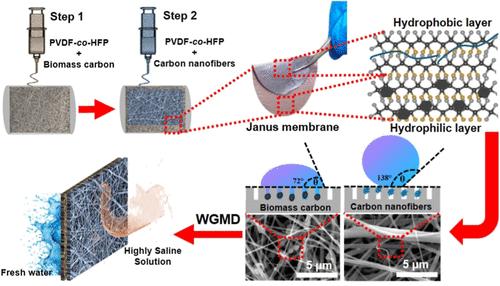
Membrane distillation (MD) is an emerging desalination technique that uses low-grade energy to extract water vapor from saline solutions. In a thermally driven MD system, achieving a lower heat transfer and a higher mass transportation rate is desirable. To balance the trade-off between heat transfer and mass transportation, we developed novel dual-layered electrospun Janus nanofibrous membranes in this study, showing asymmetric wettability on each layer. The developed Janus membrane was constructed with a bottom hydrophilic layer composed of PVDF-co-HFP/biomass-derived jute carbon (JC) particles, and the top hydrophobic layer was formed using PH/carbon nanofibers (PH/CNF). The effect of distinct carbon nanoparticles on the prepared membranes was investigated by analyzing their chemical structure, morphology, water contact angle (WCA), pore size, porosity, thickness, liquid entry pressure, and mechanical and thermal stability. The hydrophobic layer of the optimized Janus membrane exhibited a WCA of 138 ± 1°, and the hydrophilic surface showed 72 ± 4°. Additionally, the optimized Janus membrane composed of a hydrophobic PH/0.5 wt % CNF layer and PH/0.5 wt % JC hydrophilic layer experienced an outstanding improvement in water flux (with 70 g L–1 of NaCl content), reaching to a value of 71.72 kg m–2 h–1 (∼162% improvement compared to the pristine PH membrane), while maintaining a salt rejection of >99.99% for 24 h of water gap membrane distillation. Notably, the optimum Janus PH-0.5CNF/PH-0.5JC membrane demonstrated an astonishing long-term stability with real seawater, exhibiting a remarkable flux of 78.42 kg m–2 h–1, which is ∼547% higher than commercially available PVDF membranes, while maintaining a salt rejection of 99.98% after 50 h. The proposed strategies provide a novel approach to fabricate an electrospun Janus membrane, and their performance highlights a strong potential candidate to be used in commercial water desalination plants.
膜蒸馏(MD)是一种新兴的海水淡化技术,它利用低品位的能源从含盐溶液中提取水蒸气。在热驱动的MD系统中,实现较低的传热和较高的质量传递率是理想的。为了平衡传热和质量传递之间的平衡,我们在本研究中开发了一种新型的双层静电纺Janus纳米纤维膜,每层都具有不对称的润湿性。制备的Janus膜由PVDF-co-HFP/生物质黄麻碳(JC)颗粒组成的底层亲水层和PH/碳纳米纤维(PH/CNF)组成的上层疏水层组成。通过分析不同碳纳米颗粒的化学结构、形貌、水接触角(WCA)、孔径、孔隙度、厚度、入液压力、机械稳定性和热稳定性,研究了不同碳纳米颗粒对制备膜的影响。优化后的Janus膜疏水层的WCA为138±1°,亲水性层的WCA为72±4°。此外,由疏水PH/0.5 wt % CNF层和亲水PH/0.5 wt % JC层组成的优化Janus膜的水通量显著提高(NaCl含量为70 g L-1),达到71.72 kg m-2 h - 1(与原始PH膜相比提高约162%),同时在24 h的水隙膜蒸馏中保持99.99%的盐去除率。值得注意的是,最佳的Janus PH-0.5CNF/PH-0.5JC膜在真实海水中表现出惊人的长期稳定性,其通量为78.42 kg m-2 h - 1,比市售PVDF膜高出约547%,同时在50小时后仍保持99.98%的盐去除率。它们的性能突出了在商业海水淡化厂中使用的强大潜力。
期刊介绍:
ACS Applied Materials & Interfaces is a leading interdisciplinary journal that brings together chemists, engineers, physicists, and biologists to explore the development and utilization of newly-discovered materials and interfacial processes for specific applications. Our journal has experienced remarkable growth since its establishment in 2009, both in terms of the number of articles published and the impact of the research showcased. We are proud to foster a truly global community, with the majority of published articles originating from outside the United States, reflecting the rapid growth of applied research worldwide.



 京公网安备 11010802042870号
京ICP备2023020795号-1
京公网安备 11010802042870号
京ICP备2023020795号-1

 分享
分享
 求助内容:
求助内容: 应助结果提醒方式:
 扫码关注我们
