Hongxian Zhu, Andrew M. Sydor, Bing-Ru Yan, Ren Li, Michal T. Boniecki, Carina Lyons, Miroslaw Cygler, Aleixo M. Muise, Michelle E. Maxson, Sergio Grinstein, Brian Raught, John H. Brumell
{"title":"Salmonella exploits LRRK2-dependent plasma membrane dynamics to invade host cells","authors":"Hongxian Zhu, Andrew M. Sydor, Bing-Ru Yan, Ren Li, Michal T. Boniecki, Carina Lyons, Miroslaw Cygler, Aleixo M. Muise, Michelle E. Maxson, Sergio Grinstein, Brian Raught, John H. Brumell","doi":"10.1038/s41467-025-57453-x","DOIUrl":null,"url":null,"abstract":"<p><i>Salmonella</i> utilizes type 3 secreted effector proteins to induce plasma membrane (PM) perturbations during invasion of host cells<sup>1</sup>. The effectors drive mobilization of host membranes to generate cell surface ruffles, followed by invagination and scission of the PM to generate <i>Salmonella</i>-containing vacuoles (SCVs)<sup>2</sup>. Here, we show that LRRK2 kinase generates membrane reservoirs exploited by <i>Salmonella</i> during invasion. The reservoirs are tubular compartments associated with the PM under basal conditions and are formed through the phosphorylation of RAB10 GTPase by LRRK2. Mobilization of membrane reservoirs to generate invasion ruffles mediates delivery of phosphorylated RAB10 to invasion sites. Subsequently, RAB10 dephosphorylation is required for its inactivation by a bacterial GTPase activating protein and subsequent scission of the PM. RAB10 dephosphorylation is mediated by a TLR4/PIEZO1/TMEM16F-dependent pathway and is inhibited by hyperactive variants of LRRK2. Our findings reveal how <i>Salmonella</i> exploits LRRK2-dependent PM dynamics during invasion and provide new insight into how LRRK2 variants can protect against bacterial infection<sup>3,4</sup>.</p>","PeriodicalId":19066,"journal":{"name":"Nature Communications","volume":"30 1","pages":""},"PeriodicalIF":15.7000,"publicationDate":"2025-03-08","publicationTypes":"Journal Article","fieldsOfStudy":null,"isOpenAccess":false,"openAccessPdf":"","citationCount":"0","resultStr":null,"platform":"Semanticscholar","paperid":null,"PeriodicalName":"Nature Communications","FirstCategoryId":"103","ListUrlMain":"https://doi.org/10.1038/s41467-025-57453-x","RegionNum":1,"RegionCategory":"综合性期刊","ArticlePicture":[],"TitleCN":null,"AbstractTextCN":null,"PMCID":null,"EPubDate":"","PubModel":"","JCR":"Q1","JCRName":"MULTIDISCIPLINARY SCIENCES","Score":null,"Total":0}
引用次数: 0
Abstract
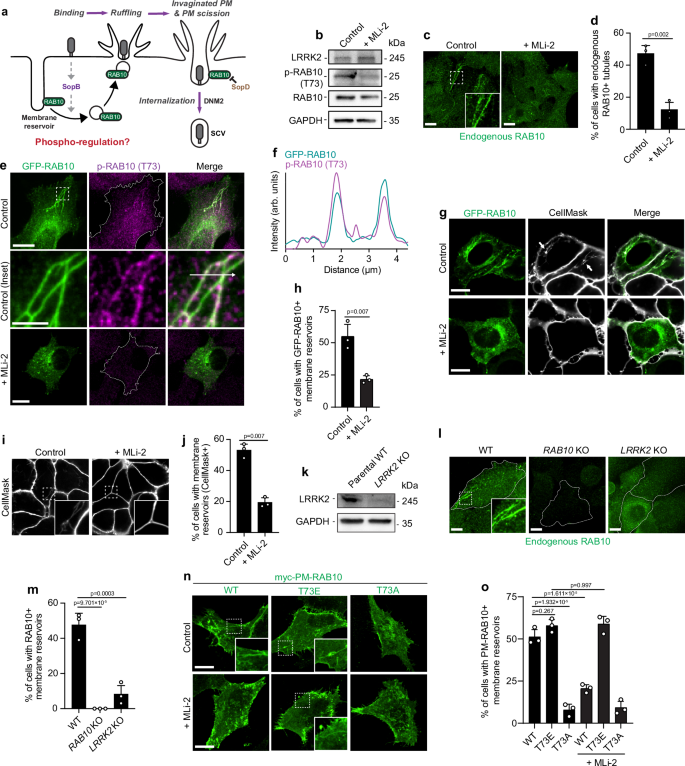
Salmonella utilizes type 3 secreted effector proteins to induce plasma membrane (PM) perturbations during invasion of host cells1. The effectors drive mobilization of host membranes to generate cell surface ruffles, followed by invagination and scission of the PM to generate Salmonella-containing vacuoles (SCVs)2. Here, we show that LRRK2 kinase generates membrane reservoirs exploited by Salmonella during invasion. The reservoirs are tubular compartments associated with the PM under basal conditions and are formed through the phosphorylation of RAB10 GTPase by LRRK2. Mobilization of membrane reservoirs to generate invasion ruffles mediates delivery of phosphorylated RAB10 to invasion sites. Subsequently, RAB10 dephosphorylation is required for its inactivation by a bacterial GTPase activating protein and subsequent scission of the PM. RAB10 dephosphorylation is mediated by a TLR4/PIEZO1/TMEM16F-dependent pathway and is inhibited by hyperactive variants of LRRK2. Our findings reveal how Salmonella exploits LRRK2-dependent PM dynamics during invasion and provide new insight into how LRRK2 variants can protect against bacterial infection3,4.
期刊介绍:
Nature Communications, an open-access journal, publishes high-quality research spanning all areas of the natural sciences. Papers featured in the journal showcase significant advances relevant to specialists in each respective field. With a 2-year impact factor of 16.6 (2022) and a median time of 8 days from submission to the first editorial decision, Nature Communications is committed to rapid dissemination of research findings. As a multidisciplinary journal, it welcomes contributions from biological, health, physical, chemical, Earth, social, mathematical, applied, and engineering sciences, aiming to highlight important breakthroughs within each domain.



 京公网安备 11010802042870号
京ICP备2023020795号-1
京公网安备 11010802042870号
京ICP备2023020795号-1

 分享
分享
 求助内容:
求助内容: 应助结果提醒方式:
 扫码关注我们
