Sana Mazouar, Ilyas Chabri, Hafida Ziouani, Abdelilah Taoufik, El Mostafa Khechoubi, Mahmoud Ettakni
{"title":"Performance Enhancement of NH3(CH2)4NH3CoCl4-Based Perovskite Solar Cell via DFT-Guided SCAPS-1D Simulations","authors":"Sana Mazouar, Ilyas Chabri, Hafida Ziouani, Abdelilah Taoufik, El Mostafa Khechoubi, Mahmoud Ettakni","doi":"10.1002/adts.202401504","DOIUrl":null,"url":null,"abstract":"<p>This work provides an investigation into enhancing the performance of solar cells based <span></span><math>\n <semantics>\n <mrow>\n <mi>N</mi>\n <msub>\n <mi>H</mi>\n <mn>3</mn>\n </msub>\n <msub>\n <mrow>\n <mo>(</mo>\n <mrow>\n <mi>C</mi>\n <msub>\n <mi>H</mi>\n <mn>2</mn>\n </msub>\n </mrow>\n <mo>)</mo>\n </mrow>\n <mn>4</mn>\n </msub>\n <mi>N</mi>\n <msub>\n <mi>H</mi>\n <mn>3</mn>\n </msub>\n <mi>CoC</mi>\n <msub>\n <mi>l</mi>\n <mn>4</mn>\n </msub>\n </mrow>\n <annotation>${\\mathrm{N}}{{{\\mathrm{H}}}_{\\mathrm{3}}}{{( {{\\mathrm{C}}{{{\\mathrm{H}}}_{\\mathrm{2}}}} )}_{\\mathrm{4}}}{\\mathrm{N}}{{{\\mathrm{H}}}_{\\mathrm{3}}}{\\mathrm{CoC}}{{{\\mathrm{l}}}_{\\mathrm{4}}}$</annotation>\n </semantics></math>, using a unique combination of density functional theory (DFT) calculations and SCAPS-1D device modeling. Through DFT, we determine that <span></span><math>\n <semantics>\n <mrow>\n <mi>N</mi>\n <msub>\n <mi>H</mi>\n <mn>3</mn>\n </msub>\n <msub>\n <mrow>\n <mo>(</mo>\n <mrow>\n <mi>C</mi>\n <msub>\n <mi>H</mi>\n <mn>2</mn>\n </msub>\n </mrow>\n <mo>)</mo>\n </mrow>\n <mn>4</mn>\n </msub>\n <mi>N</mi>\n <msub>\n <mi>H</mi>\n <mn>3</mn>\n </msub>\n <mi>CoC</mi>\n <msub>\n <mi>l</mi>\n <mn>4</mn>\n </msub>\n </mrow>\n <annotation>${\\mathrm{N}}{{{\\mathrm{H}}}_{\\mathrm{3}}}{{( {{\\mathrm{C}}{{{\\mathrm{H}}}_{\\mathrm{2}}}} )}_{\\mathrm{4}}}{\\mathrm{N}}{{{\\mathrm{H}}}_{\\mathrm{3}}}{\\mathrm{CoC}}{{{\\mathrm{l}}}_{\\mathrm{4}}}$</annotation>\n </semantics></math> has an indirect bandgap of 1.84 eV, closely matching the experimental value of 1.80 eV. The material's electronic structure is largely influenced by cobalt and chlorine atoms, while nitrogen and hydrogen contribute to lattice stability. Optical analysis reveals an initial absorption peak at 5.11 eV, along with effective absorption in the visible spectrum (1.6–3.2 eV). To ensure that SCAPS simulations produce realistic results, we benchmarked SCAPS against a reference device (FTO/<span></span><math>\n <semantics>\n <mrow>\n <mi>Ti</mi>\n <msub>\n <mi>O</mi>\n <mn>2</mn>\n </msub>\n </mrow>\n <annotation>${\\mathrm{Ti}}{{{\\mathrm{O}}}_{\\mathrm{2}}}$</annotation>\n </semantics></math>/<span></span><math>\n <semantics>\n <mrow>\n <mrow>\n <mo>[</mo>\n <mrow>\n <mi>N</mi>\n <msub>\n <mi>H</mi>\n <mn>3</mn>\n </msub>\n <msub>\n <mrow>\n <mo>(</mo>\n <mrow>\n <mi>C</mi>\n <msub>\n <mi>H</mi>\n <mn>2</mn>\n </msub>\n </mrow>\n <mo>)</mo>\n </mrow>\n <mn>2</mn>\n </msub>\n <mi>N</mi>\n <msub>\n <mi>H</mi>\n <mn>3</mn>\n </msub>\n </mrow>\n <mo>]</mo>\n </mrow>\n <mi>MnC</mi>\n <msub>\n <mi>l</mi>\n <mn>4</mn>\n </msub>\n </mrow>\n <annotation>$[ {{\\mathrm{N}}{{{\\mathrm{H}}}_{\\mathrm{3}}}{{{( {{\\mathrm{C}}{{{\\mathrm{H}}}_{\\mathrm{2}}}} )}}_{\\mathrm{2}}}{\\mathrm{N}}{{{\\mathrm{H}}}_{\\mathrm{3}}}} ]{\\mathrm{MnC}}{{{\\mathrm{l}}}_{\\mathrm{4}}}$</annotation>\n </semantics></math>/Spiro-OMeTAD/Au) and found close agreement with experimental data. With confidence in SCAPS, we utilized DFT-derived parameters for <span></span><math>\n <semantics>\n <mrow>\n <mi>N</mi>\n <msub>\n <mi>H</mi>\n <mn>3</mn>\n </msub>\n <msub>\n <mrow>\n <mo>(</mo>\n <mrow>\n <mi>C</mi>\n <msub>\n <mi>H</mi>\n <mn>2</mn>\n </msub>\n </mrow>\n <mo>)</mo>\n </mrow>\n <mn>4</mn>\n </msub>\n <mi>N</mi>\n <msub>\n <mi>H</mi>\n <mn>3</mn>\n </msub>\n <mi>CoC</mi>\n <msub>\n <mi>l</mi>\n <mn>4</mn>\n </msub>\n </mrow>\n <annotation>${\\mathrm{N}}{{{\\mathrm{H}}}_{\\mathrm{3}}}{{( {{\\mathrm{C}}{{{\\mathrm{H}}}_{\\mathrm{2}}}} )}_{\\mathrm{4}}}{\\mathrm{N}}{{{\\mathrm{H}}}_{\\mathrm{3}}}{\\mathrm{CoC}}{{{\\mathrm{l}}}_{\\mathrm{4}}}$</annotation>\n </semantics></math>, including bandgap, effective masses, density of states, mobilities, and permittivity, as inputs for further simulation. In the optimization phase, parameters such as the thicknesses of the hole and electron transport layers, defect densities, doping concentrations, and temperature effects are systematically adjusted. These optimizations result in a notable power conversion efficiency (PCE) of 19.71% at room temperature.</p>","PeriodicalId":7219,"journal":{"name":"Advanced Theory and Simulations","volume":"8 6","pages":""},"PeriodicalIF":2.9000,"publicationDate":"2025-03-08","publicationTypes":"Journal Article","fieldsOfStudy":null,"isOpenAccess":false,"openAccessPdf":"","citationCount":"0","resultStr":null,"platform":"Semanticscholar","paperid":null,"PeriodicalName":"Advanced Theory and Simulations","FirstCategoryId":"5","ListUrlMain":"https://advanced.onlinelibrary.wiley.com/doi/10.1002/adts.202401504","RegionNum":4,"RegionCategory":"工程技术","ArticlePicture":[],"TitleCN":null,"AbstractTextCN":null,"PMCID":null,"EPubDate":"","PubModel":"","JCR":"Q1","JCRName":"MULTIDISCIPLINARY SCIENCES","Score":null,"Total":0}
引用次数: 0
Abstract
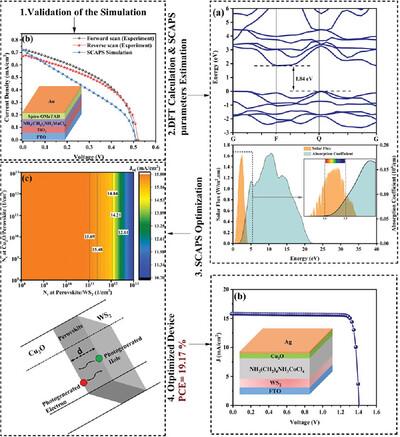
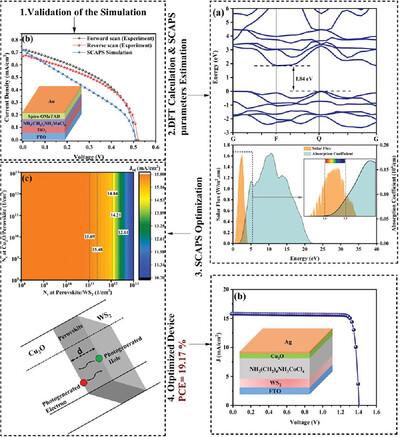
This work provides an investigation into enhancing the performance of solar cells based , using a unique combination of density functional theory (DFT) calculations and SCAPS-1D device modeling. Through DFT, we determine that has an indirect bandgap of 1.84 eV, closely matching the experimental value of 1.80 eV. The material's electronic structure is largely influenced by cobalt and chlorine atoms, while nitrogen and hydrogen contribute to lattice stability. Optical analysis reveals an initial absorption peak at 5.11 eV, along with effective absorption in the visible spectrum (1.6–3.2 eV). To ensure that SCAPS simulations produce realistic results, we benchmarked SCAPS against a reference device (FTO///Spiro-OMeTAD/Au) and found close agreement with experimental data. With confidence in SCAPS, we utilized DFT-derived parameters for , including bandgap, effective masses, density of states, mobilities, and permittivity, as inputs for further simulation. In the optimization phase, parameters such as the thicknesses of the hole and electron transport layers, defect densities, doping concentrations, and temperature effects are systematically adjusted. These optimizations result in a notable power conversion efficiency (PCE) of 19.71% at room temperature.
期刊介绍:
Advanced Theory and Simulations is an interdisciplinary, international, English-language journal that publishes high-quality scientific results focusing on the development and application of theoretical methods, modeling and simulation approaches in all natural science and medicine areas, including:
materials, chemistry, condensed matter physics
engineering, energy
life science, biology, medicine
atmospheric/environmental science, climate science
planetary science, astronomy, cosmology
method development, numerical methods, statistics







 京公网安备 11010802042870号
京ICP备2023020795号-1
京公网安备 11010802042870号
京ICP备2023020795号-1

 分享
分享
 求助内容:
求助内容: 应助结果提醒方式:
 扫码关注我们
