Reduced Honeybee Pollen Foraging under Neonicotinoid Exposure: Exploring Reproducible Individual and Colony Level Effects in the Field Using AI and Simulation
{"title":"Reduced Honeybee Pollen Foraging under Neonicotinoid Exposure: Exploring Reproducible Individual and Colony Level Effects in the Field Using AI and Simulation","authors":"Ming Wang, Frederic Tausch, Katharina Schmidt, Matthias Diehl, Silvio Knaebe, Holger Bargen, Farnaz Faramarzi, Volker Grimm","doi":"10.1021/acs.est.4c13656","DOIUrl":null,"url":null,"abstract":"Honeybees (<i>Apis mellifera</i>) are important pollinators. Their foraging behaviors are essential to colony sustainability. Sublethal exposure to pesticides such as neonicotinoids can significantly disrupt these behaviors, in particular pollen foraging. We investigated the effects of sublethal doses of the neonicotinoid imidacloprid on honeybee foraging, at both individual and colony levels, by integrating field experiments with artificial intelligence (AI)-based monitoring technology and mechanistic simulations using the BEEHAVE model. Our results replicated previous findings, which showed that imidacloprid selectively reduces pollen foraging at the colony level, with minimal impact on nectar foraging. Individually marked exposed honeybees exhibited prolonged pollen foraging trips, reduced pollen foraging frequency, and instances of drifting pollen foraging trips, likely due to impaired cognitive functions and altered metabolism. These behavioral changes at the individual level corroborated the previous model predictions derived from BEEHAVE, which highlights the value of combining experimental and simulation approaches to disentangle underlying mechanisms through which sublethal effects on individual foragers scale up to impact colony dynamics. Our findings have implications for future pesticide risk assessment, as we provide a robust feeding study design for evaluating pesticide effects on honeybee colonies and foraging in real landscapes, which could improve the realism of higher-tier ecological risk assessment.","PeriodicalId":36,"journal":{"name":"环境科学与技术","volume":"34 1","pages":""},"PeriodicalIF":11.3000,"publicationDate":"2025-03-07","publicationTypes":"Journal Article","fieldsOfStudy":null,"isOpenAccess":false,"openAccessPdf":"","citationCount":"0","resultStr":null,"platform":"Semanticscholar","paperid":null,"PeriodicalName":"环境科学与技术","FirstCategoryId":"1","ListUrlMain":"https://doi.org/10.1021/acs.est.4c13656","RegionNum":1,"RegionCategory":"环境科学与生态学","ArticlePicture":[],"TitleCN":null,"AbstractTextCN":null,"PMCID":null,"EPubDate":"","PubModel":"","JCR":"Q1","JCRName":"ENGINEERING, ENVIRONMENTAL","Score":null,"Total":0}
引用次数: 0
Abstract
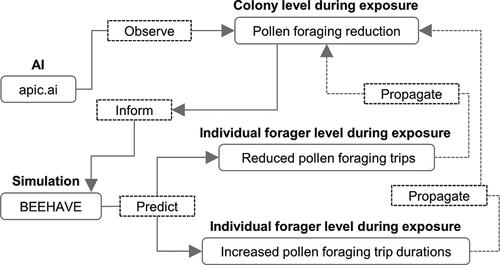
Honeybees (Apis mellifera) are important pollinators. Their foraging behaviors are essential to colony sustainability. Sublethal exposure to pesticides such as neonicotinoids can significantly disrupt these behaviors, in particular pollen foraging. We investigated the effects of sublethal doses of the neonicotinoid imidacloprid on honeybee foraging, at both individual and colony levels, by integrating field experiments with artificial intelligence (AI)-based monitoring technology and mechanistic simulations using the BEEHAVE model. Our results replicated previous findings, which showed that imidacloprid selectively reduces pollen foraging at the colony level, with minimal impact on nectar foraging. Individually marked exposed honeybees exhibited prolonged pollen foraging trips, reduced pollen foraging frequency, and instances of drifting pollen foraging trips, likely due to impaired cognitive functions and altered metabolism. These behavioral changes at the individual level corroborated the previous model predictions derived from BEEHAVE, which highlights the value of combining experimental and simulation approaches to disentangle underlying mechanisms through which sublethal effects on individual foragers scale up to impact colony dynamics. Our findings have implications for future pesticide risk assessment, as we provide a robust feeding study design for evaluating pesticide effects on honeybee colonies and foraging in real landscapes, which could improve the realism of higher-tier ecological risk assessment.
期刊介绍:
Environmental Science & Technology (ES&T) is a co-sponsored academic and technical magazine by the Hubei Provincial Environmental Protection Bureau and the Hubei Provincial Academy of Environmental Sciences.
Environmental Science & Technology (ES&T) holds the status of Chinese core journals, scientific papers source journals of China, Chinese Science Citation Database source journals, and Chinese Academic Journal Comprehensive Evaluation Database source journals. This publication focuses on the academic field of environmental protection, featuring articles related to environmental protection and technical advancements.



 京公网安备 11010802042870号
京ICP备2023020795号-1
京公网安备 11010802042870号
京ICP备2023020795号-1

 分享
分享
 求助内容:
求助内容: 应助结果提醒方式:
 扫码关注我们
