{"title":"A comprehensive back-extraction methodology for the regeneration of ionic liquids in oil extraction desulfurization","authors":"Yu Zhang, Shuo Zhang, Yanqiu Pan, Wei Wang, Hao Yuan, Heng Gu","doi":"10.1016/j.seppur.2025.132441","DOIUrl":null,"url":null,"abstract":"<div><div>A comprehensive framework for screening back-extractants was established to regenerate the ionic liquid (IL) used in the ultra-deep desulfurization of oils. The extraction indices of 196 back-extractant candidates were predicted using the COSMO-RS method, aiming at removing the typical aromatic sulfides of thiophene (TS), benzothiophene (BT), dibenzothiophene (DBT), and 4,6-dimethyldibenzothiophene (4,6-DMDBT) from the IL of 1-butyl-3-methylpyridinium dicyanamide ([BMPy][DCA]). The environmentally safety-related phy-chemical properties of these candidates were estimated based on QSAR models. These indices and properties were then statistically integrated into a representative index using the FCE combined with the EWM to identify a high-performance, eco-friendly back-extractant. According to this index, indane was chosen as the optimal back-extractant. Four ternary LLE experiments of the [BMPy][DCA] (1) + TS/BT/DBT/4,6-DMDBT (2) + indane (3) systems were conducted, and the results confirmed the satisfactory selectivities and distribution coefficients of indane. The NRTL model was employed to correlate the experimental data, yielding <em>RMSD</em>s of 0.0007, 0.0011, 4.0147 × 10<sup>–5</sup>, and 3.6053 × 10<sup>–5</sup>, respectively. The consistency of the obtained model parameters was validated through the Gibbs energy of mixing function analysis. Finally, the IL-regeneration process using indane as the back-extractant was simulated and compared with a CCl<sub>4</sub>-based process regarding industrial and economic performance. The results indicated that the indane performed better than CCl<sub>4</sub> in both respects. This study presents a universal framework for screening back-extractants, offering a referable research idea to other separation fields involving IL-regeneration.</div></div>","PeriodicalId":427,"journal":{"name":"Separation and Purification Technology","volume":"364 ","pages":"Article 132441"},"PeriodicalIF":9.0000,"publicationDate":"2025-03-08","publicationTypes":"Journal Article","fieldsOfStudy":null,"isOpenAccess":false,"openAccessPdf":"","citationCount":"0","resultStr":null,"platform":"Semanticscholar","paperid":null,"PeriodicalName":"Separation and Purification Technology","FirstCategoryId":"5","ListUrlMain":"https://www.sciencedirect.com/science/article/pii/S138358662501038X","RegionNum":1,"RegionCategory":"工程技术","ArticlePicture":[],"TitleCN":null,"AbstractTextCN":null,"PMCID":null,"EPubDate":"","PubModel":"","JCR":"Q1","JCRName":"ENGINEERING, CHEMICAL","Score":null,"Total":0}
引用次数: 0
Abstract
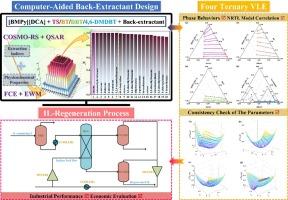
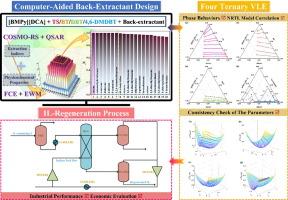
A comprehensive framework for screening back-extractants was established to regenerate the ionic liquid (IL) used in the ultra-deep desulfurization of oils. The extraction indices of 196 back-extractant candidates were predicted using the COSMO-RS method, aiming at removing the typical aromatic sulfides of thiophene (TS), benzothiophene (BT), dibenzothiophene (DBT), and 4,6-dimethyldibenzothiophene (4,6-DMDBT) from the IL of 1-butyl-3-methylpyridinium dicyanamide ([BMPy][DCA]). The environmentally safety-related phy-chemical properties of these candidates were estimated based on QSAR models. These indices and properties were then statistically integrated into a representative index using the FCE combined with the EWM to identify a high-performance, eco-friendly back-extractant. According to this index, indane was chosen as the optimal back-extractant. Four ternary LLE experiments of the [BMPy][DCA] (1) + TS/BT/DBT/4,6-DMDBT (2) + indane (3) systems were conducted, and the results confirmed the satisfactory selectivities and distribution coefficients of indane. The NRTL model was employed to correlate the experimental data, yielding RMSDs of 0.0007, 0.0011, 4.0147 × 10⁻⁵, and 3.6053 × 10⁻⁵, respectively. The consistency of the obtained model parameters was validated through the Gibbs energy of mixing function analysis. Finally, the IL-regeneration process using indane as the back-extractant was simulated and compared with a CCl4-based process regarding industrial and economic performance. The results indicated that the indane performed better than CCl4 in both respects. This study presents a universal framework for screening back-extractants, offering a referable research idea to other separation fields involving IL-regeneration.
期刊介绍:
Separation and Purification Technology is a premier journal committed to sharing innovative methods for separation and purification in chemical and environmental engineering, encompassing both homogeneous solutions and heterogeneous mixtures. Our scope includes the separation and/or purification of liquids, vapors, and gases, as well as carbon capture and separation techniques. However, it's important to note that methods solely intended for analytical purposes are not within the scope of the journal. Additionally, disciplines such as soil science, polymer science, and metallurgy fall outside the purview of Separation and Purification Technology. Join us in advancing the field of separation and purification methods for sustainable solutions in chemical and environmental engineering.



 京公网安备 11010802042870号
京ICP备2023020795号-1
京公网安备 11010802042870号
京ICP备2023020795号-1

 分享
分享
 求助内容:
求助内容: 应助结果提醒方式:
 扫码关注我们
