{"title":"A bioelectronic tongue to estimate the toxicological intensity of pollutants in wastewater treatment plant","authors":"Jouanneau Sulivan, Louineau Thomas, Thouand Gérald","doi":"10.1016/j.watres.2025.123470","DOIUrl":null,"url":null,"abstract":"<div><div>With 360 km³ of wastewater produced each year in Europe, the management and control of units responsible for their treatment appear as major challenges in preserving the environment. Nevertheless, these processes remain vulnerable to the presence of toxic compounds likely to compromise their performance. Although many toxicity tests exist to evaluate the impact of pollutants on the environment, these are generally not easily transferable to the monitoring of wastewater treatment processes (constraints of implementation, representativeness of the information provided).</div><div>This innovative project leverages the concept of a \"bioelectronic tongue\" integrated into a biosensor to evaluate the toxic impact of pollutants on wastewater treatment plant (WWTP) microbiomes. This work presents a holistic approach, covering the entire process from the selection of representative microorganisms to in situ application. The strategy hinges on the synergistic implementation of 8 bioreporters, coupled with a data processing algorithm to generate relevant toxicity assessments. In parallel, a significant focus was placed on developing a biosensor optimized for in situ deployment of this innovative measurement strategy.</div><div>The developed approach (TOXLAB) has been compared to reference methods currently used to assess the toxicological intensity of effluents. As expected, significant differences were highlighted between the standardized methods, particularly the method based on marine bioluminescent bacteria (lack of representativeness – 9 out of the 11 tested conditions could not be quantified with this method). However, the results provided by the TOXLAB approach show a certain adequacy with the toxicity data obtained on the urban WWTP microbiome. On the other hand, the results obtained on the industrial site (34 samples) are much more contrasted. Indeed, no correlation (r² = 0.033) could be established between the data from the TOXLAB approach and the effects induced on the autochthonous microbial community of the site. To explain these results, the work focused on the composition of these specific ecosystems, thus showing important differences between the microbiomes of WWTPs and the industrial site. Thus, in light of these results, the conclusion of the study shows the need to use a specific set of bioreporters, dedicated to each industrial site, in order to ensure a relative representativeness of the information provided.</div></div>","PeriodicalId":443,"journal":{"name":"Water Research","volume":"279 ","pages":"Article 123470"},"PeriodicalIF":12.4000,"publicationDate":"2025-03-09","publicationTypes":"Journal Article","fieldsOfStudy":null,"isOpenAccess":false,"openAccessPdf":"","citationCount":"0","resultStr":null,"platform":"Semanticscholar","paperid":null,"PeriodicalName":"Water Research","FirstCategoryId":"93","ListUrlMain":"https://www.sciencedirect.com/science/article/pii/S0043135425003835","RegionNum":1,"RegionCategory":"环境科学与生态学","ArticlePicture":[],"TitleCN":null,"AbstractTextCN":null,"PMCID":null,"EPubDate":"","PubModel":"","JCR":"Q1","JCRName":"ENGINEERING, ENVIRONMENTAL","Score":null,"Total":0}
引用次数: 0
Abstract
With 360 km³ of wastewater produced each year in Europe, the management and control of units responsible for their treatment appear as major challenges in preserving the environment. Nevertheless, these processes remain vulnerable to the presence of toxic compounds likely to compromise their performance. Although many toxicity tests exist to evaluate the impact of pollutants on the environment, these are generally not easily transferable to the monitoring of wastewater treatment processes (constraints of implementation, representativeness of the information provided).
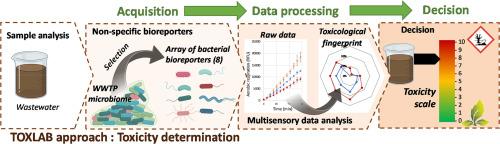
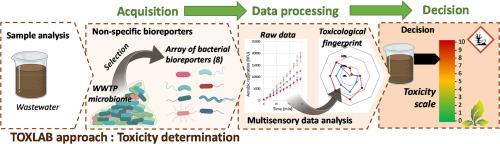
This innovative project leverages the concept of a "bioelectronic tongue" integrated into a biosensor to evaluate the toxic impact of pollutants on wastewater treatment plant (WWTP) microbiomes. This work presents a holistic approach, covering the entire process from the selection of representative microorganisms to in situ application. The strategy hinges on the synergistic implementation of 8 bioreporters, coupled with a data processing algorithm to generate relevant toxicity assessments. In parallel, a significant focus was placed on developing a biosensor optimized for in situ deployment of this innovative measurement strategy.
The developed approach (TOXLAB) has been compared to reference methods currently used to assess the toxicological intensity of effluents. As expected, significant differences were highlighted between the standardized methods, particularly the method based on marine bioluminescent bacteria (lack of representativeness – 9 out of the 11 tested conditions could not be quantified with this method). However, the results provided by the TOXLAB approach show a certain adequacy with the toxicity data obtained on the urban WWTP microbiome. On the other hand, the results obtained on the industrial site (34 samples) are much more contrasted. Indeed, no correlation (r² = 0.033) could be established between the data from the TOXLAB approach and the effects induced on the autochthonous microbial community of the site. To explain these results, the work focused on the composition of these specific ecosystems, thus showing important differences between the microbiomes of WWTPs and the industrial site. Thus, in light of these results, the conclusion of the study shows the need to use a specific set of bioreporters, dedicated to each industrial site, in order to ensure a relative representativeness of the information provided.
期刊介绍:
Water Research, along with its open access companion journal Water Research X, serves as a platform for publishing original research papers covering various aspects of the science and technology related to the anthropogenic water cycle, water quality, and its management worldwide. The audience targeted by the journal comprises biologists, chemical engineers, chemists, civil engineers, environmental engineers, limnologists, and microbiologists. The scope of the journal include:
•Treatment processes for water and wastewaters (municipal, agricultural, industrial, and on-site treatment), including resource recovery and residuals management;
•Urban hydrology including sewer systems, stormwater management, and green infrastructure;
•Drinking water treatment and distribution;
•Potable and non-potable water reuse;
•Sanitation, public health, and risk assessment;
•Anaerobic digestion, solid and hazardous waste management, including source characterization and the effects and control of leachates and gaseous emissions;
•Contaminants (chemical, microbial, anthropogenic particles such as nanoparticles or microplastics) and related water quality sensing, monitoring, fate, and assessment;
•Anthropogenic impacts on inland, tidal, coastal and urban waters, focusing on surface and ground waters, and point and non-point sources of pollution;
•Environmental restoration, linked to surface water, groundwater and groundwater remediation;
•Analysis of the interfaces between sediments and water, and between water and atmosphere, focusing specifically on anthropogenic impacts;
•Mathematical modelling, systems analysis, machine learning, and beneficial use of big data related to the anthropogenic water cycle;
•Socio-economic, policy, and regulations studies.



 京公网安备 11010802042870号
京ICP备2023020795号-1
京公网安备 11010802042870号
京ICP备2023020795号-1

 分享
分享
 求助内容:
求助内容: 应助结果提醒方式:
 扫码关注我们
