An electrochemical-mechanical synergistic regulation by constructing a double-layer fully active silicon-based alloy anode in sulfide all-solid-state batteries
Yuting Huang , Shenghao Jing , Huaqing Shen , Sijia Li , YuXin Shen , Yuanyuan Lin , Ying Zhang , Zongliang Zhang , Yang Liu , Yongle Chen , Fangyang Liu , Yang Lu
{"title":"An electrochemical-mechanical synergistic regulation by constructing a double-layer fully active silicon-based alloy anode in sulfide all-solid-state batteries","authors":"Yuting Huang , Shenghao Jing , Huaqing Shen , Sijia Li , YuXin Shen , Yuanyuan Lin , Ying Zhang , Zongliang Zhang , Yang Liu , Yongle Chen , Fangyang Liu , Yang Lu","doi":"10.1016/j.actamat.2025.120915","DOIUrl":null,"url":null,"abstract":"<div><div>Silicon anode is one of the most promising anode materials for sulfide all-solid-state batteries (ASSBs) due to its high theoretical specific capacity of up to 4200 mAh g<sup>−1</sup>. However, raw silicon anodes suffer from their intrinsic limitations, including low ionic and electronic conductivity, as well as significant mechanical stress arising from large volume changes during cycling. These factors contribute to the poor cycle life of silicon-based ASSBs. Herein, a double-layer structure composed of lithium-rich Li<sub>4.4</sub>Si alloy layer and nano silicon (nSi) anode layer, is proposed to address these issues. The double-layer structure enriches Li<sub>4.4</sub>Si on the current collector side, serving as conductive lithium reservoir that improves the Li<sup>+</sup> transport and electron conductivity. The low elastic modulus of Li<sub>4.4</sub>Si alleviates the mechanical stress induced by volume changes in the silicon upper layer. Finite element analysis indicates that the double-layer design reduces interfacial stress by three times, ensuring effective interfacial contact and providing abundant Li⁺ transport pathways. The ASSBs employing the double layer silicon anode coupled with LiNi<sub>0.8</sub>Mn<sub>0.1</sub>Co<sub>0.1</sub>O<sub>2</sub> (NCM811) cathode exhibit exceptional cycle stability, achieving the capacity retention rate of 86.50 % after 200 cycles at 0.5 C. Furthermore, a remarkable cell-level energy density of 308.04 Wh kg<sup>−1</sup> was achieved at a high loading of 3.38 mAh cm<sup>−2</sup>. The double-layer Li<sub>4.4</sub>Si/nSi anode can be incorporated into pouch cells, demonstrating good cycling stability. This design holds significant potential for the transition of sulfide ASSBs from laboratory-scale development to industrial applications.</div></div>","PeriodicalId":238,"journal":{"name":"Acta Materialia","volume":"289 ","pages":"Article 120915"},"PeriodicalIF":9.3000,"publicationDate":"2025-03-08","publicationTypes":"Journal Article","fieldsOfStudy":null,"isOpenAccess":false,"openAccessPdf":"","citationCount":"0","resultStr":null,"platform":"Semanticscholar","paperid":null,"PeriodicalName":"Acta Materialia","FirstCategoryId":"88","ListUrlMain":"https://www.sciencedirect.com/science/article/pii/S1359645425002071","RegionNum":1,"RegionCategory":"材料科学","ArticlePicture":[],"TitleCN":null,"AbstractTextCN":null,"PMCID":null,"EPubDate":"","PubModel":"","JCR":"Q1","JCRName":"MATERIALS SCIENCE, MULTIDISCIPLINARY","Score":null,"Total":0}
引用次数: 0
Abstract
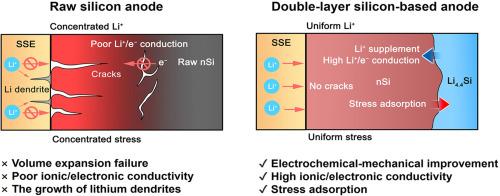
Silicon anode is one of the most promising anode materials for sulfide all-solid-state batteries (ASSBs) due to its high theoretical specific capacity of up to 4200 mAh g−1. However, raw silicon anodes suffer from their intrinsic limitations, including low ionic and electronic conductivity, as well as significant mechanical stress arising from large volume changes during cycling. These factors contribute to the poor cycle life of silicon-based ASSBs. Herein, a double-layer structure composed of lithium-rich Li4.4Si alloy layer and nano silicon (nSi) anode layer, is proposed to address these issues. The double-layer structure enriches Li4.4Si on the current collector side, serving as conductive lithium reservoir that improves the Li+ transport and electron conductivity. The low elastic modulus of Li4.4Si alleviates the mechanical stress induced by volume changes in the silicon upper layer. Finite element analysis indicates that the double-layer design reduces interfacial stress by three times, ensuring effective interfacial contact and providing abundant Li⁺ transport pathways. The ASSBs employing the double layer silicon anode coupled with LiNi0.8Mn0.1Co0.1O2 (NCM811) cathode exhibit exceptional cycle stability, achieving the capacity retention rate of 86.50 % after 200 cycles at 0.5 C. Furthermore, a remarkable cell-level energy density of 308.04 Wh kg−1 was achieved at a high loading of 3.38 mAh cm−2. The double-layer Li4.4Si/nSi anode can be incorporated into pouch cells, demonstrating good cycling stability. This design holds significant potential for the transition of sulfide ASSBs from laboratory-scale development to industrial applications.
硅阳极具有高达4200 mAh g−1的理论比容量,是硫化物全固态电池(assb)最有前途的阳极材料之一。然而,原始硅阳极受到其固有局限性的影响,包括低离子和电子导电性,以及在循环过程中由大体积变化引起的显著机械应力。这些因素导致硅基assb的循环寿命较差。本文提出了一种由富锂锂4.4 si合金层和纳米硅(nSi)阳极层组成的双层结构来解决这些问题。双层结构富集了集流侧的Li4.4Si,作为导电锂储层,提高了Li+输运和电子导电性。Li4.4Si的低弹性模量减轻了硅上层体积变化引起的机械应力。有限元分析表明,双层设计使界面应力降低了三倍,保证了有效的界面接触,并提供了丰富的Li⁺传输途径。采用双层硅阳极和LiNi0.8Mn0.1Co0.1O2 (NCM811)阴极的assb表现出优异的循环稳定性,在0.5 c下进行200次循环后,容量保持率达到86.50%。此外,在3.38 mAh cm−2的高负载下,assb的电池级能量密度达到308.04 Wh kg−1。双层Li4.4Si/nSi阳极可以并入袋状电池中,具有良好的循环稳定性。这种设计对于硫化物assb从实验室规模发展到工业应用的转变具有重要的潜力。
期刊介绍:
Acta Materialia serves as a platform for publishing full-length, original papers and commissioned overviews that contribute to a profound understanding of the correlation between the processing, structure, and properties of inorganic materials. The journal seeks papers with high impact potential or those that significantly propel the field forward. The scope includes the atomic and molecular arrangements, chemical and electronic structures, and microstructure of materials, focusing on their mechanical or functional behavior across all length scales, including nanostructures.




 京公网安备 11010802042870号
京ICP备2023020795号-1
京公网安备 11010802042870号
京ICP备2023020795号-1

 分享
分享
 求助内容:
求助内容: 应助结果提醒方式:
 扫码关注我们
