H.C. Howard , W.S. Cunningham , A. Genc , B.E. Rhodes , B. Merle , T.J. Rupert , D.S. Gianola
{"title":"Chemically ordered dislocation defect phases as a new strengthening pathway in Ni–Al alloys","authors":"H.C. Howard , W.S. Cunningham , A. Genc , B.E. Rhodes , B. Merle , T.J. Rupert , D.S. Gianola","doi":"10.1016/j.actamat.2025.120887","DOIUrl":null,"url":null,"abstract":"<div><div>There is emerging recognition that crystalline defects such as grain boundaries and dislocations can host structural and chemical environments of their own, which reside in local equilibrium with the bulk material. Targeting these defect phases as objects for materials design would promise new avenues to maximize property gains. Here, we provide experimental proof of a dislocation-templated defect phase using a processing strategy designed to engender defect phase transitions in a nickel-based alloy and demonstrate dramatic effects on strengthening. Following heat treatments designed to encourage solute segregation to dislocations, regions with introduced dislocation populations show evidence of nanoscale ordered domains with a <em>L</em>1<span><math><msub><mrow></mrow><mrow><mn>2</mn></mrow></msub></math></span> structure, whereas dislocation-free regions remain as a solid solution. Site-specific spherical nanoindentation in regions hosting dislocations and their associated ordered nanodomains exhibit a 40% increase in mean pop-in load compared to similar regions prior to the segregation heat treatment. Strength estimates based on random solute atmospheres around dislocations are not sufficient to predict our measured strengths. Our mechanical measurements, in tandem with detailed electron microscopy and diffraction of the ordered domains, as well as characterization of dislocations in the vicinity of the nanodomains, establish the defect phase framework via direct observations of chemical and structural ordering near dislocations and its potential for offering favorable properties not achievable through conventional materials design.</div></div>","PeriodicalId":238,"journal":{"name":"Acta Materialia","volume":"289 ","pages":"Article 120887"},"PeriodicalIF":9.3000,"publicationDate":"2025-03-09","publicationTypes":"Journal Article","fieldsOfStudy":null,"isOpenAccess":false,"openAccessPdf":"","citationCount":"0","resultStr":null,"platform":"Semanticscholar","paperid":null,"PeriodicalName":"Acta Materialia","FirstCategoryId":"88","ListUrlMain":"https://www.sciencedirect.com/science/article/pii/S135964542500179X","RegionNum":1,"RegionCategory":"材料科学","ArticlePicture":[],"TitleCN":null,"AbstractTextCN":null,"PMCID":null,"EPubDate":"","PubModel":"","JCR":"Q1","JCRName":"MATERIALS SCIENCE, MULTIDISCIPLINARY","Score":null,"Total":0}
引用次数: 0
Abstract
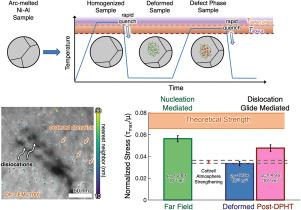
There is emerging recognition that crystalline defects such as grain boundaries and dislocations can host structural and chemical environments of their own, which reside in local equilibrium with the bulk material. Targeting these defect phases as objects for materials design would promise new avenues to maximize property gains. Here, we provide experimental proof of a dislocation-templated defect phase using a processing strategy designed to engender defect phase transitions in a nickel-based alloy and demonstrate dramatic effects on strengthening. Following heat treatments designed to encourage solute segregation to dislocations, regions with introduced dislocation populations show evidence of nanoscale ordered domains with a L1 structure, whereas dislocation-free regions remain as a solid solution. Site-specific spherical nanoindentation in regions hosting dislocations and their associated ordered nanodomains exhibit a 40% increase in mean pop-in load compared to similar regions prior to the segregation heat treatment. Strength estimates based on random solute atmospheres around dislocations are not sufficient to predict our measured strengths. Our mechanical measurements, in tandem with detailed electron microscopy and diffraction of the ordered domains, as well as characterization of dislocations in the vicinity of the nanodomains, establish the defect phase framework via direct observations of chemical and structural ordering near dislocations and its potential for offering favorable properties not achievable through conventional materials design.
期刊介绍:
Acta Materialia serves as a platform for publishing full-length, original papers and commissioned overviews that contribute to a profound understanding of the correlation between the processing, structure, and properties of inorganic materials. The journal seeks papers with high impact potential or those that significantly propel the field forward. The scope includes the atomic and molecular arrangements, chemical and electronic structures, and microstructure of materials, focusing on their mechanical or functional behavior across all length scales, including nanostructures.




 京公网安备 11010802042870号
京ICP备2023020795号-1
京公网安备 11010802042870号
京ICP备2023020795号-1

 分享
分享
 求助内容:
求助内容: 应助结果提醒方式:
 扫码关注我们
