Yan-Lin Hu , Kun Dai , Qing-Ting Wang , Chen-Yuan Zhou , Xing-Chen Huang , Xiao-Fei Yang , He-Liang Pang , Raymond Jianxiong Zeng , Fang Zhang
{"title":"Viscosity is a nonnegligible factor in the waste activated sludge fermentation: Taking hyaluronan as an example","authors":"Yan-Lin Hu , Kun Dai , Qing-Ting Wang , Chen-Yuan Zhou , Xing-Chen Huang , Xiao-Fei Yang , He-Liang Pang , Raymond Jianxiong Zeng , Fang Zhang","doi":"10.1016/j.watres.2025.123465","DOIUrl":null,"url":null,"abstract":"<div><div>The waste activated sludge (WAS) exhibits typical viscoelasticity due to the presence of viscous and gelling organics in extracellular polymeric substances (EPS). However, the positive role of reducing viscosity in WAS fermentation by degrading viscous polysaccharides has been historically overlooked. This work demonstrates the occurrence of viscous hyaluronan-like polysaccharides in the WAS for the first time. Approximately 6.8 % of bacteria, such as <em>Zoogloea</em> (1.0 %), were identified as the potential producers. The viscosity of hyaluronan could be significantly reduced by 99 % within 1 hour by the oriented hyaluronan-degrading consortium (HDC), and a reduction of 20 % was also observed for WAS after 24 h. This resulted in a 18 % improvement in methane production and a 35 % improvement in the maximum production rate in WAS fermentation. The conversion of viscous hyaluronan was mainly through the hyaluronan lyase (EC 4.2.2.1) dependent pathway. An unfamiliar genus of <em>Paludibacter</em> (9.6 %) was identified as a key bacterium, responsible for excreting five extracellular enzymes of EC 4.2.2.1, EC 3.2.1.35, EC 3.2.1.31, EC 3.2.1.52, and EC 3.2.1.180. Consequently, this study has elucidated reducing viscosity as a substantial factor in WAS fermentation by the oriented HDC, thus providing a novel paradigm to enhance methane production.</div></div>","PeriodicalId":443,"journal":{"name":"Water Research","volume":"279 ","pages":"Article 123465"},"PeriodicalIF":12.4000,"publicationDate":"2025-03-08","publicationTypes":"Journal Article","fieldsOfStudy":null,"isOpenAccess":false,"openAccessPdf":"","citationCount":"0","resultStr":null,"platform":"Semanticscholar","paperid":null,"PeriodicalName":"Water Research","FirstCategoryId":"93","ListUrlMain":"https://www.sciencedirect.com/science/article/pii/S0043135425003781","RegionNum":1,"RegionCategory":"环境科学与生态学","ArticlePicture":[],"TitleCN":null,"AbstractTextCN":null,"PMCID":null,"EPubDate":"","PubModel":"","JCR":"Q1","JCRName":"ENGINEERING, ENVIRONMENTAL","Score":null,"Total":0}
引用次数: 0
Abstract
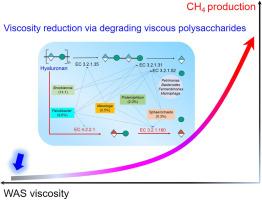
The waste activated sludge (WAS) exhibits typical viscoelasticity due to the presence of viscous and gelling organics in extracellular polymeric substances (EPS). However, the positive role of reducing viscosity in WAS fermentation by degrading viscous polysaccharides has been historically overlooked. This work demonstrates the occurrence of viscous hyaluronan-like polysaccharides in the WAS for the first time. Approximately 6.8 % of bacteria, such as Zoogloea (1.0 %), were identified as the potential producers. The viscosity of hyaluronan could be significantly reduced by 99 % within 1 hour by the oriented hyaluronan-degrading consortium (HDC), and a reduction of 20 % was also observed for WAS after 24 h. This resulted in a 18 % improvement in methane production and a 35 % improvement in the maximum production rate in WAS fermentation. The conversion of viscous hyaluronan was mainly through the hyaluronan lyase (EC 4.2.2.1) dependent pathway. An unfamiliar genus of Paludibacter (9.6 %) was identified as a key bacterium, responsible for excreting five extracellular enzymes of EC 4.2.2.1, EC 3.2.1.35, EC 3.2.1.31, EC 3.2.1.52, and EC 3.2.1.180. Consequently, this study has elucidated reducing viscosity as a substantial factor in WAS fermentation by the oriented HDC, thus providing a novel paradigm to enhance methane production.
期刊介绍:
Water Research, along with its open access companion journal Water Research X, serves as a platform for publishing original research papers covering various aspects of the science and technology related to the anthropogenic water cycle, water quality, and its management worldwide. The audience targeted by the journal comprises biologists, chemical engineers, chemists, civil engineers, environmental engineers, limnologists, and microbiologists. The scope of the journal include:
•Treatment processes for water and wastewaters (municipal, agricultural, industrial, and on-site treatment), including resource recovery and residuals management;
•Urban hydrology including sewer systems, stormwater management, and green infrastructure;
•Drinking water treatment and distribution;
•Potable and non-potable water reuse;
•Sanitation, public health, and risk assessment;
•Anaerobic digestion, solid and hazardous waste management, including source characterization and the effects and control of leachates and gaseous emissions;
•Contaminants (chemical, microbial, anthropogenic particles such as nanoparticles or microplastics) and related water quality sensing, monitoring, fate, and assessment;
•Anthropogenic impacts on inland, tidal, coastal and urban waters, focusing on surface and ground waters, and point and non-point sources of pollution;
•Environmental restoration, linked to surface water, groundwater and groundwater remediation;
•Analysis of the interfaces between sediments and water, and between water and atmosphere, focusing specifically on anthropogenic impacts;
•Mathematical modelling, systems analysis, machine learning, and beneficial use of big data related to the anthropogenic water cycle;
•Socio-economic, policy, and regulations studies.




 京公网安备 11010802042870号
京ICP备2023020795号-1
京公网安备 11010802042870号
京ICP备2023020795号-1

 分享
分享
 求助内容:
求助内容: 应助结果提醒方式:
 扫码关注我们
