{"title":"Multifunctional origami magnetic-responsive soft actuators with modular designs","authors":"Yunhu He, Yicheng Han, Zhen Yu, Wanying Wang, Shiting Chen, Amr Osman, Zhihui Liang, Zhengyi Mao, Zhou Chen, Ying Li, Jian Lu","doi":"10.1016/j.jmst.2025.01.033","DOIUrl":null,"url":null,"abstract":"Soft actuators and stimuli responsive materials are highlighted in the research field for their enormous potential in transit tasks, sensing, and biomedical devices, particularly the magnetic responsive soft actuators driven by magnetic force remotely. Nevertheless, the further study of magnetic responsive actuators with complex three-dimensional geometries and multiple functions is still limited by uncomplicated design and flexible locomotion. This work provides a novel scheme integrating the origami method and modular designs, which defines the inner properties of magnetic material, extending the functions of magnetic responsive actuators with various modules. The directions of the inner magnetic moments can be programmed and the deformation degrees can be regulated by this approach, which promotes the fabrication of complicated soft actuators with multiple functions by integrating with modular designs. Especially, a movable actuator with various sensing modulus is designed by the origami method, which can perform the sensing application to external ultra-violet (UV), heat, and UV stimuli. Moreover, a microneedle modular actuator which can be controlled wirelessly by a magnetic field was demonstrated for the potential application in the biomedical field. This proposed scheme for engineering magnetic responsive material with modular designs has shown great potential to improve the feasibility, versatility, and multiple functionalities of soft actuators.","PeriodicalId":16154,"journal":{"name":"Journal of Materials Science & Technology","volume":"31 1","pages":""},"PeriodicalIF":14.3000,"publicationDate":"2025-03-09","publicationTypes":"Journal Article","fieldsOfStudy":null,"isOpenAccess":false,"openAccessPdf":"","citationCount":"0","resultStr":null,"platform":"Semanticscholar","paperid":null,"PeriodicalName":"Journal of Materials Science & Technology","FirstCategoryId":"88","ListUrlMain":"https://doi.org/10.1016/j.jmst.2025.01.033","RegionNum":1,"RegionCategory":"材料科学","ArticlePicture":[],"TitleCN":null,"AbstractTextCN":null,"PMCID":null,"EPubDate":"","PubModel":"","JCR":"Q1","JCRName":"MATERIALS SCIENCE, MULTIDISCIPLINARY","Score":null,"Total":0}
引用次数: 0
Abstract
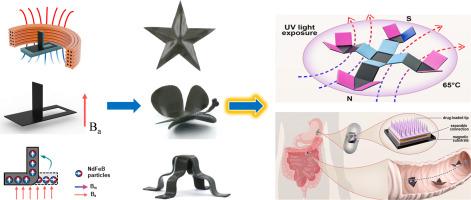
Soft actuators and stimuli responsive materials are highlighted in the research field for their enormous potential in transit tasks, sensing, and biomedical devices, particularly the magnetic responsive soft actuators driven by magnetic force remotely. Nevertheless, the further study of magnetic responsive actuators with complex three-dimensional geometries and multiple functions is still limited by uncomplicated design and flexible locomotion. This work provides a novel scheme integrating the origami method and modular designs, which defines the inner properties of magnetic material, extending the functions of magnetic responsive actuators with various modules. The directions of the inner magnetic moments can be programmed and the deformation degrees can be regulated by this approach, which promotes the fabrication of complicated soft actuators with multiple functions by integrating with modular designs. Especially, a movable actuator with various sensing modulus is designed by the origami method, which can perform the sensing application to external ultra-violet (UV), heat, and UV stimuli. Moreover, a microneedle modular actuator which can be controlled wirelessly by a magnetic field was demonstrated for the potential application in the biomedical field. This proposed scheme for engineering magnetic responsive material with modular designs has shown great potential to improve the feasibility, versatility, and multiple functionalities of soft actuators.
期刊介绍:
Journal of Materials Science & Technology strives to promote global collaboration in the field of materials science and technology. It primarily publishes original research papers, invited review articles, letters, research notes, and summaries of scientific achievements. The journal covers a wide range of materials science and technology topics, including metallic materials, inorganic nonmetallic materials, and composite materials.




 京公网安备 11010802042870号
京ICP备2023020795号-1
京公网安备 11010802042870号
京ICP备2023020795号-1

 分享
分享
 求助内容:
求助内容: 应助结果提醒方式:
 扫码关注我们
