Yibing Zhu , Yuqing Zhang , Chun Shi , Dawei Wang , Haiyan Yang , Jing Yang , Zhengjun Shi
{"title":"A vertical water transfer channel of bamboo-derived high-efficiency evaporator for solar-driven interface water evaporation","authors":"Yibing Zhu , Yuqing Zhang , Chun Shi , Dawei Wang , Haiyan Yang , Jing Yang , Zhengjun Shi","doi":"10.1016/j.indcrop.2025.120822","DOIUrl":null,"url":null,"abstract":"<div><div>Bamboo is recognized as an advanced biomaterial for interfacial solar evaporation. Owing to its rapid growth rate and high throughput transport via its unique vascular bundle pore structure, bamboo outperforms wood in solar evaporator applications. An efficient solar evaporator was developed to facilitate directional vertical water transport, a design inspired by the natural transpiration process of bamboo, designated as AB-PDA@Fe. The efficiency of this design was further enhanced in this study by incorporating iron and polydopamine (PDA) photothermal composites with in situ polymeric loads on their surfaces for thermal management. Contact angle measurements revealed optimal AB-PDA@Fe, indicating an effective water management system. UV–vis–NIR spectrophotometry showed over 90 % light absorption by the AB-PDA@Fe solar evaporator, exhibiting efficient thermal management. The resultant evaporator (AB-PDA@Fe) possesses a unique structure that facilitates vertical water transport, minimizes heat loss, and exhibits exceptional light absorption capabilities, enhancing its evaporative performance. Notably, this evaporator demonstrates an evaporation rate of 3.364 kg m<sup>−2</sup> h<sup>−1</sup>. Furthermore, it exhibits superior decontamination functionality in wastewater treatment, showing potential for harvesting freshwater from contaminated sources for daily human consumption. This study presents an innovative avenue for harnessing bamboo resources and presents new opportunities in using clean energy and biomass materials for seawater desalination.</div></div>","PeriodicalId":13581,"journal":{"name":"Industrial Crops and Products","volume":"227 ","pages":""},"PeriodicalIF":6.2000,"publicationDate":"2025-03-09","publicationTypes":"Journal Article","fieldsOfStudy":null,"isOpenAccess":false,"openAccessPdf":"","citationCount":"0","resultStr":null,"platform":"Semanticscholar","paperid":null,"PeriodicalName":"Industrial Crops and Products","FirstCategoryId":"97","ListUrlMain":"https://www.sciencedirect.com/science/article/pii/S0926669025003681","RegionNum":1,"RegionCategory":"农林科学","ArticlePicture":[],"TitleCN":null,"AbstractTextCN":null,"PMCID":null,"EPubDate":"","PubModel":"","JCR":"Q1","JCRName":"AGRICULTURAL ENGINEERING","Score":null,"Total":0}
引用次数: 0
Abstract
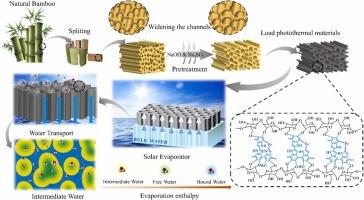
Bamboo is recognized as an advanced biomaterial for interfacial solar evaporation. Owing to its rapid growth rate and high throughput transport via its unique vascular bundle pore structure, bamboo outperforms wood in solar evaporator applications. An efficient solar evaporator was developed to facilitate directional vertical water transport, a design inspired by the natural transpiration process of bamboo, designated as AB-PDA@Fe. The efficiency of this design was further enhanced in this study by incorporating iron and polydopamine (PDA) photothermal composites with in situ polymeric loads on their surfaces for thermal management. Contact angle measurements revealed optimal AB-PDA@Fe, indicating an effective water management system. UV–vis–NIR spectrophotometry showed over 90 % light absorption by the AB-PDA@Fe solar evaporator, exhibiting efficient thermal management. The resultant evaporator (AB-PDA@Fe) possesses a unique structure that facilitates vertical water transport, minimizes heat loss, and exhibits exceptional light absorption capabilities, enhancing its evaporative performance. Notably, this evaporator demonstrates an evaporation rate of 3.364 kg m−2 h−1. Furthermore, it exhibits superior decontamination functionality in wastewater treatment, showing potential for harvesting freshwater from contaminated sources for daily human consumption. This study presents an innovative avenue for harnessing bamboo resources and presents new opportunities in using clean energy and biomass materials for seawater desalination.
竹子被认为是一种先进的界面太阳能蒸发生物材料。由于其快速的生长速度和通过其独特的维管束孔结构的高通量运输,竹子在太阳能蒸发器的应用中优于木材。一个高效的太阳能蒸发器被开发出来,以促进定向垂直水运,设计灵感来自于竹子的自然蒸腾过程,命名为AB-PDA@Fe。在本研究中,通过在铁和聚多巴胺(PDA)光热复合材料表面加入原位聚合物负载进行热管理,进一步提高了该设计的效率。接触角测量显示最佳AB-PDA@Fe,表明有效的水管理系统。紫外-可见-近红外分光光度法显示,AB-PDA@Fe太阳能蒸发器的光吸收率超过90% %,表现出有效的热管理。由此产生的蒸发器(AB-PDA@Fe)具有独特的结构,有利于垂直水输送,最大限度地减少热量损失,并表现出卓越的光吸收能力,提高其蒸发性能。值得注意的是,该蒸发器的蒸发速率为3.364 kg m−2 h−1。此外,它在废水处理中表现出优越的去污功能,显示出从受污染的来源收集淡水供日常人类消费的潜力。该研究为利用竹子资源提供了一条创新途径,并为利用清洁能源和生物质材料进行海水淡化提供了新的机会。
期刊介绍:
Industrial Crops and Products is an International Journal publishing academic and industrial research on industrial (defined as non-food/non-feed) crops and products. Papers concern both crop-oriented and bio-based materials from crops-oriented research, and should be of interest to an international audience, hypothesis driven, and where comparisons are made statistics performed.



 京公网安备 11010802042870号
京ICP备2023020795号-1
京公网安备 11010802042870号
京ICP备2023020795号-1

 分享
分享
 求助内容:
求助内容: 应助结果提醒方式:
 扫码关注我们
