Yong Zheng , Haizhu Wang , Hai Huang , Jun Ni , Bin Wang , Bing Yang , Wentong Zhang
{"title":"CFD-DEM simulation of proppant transport under variable injection strategies in rough fracture network with supercritical CO2","authors":"Yong Zheng , Haizhu Wang , Hai Huang , Jun Ni , Bin Wang , Bing Yang , Wentong Zhang","doi":"10.1016/j.powtec.2025.120856","DOIUrl":null,"url":null,"abstract":"<div><div>Supercritical CO<sub>2</sub> fracturing is a reservoir stimulation technology with broad application prospects, and the effective placement of proppant in the rough fracture network produced by fracturing is the key to determining the stimulation effect of the operating wells. In this study, an experimentally validated computational fluid dynamics-discrete element method (CFD-DEM) model is used to simulate supercritical CO<sub>2</sub> transport proppant in a rough fracture network. The results show that in rough fracture networks, the use of small-sized proppant (0.2 mm) or low-density proppant (1250 kg/m<sup>3</sup>) significantly increases the amount of proppant within branching fractures, as well as the transport distance. Combination injection gives better proppant dune placement compared to single type of proppant injection, where the pumping schedule of larger and then smaller proppant sizes is effective in increasing propping of branching fracture. The efficacy of pulse injection in enhancing proppant transport distance using supercritical CO<sub>2</sub> is significantly constrained by the absence of suitable fiber materials.</div></div>","PeriodicalId":407,"journal":{"name":"Powder Technology","volume":"457 ","pages":"Article 120856"},"PeriodicalIF":4.6000,"publicationDate":"2025-03-01","publicationTypes":"Journal Article","fieldsOfStudy":null,"isOpenAccess":false,"openAccessPdf":"","citationCount":"0","resultStr":null,"platform":"Semanticscholar","paperid":null,"PeriodicalName":"Powder Technology","FirstCategoryId":"5","ListUrlMain":"https://www.sciencedirect.com/science/article/pii/S0032591025002517","RegionNum":2,"RegionCategory":"工程技术","ArticlePicture":[],"TitleCN":null,"AbstractTextCN":null,"PMCID":null,"EPubDate":"","PubModel":"","JCR":"Q2","JCRName":"ENGINEERING, CHEMICAL","Score":null,"Total":0}
引用次数: 0
Abstract
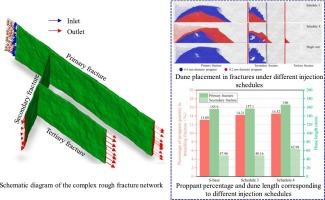
Supercritical CO2 fracturing is a reservoir stimulation technology with broad application prospects, and the effective placement of proppant in the rough fracture network produced by fracturing is the key to determining the stimulation effect of the operating wells. In this study, an experimentally validated computational fluid dynamics-discrete element method (CFD-DEM) model is used to simulate supercritical CO2 transport proppant in a rough fracture network. The results show that in rough fracture networks, the use of small-sized proppant (0.2 mm) or low-density proppant (1250 kg/m3) significantly increases the amount of proppant within branching fractures, as well as the transport distance. Combination injection gives better proppant dune placement compared to single type of proppant injection, where the pumping schedule of larger and then smaller proppant sizes is effective in increasing propping of branching fracture. The efficacy of pulse injection in enhancing proppant transport distance using supercritical CO2 is significantly constrained by the absence of suitable fiber materials.
期刊介绍:
Powder Technology is an International Journal on the Science and Technology of Wet and Dry Particulate Systems. Powder Technology publishes papers on all aspects of the formation of particles and their characterisation and on the study of systems containing particulate solids. No limitation is imposed on the size of the particles, which may range from nanometre scale, as in pigments or aerosols, to that of mined or quarried materials. The following list of topics is not intended to be comprehensive, but rather to indicate typical subjects which fall within the scope of the journal's interests:
Formation and synthesis of particles by precipitation and other methods.
Modification of particles by agglomeration, coating, comminution and attrition.
Characterisation of the size, shape, surface area, pore structure and strength of particles and agglomerates (including the origins and effects of inter particle forces).
Packing, failure, flow and permeability of assemblies of particles.
Particle-particle interactions and suspension rheology.
Handling and processing operations such as slurry flow, fluidization, pneumatic conveying.
Interactions between particles and their environment, including delivery of particulate products to the body.
Applications of particle technology in production of pharmaceuticals, chemicals, foods, pigments, structural, and functional materials and in environmental and energy related matters.
For materials-oriented contributions we are looking for articles revealing the effect of particle/powder characteristics (size, morphology and composition, in that order) on material performance or functionality and, ideally, comparison to any industrial standard.



 京公网安备 11010802042870号
京ICP备2023020795号-1
京公网安备 11010802042870号
京ICP备2023020795号-1

 分享
分享
 求助内容:
求助内容: 应助结果提醒方式:
 扫码关注我们
