Amphiphilic block copolymer conjugated with cell-penetrating-peptides derived from Influenza A H1N1 virus as a biocompatible scaffold for enhanced cell-uptake
Carolina Ventura-Hunter , David Pretzel , Carolin Kellner , Stephanie Hoeppener , Nicole C. Roesner , Patricia Quintana-Owen , Ulrich S. Schubert , Guadalupe Ayora-Talavera , Enrique Saldívar-Guerra , Stefano Fedeli , Carlos Guerrero-Sanchez
{"title":"Amphiphilic block copolymer conjugated with cell-penetrating-peptides derived from Influenza A H1N1 virus as a biocompatible scaffold for enhanced cell-uptake","authors":"Carolina Ventura-Hunter , David Pretzel , Carolin Kellner , Stephanie Hoeppener , Nicole C. Roesner , Patricia Quintana-Owen , Ulrich S. Schubert , Guadalupe Ayora-Talavera , Enrique Saldívar-Guerra , Stefano Fedeli , Carlos Guerrero-Sanchez","doi":"10.1016/j.eurpolymj.2025.113876","DOIUrl":null,"url":null,"abstract":"<div><div>Amphiphilic copolymers prepared by reversible addition-fragmentation chain-transfer (RAFT) polymerization are versatile and biocompatible scaffolds for multiple drug delivery applications. Decorating these structures with biomolecules and targeting moieties is a proven approach to enhance the cell uptake of polymers. In particular, spike proteins on the surface of the influenza A H1N1 virus are biomacromolecules highly evolved to promote cell adhesion and uptake, leading to effective cell-penetrating processes. We harnessed this uptake ability by selecting the peptide sequences responsible for the cell uptake and grafting them on a methacrylate copolymer. The adopted polymeric scaffold included glycerol, butyl, and N-hydroxy succinimide ester (NHS-ester) groups. This polymer resulted in a water-dispersible and biocompatible structure. Moreover, the reactivity of NHS-ester units enabled the modular insertion of the peptide in post-polymerization reactions. Through this approach, we combined the cell penetration efficiency of influenza A H1N1 virus with the easy manipulation of polymers and small biomolecules. The resulting bioconjugate was demonstrated to be a modular, safe, and effective platform for potential intracellular delivery applications.</div></div>","PeriodicalId":315,"journal":{"name":"European Polymer Journal","volume":"229 ","pages":"Article 113876"},"PeriodicalIF":6.3000,"publicationDate":"2025-03-01","publicationTypes":"Journal Article","fieldsOfStudy":null,"isOpenAccess":false,"openAccessPdf":"","citationCount":"0","resultStr":null,"platform":"Semanticscholar","paperid":null,"PeriodicalName":"European Polymer Journal","FirstCategoryId":"92","ListUrlMain":"https://www.sciencedirect.com/science/article/pii/S0014305725001648","RegionNum":2,"RegionCategory":"化学","ArticlePicture":[],"TitleCN":null,"AbstractTextCN":null,"PMCID":null,"EPubDate":"","PubModel":"","JCR":"Q1","JCRName":"POLYMER SCIENCE","Score":null,"Total":0}
引用次数: 0
Abstract
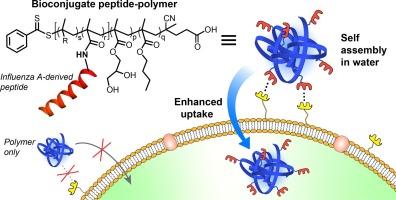
Amphiphilic copolymers prepared by reversible addition-fragmentation chain-transfer (RAFT) polymerization are versatile and biocompatible scaffolds for multiple drug delivery applications. Decorating these structures with biomolecules and targeting moieties is a proven approach to enhance the cell uptake of polymers. In particular, spike proteins on the surface of the influenza A H1N1 virus are biomacromolecules highly evolved to promote cell adhesion and uptake, leading to effective cell-penetrating processes. We harnessed this uptake ability by selecting the peptide sequences responsible for the cell uptake and grafting them on a methacrylate copolymer. The adopted polymeric scaffold included glycerol, butyl, and N-hydroxy succinimide ester (NHS-ester) groups. This polymer resulted in a water-dispersible and biocompatible structure. Moreover, the reactivity of NHS-ester units enabled the modular insertion of the peptide in post-polymerization reactions. Through this approach, we combined the cell penetration efficiency of influenza A H1N1 virus with the easy manipulation of polymers and small biomolecules. The resulting bioconjugate was demonstrated to be a modular, safe, and effective platform for potential intracellular delivery applications.
期刊介绍:
European Polymer Journal is dedicated to publishing work on fundamental and applied polymer chemistry and macromolecular materials. The journal covers all aspects of polymer synthesis, including polymerization mechanisms and chemical functional transformations, with a focus on novel polymers and the relationships between molecular structure and polymer properties. In addition, we welcome submissions on bio-based or renewable polymers, stimuli-responsive systems and polymer bio-hybrids. European Polymer Journal also publishes research on the biomedical application of polymers, including drug delivery and regenerative medicine. The main scope is covered but not limited to the following core research areas:
Polymer synthesis and functionalization
• Novel synthetic routes for polymerization, functional modification, controlled/living polymerization and precision polymers.
Stimuli-responsive polymers
• Including shape memory and self-healing polymers.
Supramolecular polymers and self-assembly
• Molecular recognition and higher order polymer structures.
Renewable and sustainable polymers
• Bio-based, biodegradable and anti-microbial polymers and polymeric bio-nanocomposites.
Polymers at interfaces and surfaces
• Chemistry and engineering of surfaces with biological relevance, including patterning, antifouling polymers and polymers for membrane applications.
Biomedical applications and nanomedicine
• Polymers for regenerative medicine, drug delivery molecular release and gene therapy
The scope of European Polymer Journal no longer includes Polymer Physics.




 京公网安备 11010802042870号
京ICP备2023020795号-1
京公网安备 11010802042870号
京ICP备2023020795号-1

 分享
分享
 求助内容:
求助内容: 应助结果提醒方式:
 扫码关注我们
