Jennifer C. Hughes , James A. Wilson , N. Hawkins , Yi. Zhang , Chris Holland , Andrew T. Slark
{"title":"Compatibilisation of immiscible soft segments in self-healing thermoplastic polyurethane elastomers via Diels-Alder cycloaddition","authors":"Jennifer C. Hughes , James A. Wilson , N. Hawkins , Yi. Zhang , Chris Holland , Andrew T. Slark","doi":"10.1016/j.eurpolymj.2025.113881","DOIUrl":null,"url":null,"abstract":"<div><div>In this work, Diels-Alder (DA) chemistry has been used for the first time to make dual-soft segment thermoplastic polyurethane (TPU) elastomers (<em>M</em><sub>n</sub> = 34,000–42,000 g.mol<sup>−1</sup>) with superior properties from incompatible precursors. Immiscible poly(1,4-butadiene) and poly(ɛ-caprolactone) polyols were used to prepare maleimide and furan-terminated poly(butadiene urethane) (PBU) and poly(ɛ-caprolactone urethane) (PEU) prepolymers (<em>M</em><sub>n</sub> = 7000–8000 g.mol<sup>−1</sup>) from isocyanate terminated intermediates. These prepolymers were subsequently copolymerised <em>via</em> DA-cycloaddition reactions to prepare DA-(PBU<em>-co-</em>PEU) multiblock copolymers comprising 25, 50 and 75 wt.% PBU and PEU segments, which were compared to DA-100PBU or DA-100PEU copolymers containing 100 wt.% PBU or PEU segments. The morphology and thermomechanical properties of the DA-TPUs can be systematically controlled <em>via</em> altering PBU : PEU composition. Copolymers containing ≥75 wt.% PEU segments display predominantly semi-crystalline behaviour, whilst those containing ≤50 wt.% PEU segments exhibit amorphous behaviour. Copolymerisation <em>via</em> DA-cycloaddition enables soft segment compatibilisation providing the composition DA-(50PBU<em>-co-</em>50PEU) with excellent elastomeric properties (increased toughness by a factor of 7 over DA-100PBU and enhanced elastic recovery over DA-100PEU). The elastomers also display excellent thermal reprocessing and healing abilities under mild conditions (≤130 °C), retaining high stress recovery ratios over 85 % and rapidly healing 50 µm defects. The facile methodology established in this study could be applied to compatibilise other immiscible soft segments to obtain recyclable, self-healing materials with unique properties.</div></div>","PeriodicalId":315,"journal":{"name":"European Polymer Journal","volume":"229 ","pages":"Article 113881"},"PeriodicalIF":6.3000,"publicationDate":"2025-04-16","publicationTypes":"Journal Article","fieldsOfStudy":null,"isOpenAccess":false,"openAccessPdf":"","citationCount":"0","resultStr":null,"platform":"Semanticscholar","paperid":null,"PeriodicalName":"European Polymer Journal","FirstCategoryId":"92","ListUrlMain":"https://www.sciencedirect.com/science/article/pii/S0014305725001697","RegionNum":2,"RegionCategory":"化学","ArticlePicture":[],"TitleCN":null,"AbstractTextCN":null,"PMCID":null,"EPubDate":"2025/3/4 0:00:00","PubModel":"Epub","JCR":"Q1","JCRName":"POLYMER SCIENCE","Score":null,"Total":0}
引用次数: 0
Abstract
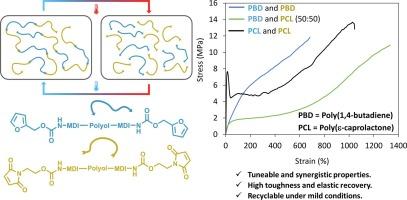
In this work, Diels-Alder (DA) chemistry has been used for the first time to make dual-soft segment thermoplastic polyurethane (TPU) elastomers (Mn = 34,000–42,000 g.mol−1) with superior properties from incompatible precursors. Immiscible poly(1,4-butadiene) and poly(ɛ-caprolactone) polyols were used to prepare maleimide and furan-terminated poly(butadiene urethane) (PBU) and poly(ɛ-caprolactone urethane) (PEU) prepolymers (Mn = 7000–8000 g.mol−1) from isocyanate terminated intermediates. These prepolymers were subsequently copolymerised via DA-cycloaddition reactions to prepare DA-(PBU-co-PEU) multiblock copolymers comprising 25, 50 and 75 wt.% PBU and PEU segments, which were compared to DA-100PBU or DA-100PEU copolymers containing 100 wt.% PBU or PEU segments. The morphology and thermomechanical properties of the DA-TPUs can be systematically controlled via altering PBU : PEU composition. Copolymers containing ≥75 wt.% PEU segments display predominantly semi-crystalline behaviour, whilst those containing ≤50 wt.% PEU segments exhibit amorphous behaviour. Copolymerisation via DA-cycloaddition enables soft segment compatibilisation providing the composition DA-(50PBU-co-50PEU) with excellent elastomeric properties (increased toughness by a factor of 7 over DA-100PBU and enhanced elastic recovery over DA-100PEU). The elastomers also display excellent thermal reprocessing and healing abilities under mild conditions (≤130 °C), retaining high stress recovery ratios over 85 % and rapidly healing 50 µm defects. The facile methodology established in this study could be applied to compatibilise other immiscible soft segments to obtain recyclable, self-healing materials with unique properties.
期刊介绍:
European Polymer Journal is dedicated to publishing work on fundamental and applied polymer chemistry and macromolecular materials. The journal covers all aspects of polymer synthesis, including polymerization mechanisms and chemical functional transformations, with a focus on novel polymers and the relationships between molecular structure and polymer properties. In addition, we welcome submissions on bio-based or renewable polymers, stimuli-responsive systems and polymer bio-hybrids. European Polymer Journal also publishes research on the biomedical application of polymers, including drug delivery and regenerative medicine. The main scope is covered but not limited to the following core research areas:
Polymer synthesis and functionalization
• Novel synthetic routes for polymerization, functional modification, controlled/living polymerization and precision polymers.
Stimuli-responsive polymers
• Including shape memory and self-healing polymers.
Supramolecular polymers and self-assembly
• Molecular recognition and higher order polymer structures.
Renewable and sustainable polymers
• Bio-based, biodegradable and anti-microbial polymers and polymeric bio-nanocomposites.
Polymers at interfaces and surfaces
• Chemistry and engineering of surfaces with biological relevance, including patterning, antifouling polymers and polymers for membrane applications.
Biomedical applications and nanomedicine
• Polymers for regenerative medicine, drug delivery molecular release and gene therapy
The scope of European Polymer Journal no longer includes Polymer Physics.



 京公网安备 11010802042870号
京ICP备2023020795号-1
京公网安备 11010802042870号
京ICP备2023020795号-1

 分享
分享
 求助内容:
求助内容: 应助结果提醒方式:
 扫码关注我们
