Zichen Zhao , Yupeng Liu , Jie Li , Guozhao Ren , Xiaolu Yuan , Mingming Guo , Liangxian Chen , Jianjun Zhang , Junjun Wei , Jianlin Li , Jinlong Liu , Chengming Li
{"title":"Atomically flat high-purity (100) diamond surfaces: Conductivity of hydrogen terminated diamond","authors":"Zichen Zhao , Yupeng Liu , Jie Li , Guozhao Ren , Xiaolu Yuan , Mingming Guo , Liangxian Chen , Jianjun Zhang , Junjun Wei , Jianlin Li , Jinlong Liu , Chengming Li","doi":"10.1016/j.diamond.2025.112181","DOIUrl":null,"url":null,"abstract":"<div><div>As an ideal candidate material for semiconductor devices, diamond exhibits remarkable potential in high-frequency and high-power applications due to its unique electrical properties. However, surface and bulk defects significantly impede its semiconductor performance due to the surface roughness scattering and impurity ionization scattering. In this work, based on the high-purity diamond materials with impurity levels below 5 ppb, atomic-level surface planarization of (100) single-crystal diamond (SCD) was achieved using a combination of mechanical polishing and chemical mechanical polishing (CMP) techniques. The effects of the surface roughness on the surface conductivity of hydrogen-terminated diamond were systematically evaluated. The results demonstrate that subsurface damage on the CMP diamond surface is removed through oxidation, reducing the surface roughness to Ra = 0.0973 nm over a 5 × 5 μm<sup>2</sup> area. Following hydrogenation treatment, the surface sheet resistance of hydrogen-terminated diamond with atomic-level flatness was significantly reduced to 1.03 kΩ/□, accompanied by a carrier mobility of 237 cm<sup>2</sup>/Vs. These findings confirm that CMP polishing significantly enhances the conductivity of hydrogen-terminated diamond. This work provides theoretical insights and technical guidance for the fabrication of high-performance diamond-based semiconductor devices.</div></div>","PeriodicalId":11266,"journal":{"name":"Diamond and Related Materials","volume":"154 ","pages":"Article 112181"},"PeriodicalIF":5.1000,"publicationDate":"2025-04-01","publicationTypes":"Journal Article","fieldsOfStudy":null,"isOpenAccess":false,"openAccessPdf":"","citationCount":"0","resultStr":null,"platform":"Semanticscholar","paperid":null,"PeriodicalName":"Diamond and Related Materials","FirstCategoryId":"88","ListUrlMain":"https://www.sciencedirect.com/science/article/pii/S0925963525002389","RegionNum":3,"RegionCategory":"材料科学","ArticlePicture":[],"TitleCN":null,"AbstractTextCN":null,"PMCID":null,"EPubDate":"2025/3/4 0:00:00","PubModel":"Epub","JCR":"Q2","JCRName":"MATERIALS SCIENCE, COATINGS & FILMS","Score":null,"Total":0}
引用次数: 0
Abstract
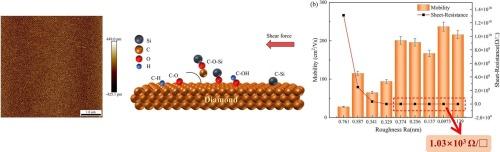
As an ideal candidate material for semiconductor devices, diamond exhibits remarkable potential in high-frequency and high-power applications due to its unique electrical properties. However, surface and bulk defects significantly impede its semiconductor performance due to the surface roughness scattering and impurity ionization scattering. In this work, based on the high-purity diamond materials with impurity levels below 5 ppb, atomic-level surface planarization of (100) single-crystal diamond (SCD) was achieved using a combination of mechanical polishing and chemical mechanical polishing (CMP) techniques. The effects of the surface roughness on the surface conductivity of hydrogen-terminated diamond were systematically evaluated. The results demonstrate that subsurface damage on the CMP diamond surface is removed through oxidation, reducing the surface roughness to Ra = 0.0973 nm over a 5 × 5 μm2 area. Following hydrogenation treatment, the surface sheet resistance of hydrogen-terminated diamond with atomic-level flatness was significantly reduced to 1.03 kΩ/□, accompanied by a carrier mobility of 237 cm2/Vs. These findings confirm that CMP polishing significantly enhances the conductivity of hydrogen-terminated diamond. This work provides theoretical insights and technical guidance for the fabrication of high-performance diamond-based semiconductor devices.
期刊介绍:
DRM is a leading international journal that publishes new fundamental and applied research on all forms of diamond, the integration of diamond with other advanced materials and development of technologies exploiting diamond. The synthesis, characterization and processing of single crystal diamond, polycrystalline films, nanodiamond powders and heterostructures with other advanced materials are encouraged topics for technical and review articles. In addition to diamond, the journal publishes manuscripts on the synthesis, characterization and application of other related materials including diamond-like carbons, carbon nanotubes, graphene, and boron and carbon nitrides. Articles are sought on the chemical functionalization of diamond and related materials as well as their use in electrochemistry, energy storage and conversion, chemical and biological sensing, imaging, thermal management, photonic and quantum applications, electron emission and electronic devices.
The International Conference on Diamond and Carbon Materials has evolved into the largest and most well attended forum in the field of diamond, providing a forum to showcase the latest results in the science and technology of diamond and other carbon materials such as carbon nanotubes, graphene, and diamond-like carbon. Run annually in association with Diamond and Related Materials the conference provides junior and established researchers the opportunity to exchange the latest results ranging from fundamental physical and chemical concepts to applied research focusing on the next generation carbon-based devices.



 京公网安备 11010802042870号
京ICP备2023020795号-1
京公网安备 11010802042870号
京ICP备2023020795号-1

 分享
分享
 求助内容:
求助内容: 应助结果提醒方式:
 扫码关注我们
