Advanced CuMnCr-LDH modified glassy carbon electrode for simultaneous electrochemical quantification of cabotegravir and paracetamol in biological and pharmaceutical samples
Wiem Bouali , Asena Ayse Genc , Nevin Erk , Hassan Elzain Hassan Ahmed , Mustafa Soylak
{"title":"Advanced CuMnCr-LDH modified glassy carbon electrode for simultaneous electrochemical quantification of cabotegravir and paracetamol in biological and pharmaceutical samples","authors":"Wiem Bouali , Asena Ayse Genc , Nevin Erk , Hassan Elzain Hassan Ahmed , Mustafa Soylak","doi":"10.1016/j.microc.2025.113267","DOIUrl":null,"url":null,"abstract":"<div><div>The simultaneous detection of antiviral and analgesic drugs in biological samples is critical for effective drug therapy monitoring. In this study, a novel electrochemical sensor was developed for the concurrent determination of the antiviral drug Cabotegravir (CABO) and the analgesic Paracetamol (PARA). The sensor was fabricated by modifying a glassy carbon electrode (GCE) with a CuMnCr-LDH nanocomposite, which served as an efficient electrocatalyst. The electrochemical properties of the modified electrode were characterized by cyclic voltammetry (CV) and electrochemical impedance spectroscopy (EIS). The novel CuMnCr-LDH composite exhibits exceptional electrocatalytic activity due to its numerous active sites, reduced charge-transfer resistance, and rapid electron transfer. The sensor’s performance for simultaneous CABO and PARA detection was assessed using CV and differential pulse voltammetry (DPV) techniques. Under optimized conditions, the sensor demonstrated excellent sensitivity with linear ranges of 0.06–28.3 μM for CABO and 0.4–53 μM for PARA and detection limits (LOD) of 0.028 μM and 0.19 μM, respectively. Furthermore, the sensor demonstrated excellent reliability and accuracy when applied to pharmaceutical and biological samples, showcasing its potential for real-world applications in clinical and pharmaceutical settings.</div></div>","PeriodicalId":391,"journal":{"name":"Microchemical Journal","volume":"212 ","pages":"Article 113267"},"PeriodicalIF":4.9000,"publicationDate":"2025-05-01","publicationTypes":"Journal Article","fieldsOfStudy":null,"isOpenAccess":false,"openAccessPdf":"","citationCount":"0","resultStr":null,"platform":"Semanticscholar","paperid":null,"PeriodicalName":"Microchemical Journal","FirstCategoryId":"92","ListUrlMain":"https://www.sciencedirect.com/science/article/pii/S0026265X25006228","RegionNum":2,"RegionCategory":"化学","ArticlePicture":[],"TitleCN":null,"AbstractTextCN":null,"PMCID":null,"EPubDate":"2025/3/6 0:00:00","PubModel":"Epub","JCR":"Q1","JCRName":"CHEMISTRY, ANALYTICAL","Score":null,"Total":0}
引用次数: 0
Abstract
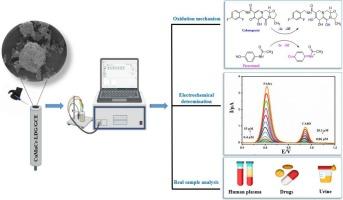
The simultaneous detection of antiviral and analgesic drugs in biological samples is critical for effective drug therapy monitoring. In this study, a novel electrochemical sensor was developed for the concurrent determination of the antiviral drug Cabotegravir (CABO) and the analgesic Paracetamol (PARA). The sensor was fabricated by modifying a glassy carbon electrode (GCE) with a CuMnCr-LDH nanocomposite, which served as an efficient electrocatalyst. The electrochemical properties of the modified electrode were characterized by cyclic voltammetry (CV) and electrochemical impedance spectroscopy (EIS). The novel CuMnCr-LDH composite exhibits exceptional electrocatalytic activity due to its numerous active sites, reduced charge-transfer resistance, and rapid electron transfer. The sensor’s performance for simultaneous CABO and PARA detection was assessed using CV and differential pulse voltammetry (DPV) techniques. Under optimized conditions, the sensor demonstrated excellent sensitivity with linear ranges of 0.06–28.3 μM for CABO and 0.4–53 μM for PARA and detection limits (LOD) of 0.028 μM and 0.19 μM, respectively. Furthermore, the sensor demonstrated excellent reliability and accuracy when applied to pharmaceutical and biological samples, showcasing its potential for real-world applications in clinical and pharmaceutical settings.
期刊介绍:
The Microchemical Journal is a peer reviewed journal devoted to all aspects and phases of analytical chemistry and chemical analysis. The Microchemical Journal publishes articles which are at the forefront of modern analytical chemistry and cover innovations in the techniques to the finest possible limits. This includes fundamental aspects, instrumentation, new developments, innovative and novel methods and applications including environmental and clinical field.
Traditional classical analytical methods such as spectrophotometry and titrimetry as well as established instrumentation methods such as flame and graphite furnace atomic absorption spectrometry, gas chromatography, and modified glassy or carbon electrode electrochemical methods will be considered, provided they show significant improvements and novelty compared to the established methods.



 京公网安备 11010802042870号
京ICP备2023020795号-1
京公网安备 11010802042870号
京ICP备2023020795号-1

 分享
分享
 求助内容:
求助内容: 应助结果提醒方式:
 扫码关注我们
