Jie Cui , Yuxin Xia , Leilei Jin , Jishuang Chen , Zongli Huo , Fei Shen , Li Mi
{"title":"A highly sensitive and anti-interference Bio-QDs biosensor for electrochemical detection calcium ion in plant tissue culture medium","authors":"Jie Cui , Yuxin Xia , Leilei Jin , Jishuang Chen , Zongli Huo , Fei Shen , Li Mi","doi":"10.1016/j.microc.2025.113284","DOIUrl":null,"url":null,"abstract":"<div><div>Metal ions are widely present in biological systems and participate in many critical biochemical processes. Resisting interfering ions and achieving specific detection at the biosensor present a significant challenge. Herein, we designed a highly sensitive and anti-interference Bio-QDs biosensor through the biosynthesis CdSe quantum dots (QDs) and the use of sodium hexametaphosphate (HMP) as a stabilizer (CdSe QD@HMP) for detecting the calcium ion (Ca<sup>2+</sup>) in plant tissue culture medium, which is known for its complexity. Because of the spatial hexahedron molecular structure and six interconnected tetrahedral P-O units of HMP increased the electronegativity and stability of CdSe, the CdSe QD@HMP easily captured Ca<sup>2+</sup> in solution, resulting in a minimum detection limit of 0.377 µM for Ca<sup>2+</sup> in the range of 1–300 μM. And HMP can also ensure that the detection process is not affected by negative ion interference. Additionally, the recovery rate of environmental samples was 96.40 % and 101.13 %, confirming the reliability and practicality of the prepared biosensors. Therefore, this strategy not only provides a green and safe pathway for synthesizing QDs, but also lays the foundation for the sensitive determination of metal cations in complex environment.</div></div>","PeriodicalId":391,"journal":{"name":"Microchemical Journal","volume":"212 ","pages":"Article 113284"},"PeriodicalIF":4.9000,"publicationDate":"2025-05-01","publicationTypes":"Journal Article","fieldsOfStudy":null,"isOpenAccess":false,"openAccessPdf":"","citationCount":"0","resultStr":null,"platform":"Semanticscholar","paperid":null,"PeriodicalName":"Microchemical Journal","FirstCategoryId":"92","ListUrlMain":"https://www.sciencedirect.com/science/article/pii/S0026265X25006393","RegionNum":2,"RegionCategory":"化学","ArticlePicture":[],"TitleCN":null,"AbstractTextCN":null,"PMCID":null,"EPubDate":"2025/3/6 0:00:00","PubModel":"Epub","JCR":"Q1","JCRName":"CHEMISTRY, ANALYTICAL","Score":null,"Total":0}
引用次数: 0
Abstract
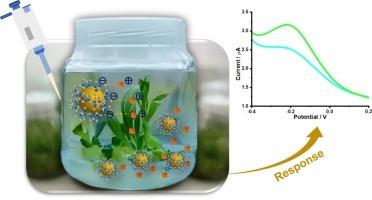
Metal ions are widely present in biological systems and participate in many critical biochemical processes. Resisting interfering ions and achieving specific detection at the biosensor present a significant challenge. Herein, we designed a highly sensitive and anti-interference Bio-QDs biosensor through the biosynthesis CdSe quantum dots (QDs) and the use of sodium hexametaphosphate (HMP) as a stabilizer (CdSe QD@HMP) for detecting the calcium ion (Ca2+) in plant tissue culture medium, which is known for its complexity. Because of the spatial hexahedron molecular structure and six interconnected tetrahedral P-O units of HMP increased the electronegativity and stability of CdSe, the CdSe QD@HMP easily captured Ca2+ in solution, resulting in a minimum detection limit of 0.377 µM for Ca2+ in the range of 1–300 μM. And HMP can also ensure that the detection process is not affected by negative ion interference. Additionally, the recovery rate of environmental samples was 96.40 % and 101.13 %, confirming the reliability and practicality of the prepared biosensors. Therefore, this strategy not only provides a green and safe pathway for synthesizing QDs, but also lays the foundation for the sensitive determination of metal cations in complex environment.
期刊介绍:
The Microchemical Journal is a peer reviewed journal devoted to all aspects and phases of analytical chemistry and chemical analysis. The Microchemical Journal publishes articles which are at the forefront of modern analytical chemistry and cover innovations in the techniques to the finest possible limits. This includes fundamental aspects, instrumentation, new developments, innovative and novel methods and applications including environmental and clinical field.
Traditional classical analytical methods such as spectrophotometry and titrimetry as well as established instrumentation methods such as flame and graphite furnace atomic absorption spectrometry, gas chromatography, and modified glassy or carbon electrode electrochemical methods will be considered, provided they show significant improvements and novelty compared to the established methods.



 京公网安备 11010802042870号
京ICP备2023020795号-1
京公网安备 11010802042870号
京ICP备2023020795号-1

 分享
分享
 求助内容:
求助内容: 应助结果提醒方式:
 扫码关注我们
