Roberto Magalhães , Nádia T. Paiva , Fernão D. Magalhães , F.G. Martins
{"title":"Prediction of amino resin solids content with PLS based on NIR: Improving model performance using a data balancing strategy","authors":"Roberto Magalhães , Nádia T. Paiva , Fernão D. Magalhães , F.G. Martins","doi":"10.1016/j.microc.2025.113279","DOIUrl":null,"url":null,"abstract":"<div><div>Monitoring the solids content (SC) of amino resins plays a significant role in reducing costs and increasing production efficiency in the wood-based panels (WBP) industry. The goal of this study was to use NIR spectroscopy and regression-based methods for predicting SC in amino resins. Several wavenumber intervals were investigated to determine the best regions of the spectrum for model improvement. To address dataset imbalances, an oversampling technique was used, resulting in a more accurate representation of underrepresented SC values in the initial dataset.</div><div>The calibration and test set splitting were performed using the random (RD) method, as well as the Sample set Partitioning based on joint X–Y distances (SPXY) and Kennard-Stone (KS) methods, which improved model reliability by providing calibration data that covered the entire input space. Predictive models were developed using Partial Least Squares (PLS) regression, with the number of latent variables optimized through 10-fold cross-validation. Combining wavenumber interval selection, oversampling, and the KS split enabled significantly improved prediction performance metrics and robustness. This approach provides an effective alternative for the WBP industry, allowing for more efficient and robust quality control of amino resins. The best model had a maximum absolute error of 0.3 % on the test set, which was comparable to the performance of the reference method, demonstrating its potential for use in industrial applications.</div></div>","PeriodicalId":391,"journal":{"name":"Microchemical Journal","volume":"212 ","pages":"Article 113279"},"PeriodicalIF":4.9000,"publicationDate":"2025-03-06","publicationTypes":"Journal Article","fieldsOfStudy":null,"isOpenAccess":false,"openAccessPdf":"","citationCount":"0","resultStr":null,"platform":"Semanticscholar","paperid":null,"PeriodicalName":"Microchemical Journal","FirstCategoryId":"92","ListUrlMain":"https://www.sciencedirect.com/science/article/pii/S0026265X25006344","RegionNum":2,"RegionCategory":"化学","ArticlePicture":[],"TitleCN":null,"AbstractTextCN":null,"PMCID":null,"EPubDate":"","PubModel":"","JCR":"Q1","JCRName":"CHEMISTRY, ANALYTICAL","Score":null,"Total":0}
引用次数: 0
Abstract
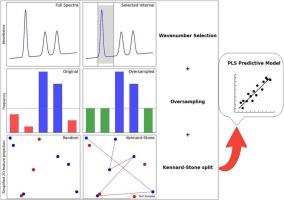
Monitoring the solids content (SC) of amino resins plays a significant role in reducing costs and increasing production efficiency in the wood-based panels (WBP) industry. The goal of this study was to use NIR spectroscopy and regression-based methods for predicting SC in amino resins. Several wavenumber intervals were investigated to determine the best regions of the spectrum for model improvement. To address dataset imbalances, an oversampling technique was used, resulting in a more accurate representation of underrepresented SC values in the initial dataset.
The calibration and test set splitting were performed using the random (RD) method, as well as the Sample set Partitioning based on joint X–Y distances (SPXY) and Kennard-Stone (KS) methods, which improved model reliability by providing calibration data that covered the entire input space. Predictive models were developed using Partial Least Squares (PLS) regression, with the number of latent variables optimized through 10-fold cross-validation. Combining wavenumber interval selection, oversampling, and the KS split enabled significantly improved prediction performance metrics and robustness. This approach provides an effective alternative for the WBP industry, allowing for more efficient and robust quality control of amino resins. The best model had a maximum absolute error of 0.3 % on the test set, which was comparable to the performance of the reference method, demonstrating its potential for use in industrial applications.
期刊介绍:
The Microchemical Journal is a peer reviewed journal devoted to all aspects and phases of analytical chemistry and chemical analysis. The Microchemical Journal publishes articles which are at the forefront of modern analytical chemistry and cover innovations in the techniques to the finest possible limits. This includes fundamental aspects, instrumentation, new developments, innovative and novel methods and applications including environmental and clinical field.
Traditional classical analytical methods such as spectrophotometry and titrimetry as well as established instrumentation methods such as flame and graphite furnace atomic absorption spectrometry, gas chromatography, and modified glassy or carbon electrode electrochemical methods will be considered, provided they show significant improvements and novelty compared to the established methods.



 京公网安备 11010802042870号
京ICP备2023020795号-1
京公网安备 11010802042870号
京ICP备2023020795号-1

 分享
分享
 求助内容:
求助内容: 应助结果提醒方式:
 扫码关注我们
