Suqi Liu , Xiaowei Wu , Shihao Chen , Cong Liu , Wanqi Zhang , Mingyi Yang , Jiyu Cheng , Guoquan Lu , Zhenhe Wang , Wei Chen , Yuge Guan , Linjiang Pang , Xinghua Lu
{"title":"Rapid detection of linalool by QCM gas sensor based on HKUST-1/MWCNT-gel@MIP in early sweetpotato black spot disease","authors":"Suqi Liu , Xiaowei Wu , Shihao Chen , Cong Liu , Wanqi Zhang , Mingyi Yang , Jiyu Cheng , Guoquan Lu , Zhenhe Wang , Wei Chen , Yuge Guan , Linjiang Pang , Xinghua Lu","doi":"10.1016/j.microc.2025.113232","DOIUrl":null,"url":null,"abstract":"<div><div>Linalool, a terpenoid alcohol with bacteriostatic properties, was detected in sweetpotato suffering from black spot disease. In this research, a composite material based on HKUST-1/MWCNT-gel@MIP was employed to detect the linalool content in these infected sweetpotatoes. The micro-morphology and crystal structure of the composite were characterized using scanning electron microscopy (SEM), fourier transform infrared (FTIR), and x-ray diffraction (XRD). Experimental results demonstrated that the quartz crystal microbalance (QCM) gas sensor of HKUST-1/MWCNT-gel@MIP composite exhibited high sensitivity (0.873 Hz/ppm), a low detection limit (0.237 ppm), a small standard deviation (0.83 %), good reproducibility, and outstanding selectivity. The QCM gas sensor data from actual samples showed a strong correlation with gas chromatography-mass spectrometry (GC–MS) results (r = −0.976, p < 0.01), demonstrating its exceptional ability to identify linalool. Thus, it can be used for early detection of sweetpotato black spot disease.</div></div>","PeriodicalId":391,"journal":{"name":"Microchemical Journal","volume":"212 ","pages":"Article 113232"},"PeriodicalIF":4.9000,"publicationDate":"2025-05-01","publicationTypes":"Journal Article","fieldsOfStudy":null,"isOpenAccess":false,"openAccessPdf":"","citationCount":"0","resultStr":null,"platform":"Semanticscholar","paperid":null,"PeriodicalName":"Microchemical Journal","FirstCategoryId":"92","ListUrlMain":"https://www.sciencedirect.com/science/article/pii/S0026265X25005867","RegionNum":2,"RegionCategory":"化学","ArticlePicture":[],"TitleCN":null,"AbstractTextCN":null,"PMCID":null,"EPubDate":"2025/3/6 0:00:00","PubModel":"Epub","JCR":"Q1","JCRName":"CHEMISTRY, ANALYTICAL","Score":null,"Total":0}
引用次数: 0
Abstract
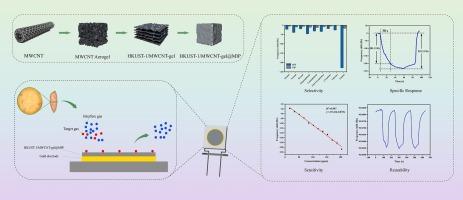
Linalool, a terpenoid alcohol with bacteriostatic properties, was detected in sweetpotato suffering from black spot disease. In this research, a composite material based on HKUST-1/MWCNT-gel@MIP was employed to detect the linalool content in these infected sweetpotatoes. The micro-morphology and crystal structure of the composite were characterized using scanning electron microscopy (SEM), fourier transform infrared (FTIR), and x-ray diffraction (XRD). Experimental results demonstrated that the quartz crystal microbalance (QCM) gas sensor of HKUST-1/MWCNT-gel@MIP composite exhibited high sensitivity (0.873 Hz/ppm), a low detection limit (0.237 ppm), a small standard deviation (0.83 %), good reproducibility, and outstanding selectivity. The QCM gas sensor data from actual samples showed a strong correlation with gas chromatography-mass spectrometry (GC–MS) results (r = −0.976, p < 0.01), demonstrating its exceptional ability to identify linalool. Thus, it can be used for early detection of sweetpotato black spot disease.
期刊介绍:
The Microchemical Journal is a peer reviewed journal devoted to all aspects and phases of analytical chemistry and chemical analysis. The Microchemical Journal publishes articles which are at the forefront of modern analytical chemistry and cover innovations in the techniques to the finest possible limits. This includes fundamental aspects, instrumentation, new developments, innovative and novel methods and applications including environmental and clinical field.
Traditional classical analytical methods such as spectrophotometry and titrimetry as well as established instrumentation methods such as flame and graphite furnace atomic absorption spectrometry, gas chromatography, and modified glassy or carbon electrode electrochemical methods will be considered, provided they show significant improvements and novelty compared to the established methods.




 京公网安备 11010802042870号
京ICP备2023020795号-1
京公网安备 11010802042870号
京ICP备2023020795号-1

 分享
分享
 求助内容:
求助内容: 应助结果提醒方式:
 扫码关注我们
