Ratiometric colorimetric and fluorometric dual-sensing system based on anthracene derivatives for the determination of ClO− and total antioxidant capacity
Yan Zhang , Binling Yan , Bing Liu , Yuting Wang , Wenjing Qi , Lianzhe Hu , Jiaxing Song
{"title":"Ratiometric colorimetric and fluorometric dual-sensing system based on anthracene derivatives for the determination of ClO− and total antioxidant capacity","authors":"Yan Zhang , Binling Yan , Bing Liu , Yuting Wang , Wenjing Qi , Lianzhe Hu , Jiaxing Song","doi":"10.1016/j.microc.2025.113234","DOIUrl":null,"url":null,"abstract":"<div><div>In this work, a fluorescent small molecule based on 9,10-distyryl anthracene (DSA-2OH) with AIE properties was prepared. DSA-2OH can be oxidized by hypochlorite (ClO<sup>−</sup>) to oxidized DSA (ODSA), which can be re-reduced to DSA-2OH by reducing agents. This oxidation–reduction process is accompanied by changes in fluorescence intensity and absorption wavelength. Based on this principle, a colorimetric/fluorometric dual-mode assay for the determination of ClO<sup>−</sup> and the total antioxidant capacity (TAC) are realized. In contrast to the colorimetric method, the fluorometric method has better detection effect. The fluorometric detection method can detect ClO<sup>−</sup> and ascorbic acid (AA) in a three-order-of-magnitude concentration range (0.1–20 μM and 0.2–30 μM). The detection limits (LOD) of fluorometric methods for ClO<sup>−</sup> and AA are 44 nM and 55 nM, respectively. The two methods can mutually validate each other to improve detection accuracy. The proposed assay can detect TAC in drinks such as orange juice, kiwi juice and drinking water with recoveries ranging from 95 % to 105 %, which can help us to make healthier and more sensible dietary choices.</div></div>","PeriodicalId":391,"journal":{"name":"Microchemical Journal","volume":"212 ","pages":"Article 113234"},"PeriodicalIF":4.9000,"publicationDate":"2025-05-01","publicationTypes":"Journal Article","fieldsOfStudy":null,"isOpenAccess":false,"openAccessPdf":"","citationCount":"0","resultStr":null,"platform":"Semanticscholar","paperid":null,"PeriodicalName":"Microchemical Journal","FirstCategoryId":"92","ListUrlMain":"https://www.sciencedirect.com/science/article/pii/S0026265X25005880","RegionNum":2,"RegionCategory":"化学","ArticlePicture":[],"TitleCN":null,"AbstractTextCN":null,"PMCID":null,"EPubDate":"2025/3/6 0:00:00","PubModel":"Epub","JCR":"Q1","JCRName":"CHEMISTRY, ANALYTICAL","Score":null,"Total":0}
引用次数: 0
Abstract
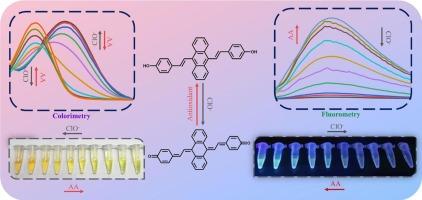
In this work, a fluorescent small molecule based on 9,10-distyryl anthracene (DSA-2OH) with AIE properties was prepared. DSA-2OH can be oxidized by hypochlorite (ClO−) to oxidized DSA (ODSA), which can be re-reduced to DSA-2OH by reducing agents. This oxidation–reduction process is accompanied by changes in fluorescence intensity and absorption wavelength. Based on this principle, a colorimetric/fluorometric dual-mode assay for the determination of ClO− and the total antioxidant capacity (TAC) are realized. In contrast to the colorimetric method, the fluorometric method has better detection effect. The fluorometric detection method can detect ClO− and ascorbic acid (AA) in a three-order-of-magnitude concentration range (0.1–20 μM and 0.2–30 μM). The detection limits (LOD) of fluorometric methods for ClO− and AA are 44 nM and 55 nM, respectively. The two methods can mutually validate each other to improve detection accuracy. The proposed assay can detect TAC in drinks such as orange juice, kiwi juice and drinking water with recoveries ranging from 95 % to 105 %, which can help us to make healthier and more sensible dietary choices.
期刊介绍:
The Microchemical Journal is a peer reviewed journal devoted to all aspects and phases of analytical chemistry and chemical analysis. The Microchemical Journal publishes articles which are at the forefront of modern analytical chemistry and cover innovations in the techniques to the finest possible limits. This includes fundamental aspects, instrumentation, new developments, innovative and novel methods and applications including environmental and clinical field.
Traditional classical analytical methods such as spectrophotometry and titrimetry as well as established instrumentation methods such as flame and graphite furnace atomic absorption spectrometry, gas chromatography, and modified glassy or carbon electrode electrochemical methods will be considered, provided they show significant improvements and novelty compared to the established methods.




 京公网安备 11010802042870号
京ICP备2023020795号-1
京公网安备 11010802042870号
京ICP备2023020795号-1

 分享
分享
 求助内容:
求助内容: 应助结果提醒方式:
 扫码关注我们
