Esmaeil Babaei , Shukur Wasman smail , Salah Tofik Jalal Balaky , Noor Mohsin Hadi , Hewa Jalal Azeez
{"title":"Nanozyme-assisted CRISPR/Cas systems as an emerging platform for food safety applications: Recent advances","authors":"Esmaeil Babaei , Shukur Wasman smail , Salah Tofik Jalal Balaky , Noor Mohsin Hadi , Hewa Jalal Azeez","doi":"10.1016/j.microc.2025.113270","DOIUrl":null,"url":null,"abstract":"<div><div>It is of paramount importance to establish user-friendly, consensus-driven, and conceptually novel techniques for ensuring food safety. The CRISPR/Cas system represents an emerging technology with exceptional capabilities for targeting RNA and DNA. It has been repurposed as a robust tool for the diagnosis of nucleic acids. Nevertheless, most CRISPR-based techniques rely on specialized detection equipment and expensive reporters, despite their exceptional accuracy and rapid analysis capabilities. Recently, nanozymes have been integrated into CRISPR/Cas-based biosensors due to their low cost, good stability, higher recycling efficiency, simpler preparation processes, and more robust catalytic functions. Therefore, significant efforts have been devoted to the advancement of nanozyme-integrated CRISPR/Cas-derived biosensors for the analysis of various targets. This review focuses on the recent developments in nanozyme-assisted CRISPR/Cas systems-based biosensors, with particular emphasis on the detection principles and performance of these platforms. The principles and properties of commonly employed CRISPR/Cas systems are outlined. Additionally, the application of nanozyme-assisted CRISPR/Cas systems in food safety analysis, which includes pathogenic bacteria, viruses, toxins, and heavy metal ions, is thoroughly described. Ultimately, the main challenges and future trends in this field are discussed in detail.</div></div>","PeriodicalId":391,"journal":{"name":"Microchemical Journal","volume":"212 ","pages":"Article 113270"},"PeriodicalIF":4.9000,"publicationDate":"2025-05-01","publicationTypes":"Journal Article","fieldsOfStudy":null,"isOpenAccess":false,"openAccessPdf":"","citationCount":"0","resultStr":null,"platform":"Semanticscholar","paperid":null,"PeriodicalName":"Microchemical Journal","FirstCategoryId":"92","ListUrlMain":"https://www.sciencedirect.com/science/article/pii/S0026265X25006253","RegionNum":2,"RegionCategory":"化学","ArticlePicture":[],"TitleCN":null,"AbstractTextCN":null,"PMCID":null,"EPubDate":"2025/3/6 0:00:00","PubModel":"Epub","JCR":"Q1","JCRName":"CHEMISTRY, ANALYTICAL","Score":null,"Total":0}
引用次数: 0
Abstract
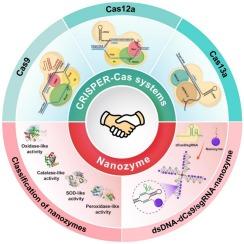
It is of paramount importance to establish user-friendly, consensus-driven, and conceptually novel techniques for ensuring food safety. The CRISPR/Cas system represents an emerging technology with exceptional capabilities for targeting RNA and DNA. It has been repurposed as a robust tool for the diagnosis of nucleic acids. Nevertheless, most CRISPR-based techniques rely on specialized detection equipment and expensive reporters, despite their exceptional accuracy and rapid analysis capabilities. Recently, nanozymes have been integrated into CRISPR/Cas-based biosensors due to their low cost, good stability, higher recycling efficiency, simpler preparation processes, and more robust catalytic functions. Therefore, significant efforts have been devoted to the advancement of nanozyme-integrated CRISPR/Cas-derived biosensors for the analysis of various targets. This review focuses on the recent developments in nanozyme-assisted CRISPR/Cas systems-based biosensors, with particular emphasis on the detection principles and performance of these platforms. The principles and properties of commonly employed CRISPR/Cas systems are outlined. Additionally, the application of nanozyme-assisted CRISPR/Cas systems in food safety analysis, which includes pathogenic bacteria, viruses, toxins, and heavy metal ions, is thoroughly described. Ultimately, the main challenges and future trends in this field are discussed in detail.
期刊介绍:
The Microchemical Journal is a peer reviewed journal devoted to all aspects and phases of analytical chemistry and chemical analysis. The Microchemical Journal publishes articles which are at the forefront of modern analytical chemistry and cover innovations in the techniques to the finest possible limits. This includes fundamental aspects, instrumentation, new developments, innovative and novel methods and applications including environmental and clinical field.
Traditional classical analytical methods such as spectrophotometry and titrimetry as well as established instrumentation methods such as flame and graphite furnace atomic absorption spectrometry, gas chromatography, and modified glassy or carbon electrode electrochemical methods will be considered, provided they show significant improvements and novelty compared to the established methods.



 京公网安备 11010802042870号
京ICP备2023020795号-1
京公网安备 11010802042870号
京ICP备2023020795号-1

 分享
分享
 求助内容:
求助内容: 应助结果提醒方式:
 扫码关注我们
