A protocol for synthesizing reference materials for multi-isotope analysis via high-temperature and high-pressure sintering: A demonstration with Ti-Hf in rutile
Deyi Peng, Zhian Bao, Lei Kang, Xiaojuan Nie, Kaiyun Chen, Yan Zhang, Honglin Yuan
{"title":"A protocol for synthesizing reference materials for multi-isotope analysis via high-temperature and high-pressure sintering: A demonstration with Ti-Hf in rutile","authors":"Deyi Peng, Zhian Bao, Lei Kang, Xiaojuan Nie, Kaiyun Chen, Yan Zhang, Honglin Yuan","doi":"10.1016/j.microc.2025.113238","DOIUrl":null,"url":null,"abstract":"<div><div>Multi-isotope tracers are vital in exploring complex systems and processes in environmental science, archaeology, and Earth sciences. Laser ablation multiple-collector inductively coupled plasma mass spectrometry (LA-MC-ICP-MS), as a robust technique for such isotope analyses, offers high spatial resolution to identify micro-regional isotopic heterogeneity. However, high-precision in-situ isotope measurements typically necessitate the use of matrix-matched reference materials to correct for matrix effects, instrumental bias, and fractionation induced by laser ablation. Natural minerals with homogeneous multi-isotopic compositions are extremely rare and inadequate to fully meet diverse experimental requirements. This study proposes a robust synthesis protocol to make matrix-matched reference materials tailored for in-situ multi-isotope analysis via LA-MC-ICP-MS. This protocol integrates elemental doping (ED) with high-temperature and high-pressure (HTHP) techniques, offering a versatile approach to prepare solid reference materials tailored for multiple isotopes of interest. To validate the reliability of this method, a HfO<sub>2</sub>-doped rutile (NWU-RT) was synthesized for Ti-Hf isotope determination. Comprehensive in-situ analyses demonstrate that NWU-RT exhibits exceptional homogeneity in Ti and Hf isotopes. The mean δ<sup>49</sup>Ti<sub>OL-Ti</sub> value is 0.42 ± 0.12 ‰ (2SD, n = 666), with a <sup>176</sup>Hf/<sup>177</sup>Hf isotopic ratio of 0.282265 ± 0.000071 (2SD, n = 561), aligning with results obtained from SN-MC-ICP-MS. Reproducibility tests involving six batches of NWU-RT synthesized under identical experimental conditions over a year confirm the significant potential of the ED-HTHP method for synthesizing reliable solid reference materials for in-situ multi-isotope measurements using LA-MC-ICP-MS.</div></div>","PeriodicalId":391,"journal":{"name":"Microchemical Journal","volume":"212 ","pages":"Article 113238"},"PeriodicalIF":4.9000,"publicationDate":"2025-05-01","publicationTypes":"Journal Article","fieldsOfStudy":null,"isOpenAccess":false,"openAccessPdf":"","citationCount":"0","resultStr":null,"platform":"Semanticscholar","paperid":null,"PeriodicalName":"Microchemical Journal","FirstCategoryId":"92","ListUrlMain":"https://www.sciencedirect.com/science/article/pii/S0026265X25005922","RegionNum":2,"RegionCategory":"化学","ArticlePicture":[],"TitleCN":null,"AbstractTextCN":null,"PMCID":null,"EPubDate":"2025/3/5 0:00:00","PubModel":"Epub","JCR":"Q1","JCRName":"CHEMISTRY, ANALYTICAL","Score":null,"Total":0}
引用次数: 0
Abstract
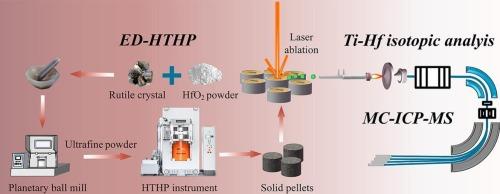
Multi-isotope tracers are vital in exploring complex systems and processes in environmental science, archaeology, and Earth sciences. Laser ablation multiple-collector inductively coupled plasma mass spectrometry (LA-MC-ICP-MS), as a robust technique for such isotope analyses, offers high spatial resolution to identify micro-regional isotopic heterogeneity. However, high-precision in-situ isotope measurements typically necessitate the use of matrix-matched reference materials to correct for matrix effects, instrumental bias, and fractionation induced by laser ablation. Natural minerals with homogeneous multi-isotopic compositions are extremely rare and inadequate to fully meet diverse experimental requirements. This study proposes a robust synthesis protocol to make matrix-matched reference materials tailored for in-situ multi-isotope analysis via LA-MC-ICP-MS. This protocol integrates elemental doping (ED) with high-temperature and high-pressure (HTHP) techniques, offering a versatile approach to prepare solid reference materials tailored for multiple isotopes of interest. To validate the reliability of this method, a HfO2-doped rutile (NWU-RT) was synthesized for Ti-Hf isotope determination. Comprehensive in-situ analyses demonstrate that NWU-RT exhibits exceptional homogeneity in Ti and Hf isotopes. The mean δ49TiOL-Ti value is 0.42 ± 0.12 ‰ (2SD, n = 666), with a 176Hf/177Hf isotopic ratio of 0.282265 ± 0.000071 (2SD, n = 561), aligning with results obtained from SN-MC-ICP-MS. Reproducibility tests involving six batches of NWU-RT synthesized under identical experimental conditions over a year confirm the significant potential of the ED-HTHP method for synthesizing reliable solid reference materials for in-situ multi-isotope measurements using LA-MC-ICP-MS.
多同位素示踪剂在环境科学、考古学和地球科学中探索复杂系统和过程是至关重要的。激光烧蚀多收集器电感耦合等离子体质谱(LA-MC-ICP-MS)作为一种可靠的同位素分析技术,提供了高空间分辨率来识别微区域同位素异质性。然而,高精度的原位同位素测量通常需要使用基质匹配的参考物质来纠正基质效应、仪器偏差和激光烧蚀引起的分馏。具有均匀多同位素组成的天然矿物极为稀少,不足以充分满足多样化的实验要求。本研究提出了一种强大的合成方案,用于LA-MC-ICP-MS原位多同位素分析的基质匹配参考物质。该方案将元素掺杂(ED)与高温高压(HTHP)技术相结合,提供了一种通用的方法来制备针对多种感兴趣的同位素量身定制的固体参考材料。为了验证该方法的可靠性,合成了一种hfo2掺杂金红石(NWU-RT)用于Ti-Hf同位素的测定。综合原位分析表明,NWU-RT在Ti和Hf同位素中表现出优异的均匀性。δ49TiOL-Ti平均值为0.42±0.12‰(2SD, n = 666), 176Hf/177Hf同位素比值为0.282265±0.000071 (2SD, n = 561),与SN-MC-ICP-MS测定结果一致。在一年多的时间里,在相同的实验条件下合成了6批NWU-RT,重复性测试证实了ED-HTHP方法为LA-MC-ICP-MS原位多同位素测量合成可靠的固体参考物质的巨大潜力。
期刊介绍:
The Microchemical Journal is a peer reviewed journal devoted to all aspects and phases of analytical chemistry and chemical analysis. The Microchemical Journal publishes articles which are at the forefront of modern analytical chemistry and cover innovations in the techniques to the finest possible limits. This includes fundamental aspects, instrumentation, new developments, innovative and novel methods and applications including environmental and clinical field.
Traditional classical analytical methods such as spectrophotometry and titrimetry as well as established instrumentation methods such as flame and graphite furnace atomic absorption spectrometry, gas chromatography, and modified glassy or carbon electrode electrochemical methods will be considered, provided they show significant improvements and novelty compared to the established methods.



 京公网安备 11010802042870号
京ICP备2023020795号-1
京公网安备 11010802042870号
京ICP备2023020795号-1

 分享
分享
 求助内容:
求助内容: 应助结果提醒方式:
 扫码关注我们
