Kirtika Kohli , Ravindra Prajapati , Sarmila Katuwal , Jaemin Kim , Charles A. Mullen , Gary D. Strahan , Atanu Biswas , Brajendra K. Sharma
{"title":"Maximization of Kraft lignin depolymerization using synthetic mixed oxide catalysts under microwave exposure","authors":"Kirtika Kohli , Ravindra Prajapati , Sarmila Katuwal , Jaemin Kim , Charles A. Mullen , Gary D. Strahan , Atanu Biswas , Brajendra K. Sharma","doi":"10.1016/j.indcrop.2025.120787","DOIUrl":null,"url":null,"abstract":"<div><div>The efficient utilization of biomass-derived waste, particularly lignin, is crucial for the economic success of biorefineries. Lignin, comprising 15–30 % of the available renewable carbon, can be transformed into valuable aromatic chemicals. This study explores microwave-assisted depolymerization of Kraft lignin using a methanol/formic acid solvent system, with formic acid acting as both a hydrogen donor and acid catalyst. A maximum 78 % of lignin conversion was achieved at 140°C with a formic acid-to-lignin mass ratio of 4 after 20 minutes. To further enhance product yield and reduce solid residues, mixed-metal oxide (MMO) catalysts i.e., Mg<sub>3</sub>AlCO<sub>3</sub>, Mg<sub>3</sub>AlSO<sub>4</sub>, and Mg<sub>3</sub>AlCl were used. The optimized reaction conditions (100°C, 20 minutes, formic acid-to-lignin mass ratio of 4, and catalyst-to-lignin ratio of 0.25) resulted in a bio-oil yield of 81 % and a lignin conversion of 89 %. The primary liquid product was G-type phenolic monomers (∼60 %), highlighting the effective role of MMOs in selectively cleaving lignin linkages. This method provides an efficient, external hydrogen-free route for producing valuable phenolic compounds from lignin.</div></div>","PeriodicalId":13581,"journal":{"name":"Industrial Crops and Products","volume":"227 ","pages":"Article 120787"},"PeriodicalIF":6.2000,"publicationDate":"2025-05-01","publicationTypes":"Journal Article","fieldsOfStudy":null,"isOpenAccess":false,"openAccessPdf":"","citationCount":"0","resultStr":null,"platform":"Semanticscholar","paperid":null,"PeriodicalName":"Industrial Crops and Products","FirstCategoryId":"97","ListUrlMain":"https://www.sciencedirect.com/science/article/pii/S0926669025003334","RegionNum":1,"RegionCategory":"农林科学","ArticlePicture":[],"TitleCN":null,"AbstractTextCN":null,"PMCID":null,"EPubDate":"2025/3/10 0:00:00","PubModel":"Epub","JCR":"Q1","JCRName":"AGRICULTURAL ENGINEERING","Score":null,"Total":0}
引用次数: 0
Abstract
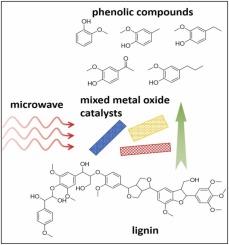
The efficient utilization of biomass-derived waste, particularly lignin, is crucial for the economic success of biorefineries. Lignin, comprising 15–30 % of the available renewable carbon, can be transformed into valuable aromatic chemicals. This study explores microwave-assisted depolymerization of Kraft lignin using a methanol/formic acid solvent system, with formic acid acting as both a hydrogen donor and acid catalyst. A maximum 78 % of lignin conversion was achieved at 140°C with a formic acid-to-lignin mass ratio of 4 after 20 minutes. To further enhance product yield and reduce solid residues, mixed-metal oxide (MMO) catalysts i.e., Mg3AlCO3, Mg3AlSO4, and Mg3AlCl were used. The optimized reaction conditions (100°C, 20 minutes, formic acid-to-lignin mass ratio of 4, and catalyst-to-lignin ratio of 0.25) resulted in a bio-oil yield of 81 % and a lignin conversion of 89 %. The primary liquid product was G-type phenolic monomers (∼60 %), highlighting the effective role of MMOs in selectively cleaving lignin linkages. This method provides an efficient, external hydrogen-free route for producing valuable phenolic compounds from lignin.
期刊介绍:
Industrial Crops and Products is an International Journal publishing academic and industrial research on industrial (defined as non-food/non-feed) crops and products. Papers concern both crop-oriented and bio-based materials from crops-oriented research, and should be of interest to an international audience, hypothesis driven, and where comparisons are made statistics performed.



 京公网安备 11010802042870号
京ICP备2023020795号-1
京公网安备 11010802042870号
京ICP备2023020795号-1

 分享
分享
 求助内容:
求助内容: 应助结果提醒方式:
 扫码关注我们
