A spherical nucleic acid-based colorimetric and fluorescent dual-responsive sensor for rapid and sensitive detection of neomycin in environmental water samples
{"title":"A spherical nucleic acid-based colorimetric and fluorescent dual-responsive sensor for rapid and sensitive detection of neomycin in environmental water samples","authors":"Yinghua Zhu , Youduo Zhao , Jingjing Deng , Tianshu Zhou","doi":"10.1016/j.microc.2025.113252","DOIUrl":null,"url":null,"abstract":"<div><div>The widespread application of neomycin (NEO) has raised pollution problem caused by the accumulation of its residues, which poses potential risk to human health and ecological safety. Therefore, the development of sensitive and reliable approaches is crucial for detecting and monitoring low levels of NEO in complex samples. In this study, an innovative spherical nucleic acid (SNA) based sensor was designed for the selective detection of NEO. The colorimetric response was attributed to hydrogen bonding, electrostatic interaction, and coordination between the SNA and NEO. Meanwhile, the fluorescence of FAM-labeled SNA was quenched by NEO due to fluorescence resonance energy transfer (FRET) effect. By integrating visual colorimetry and fluorescence analysis, the dual-responsive sensor enabled rapid, selective, and sensitive determination of NEO, with detection limits of 40.0 nM and 3.3 nM, respectively. Furthermore, the SNA exhibited good salt tolerance, maintaining stability without aggregation even in high-salt conditions. The average recoveries for detecting NEO in water samples analysis ranged from 97.6 % to 108.7 %, confirming its reliability and accuracy in practical applications. This work provides an effective strategy for NEO detection and expands the potential applications of SNA in environmental monitoring and pollution control.</div></div>","PeriodicalId":391,"journal":{"name":"Microchemical Journal","volume":"212 ","pages":"Article 113252"},"PeriodicalIF":4.9000,"publicationDate":"2025-05-01","publicationTypes":"Journal Article","fieldsOfStudy":null,"isOpenAccess":false,"openAccessPdf":"","citationCount":"0","resultStr":null,"platform":"Semanticscholar","paperid":null,"PeriodicalName":"Microchemical Journal","FirstCategoryId":"92","ListUrlMain":"https://www.sciencedirect.com/science/article/pii/S0026265X2500606X","RegionNum":2,"RegionCategory":"化学","ArticlePicture":[],"TitleCN":null,"AbstractTextCN":null,"PMCID":null,"EPubDate":"2025/3/4 0:00:00","PubModel":"Epub","JCR":"Q1","JCRName":"CHEMISTRY, ANALYTICAL","Score":null,"Total":0}
引用次数: 0
Abstract
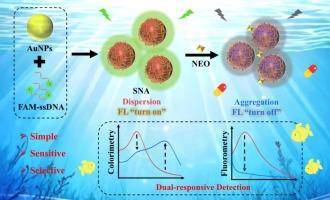
The widespread application of neomycin (NEO) has raised pollution problem caused by the accumulation of its residues, which poses potential risk to human health and ecological safety. Therefore, the development of sensitive and reliable approaches is crucial for detecting and monitoring low levels of NEO in complex samples. In this study, an innovative spherical nucleic acid (SNA) based sensor was designed for the selective detection of NEO. The colorimetric response was attributed to hydrogen bonding, electrostatic interaction, and coordination between the SNA and NEO. Meanwhile, the fluorescence of FAM-labeled SNA was quenched by NEO due to fluorescence resonance energy transfer (FRET) effect. By integrating visual colorimetry and fluorescence analysis, the dual-responsive sensor enabled rapid, selective, and sensitive determination of NEO, with detection limits of 40.0 nM and 3.3 nM, respectively. Furthermore, the SNA exhibited good salt tolerance, maintaining stability without aggregation even in high-salt conditions. The average recoveries for detecting NEO in water samples analysis ranged from 97.6 % to 108.7 %, confirming its reliability and accuracy in practical applications. This work provides an effective strategy for NEO detection and expands the potential applications of SNA in environmental monitoring and pollution control.
期刊介绍:
The Microchemical Journal is a peer reviewed journal devoted to all aspects and phases of analytical chemistry and chemical analysis. The Microchemical Journal publishes articles which are at the forefront of modern analytical chemistry and cover innovations in the techniques to the finest possible limits. This includes fundamental aspects, instrumentation, new developments, innovative and novel methods and applications including environmental and clinical field.
Traditional classical analytical methods such as spectrophotometry and titrimetry as well as established instrumentation methods such as flame and graphite furnace atomic absorption spectrometry, gas chromatography, and modified glassy or carbon electrode electrochemical methods will be considered, provided they show significant improvements and novelty compared to the established methods.



 京公网安备 11010802042870号
京ICP备2023020795号-1
京公网安备 11010802042870号
京ICP备2023020795号-1

 分享
分享
 求助内容:
求助内容: 应助结果提醒方式:
 扫码关注我们
