Ramon Felipe Bicudo da Silva , Andrés Viña , Daniel de Castro Victoria , Mateus Batistella , Geraldo B. Martha Jr. , Emilio Federico Moran , Jianguo Liu
{"title":"Compound effects of drought and COVID-19 on soybean production in Brazil: Challenges and policy responses","authors":"Ramon Felipe Bicudo da Silva , Andrés Viña , Daniel de Castro Victoria , Mateus Batistella , Geraldo B. Martha Jr. , Emilio Federico Moran , Jianguo Liu","doi":"10.1016/j.scitotenv.2025.179047","DOIUrl":null,"url":null,"abstract":"<div><div>This study investigates the cumulative and interactive impacts of drought and COVID-19 on soybean production in Brazil, focusing on cascading economic and operational disruptions. The country has faced numerous drought events in recent years (1989 to 2022), culminating with one in 2022 that, together with the occurrence of COVID-19, led to the highest decline in soybean production since 1990 (10.5 % of the total national production). Our analyses based on spatial lagged regression models revealed that the cumulative impacts of consecutive drought events significantly affect soybean production. Furthermore, the study uncovered a significant interactive association between COVID-19 and drought by using spatial lag models, emphasizing the compounded challenges posed by simultaneous shocks of climate change and rising agricultural production costs due to pandemic-induced supply chain disruptions. In addition, descriptive statistics on agricultural economics showed that COVID-19 triggered historical peaks in agricultural input prices, forcing producers to enter the 2021–2022 crop season under critical conditions. Specifically, previous losses in soybean production due to droughts during the 2020—2021 season left producers facing financial constraints while contending with historically high production costs for the next season. These results show how the impacts of a global pandemic cascade into soybean production costs (input prices), while highlight the vulnerability of Brazil's soybean production system to multiple shocks. Hence, we envision responses encompassing short-term changes in management practices and land-use decisions at the farm level; mid-term public policies providing risk assessments and emergency credit to address abnormal spikes in production costs caused by socio-health stressors, which would enable producers to secure more suitable input packages, helping to mitigate potential losses associated with co-occurring climate extreme events; and long-term further investments in developing more self-sufficient food production systems, reducing the heavy reliance on imported agricultural inputs—as seen in the Brazilian case—, and development of highly soybean tolerant-drought varieties.</div></div>","PeriodicalId":422,"journal":{"name":"Science of the Total Environment","volume":"971 ","pages":"Article 179047"},"PeriodicalIF":8.0000,"publicationDate":"2025-03-09","publicationTypes":"Journal Article","fieldsOfStudy":null,"isOpenAccess":false,"openAccessPdf":"","citationCount":"0","resultStr":null,"platform":"Semanticscholar","paperid":null,"PeriodicalName":"Science of the Total Environment","FirstCategoryId":"93","ListUrlMain":"https://www.sciencedirect.com/science/article/pii/S0048969725006825","RegionNum":1,"RegionCategory":"环境科学与生态学","ArticlePicture":[],"TitleCN":null,"AbstractTextCN":null,"PMCID":null,"EPubDate":"","PubModel":"","JCR":"Q1","JCRName":"ENVIRONMENTAL SCIENCES","Score":null,"Total":0}
引用次数: 0
Abstract
This study investigates the cumulative and interactive impacts of drought and COVID-19 on soybean production in Brazil, focusing on cascading economic and operational disruptions. The country has faced numerous drought events in recent years (1989 to 2022), culminating with one in 2022 that, together with the occurrence of COVID-19, led to the highest decline in soybean production since 1990 (10.5 % of the total national production). Our analyses based on spatial lagged regression models revealed that the cumulative impacts of consecutive drought events significantly affect soybean production. Furthermore, the study uncovered a significant interactive association between COVID-19 and drought by using spatial lag models, emphasizing the compounded challenges posed by simultaneous shocks of climate change and rising agricultural production costs due to pandemic-induced supply chain disruptions. In addition, descriptive statistics on agricultural economics showed that COVID-19 triggered historical peaks in agricultural input prices, forcing producers to enter the 2021–2022 crop season under critical conditions. Specifically, previous losses in soybean production due to droughts during the 2020—2021 season left producers facing financial constraints while contending with historically high production costs for the next season. These results show how the impacts of a global pandemic cascade into soybean production costs (input prices), while highlight the vulnerability of Brazil's soybean production system to multiple shocks. Hence, we envision responses encompassing short-term changes in management practices and land-use decisions at the farm level; mid-term public policies providing risk assessments and emergency credit to address abnormal spikes in production costs caused by socio-health stressors, which would enable producers to secure more suitable input packages, helping to mitigate potential losses associated with co-occurring climate extreme events; and long-term further investments in developing more self-sufficient food production systems, reducing the heavy reliance on imported agricultural inputs—as seen in the Brazilian case—, and development of highly soybean tolerant-drought varieties.
期刊介绍:
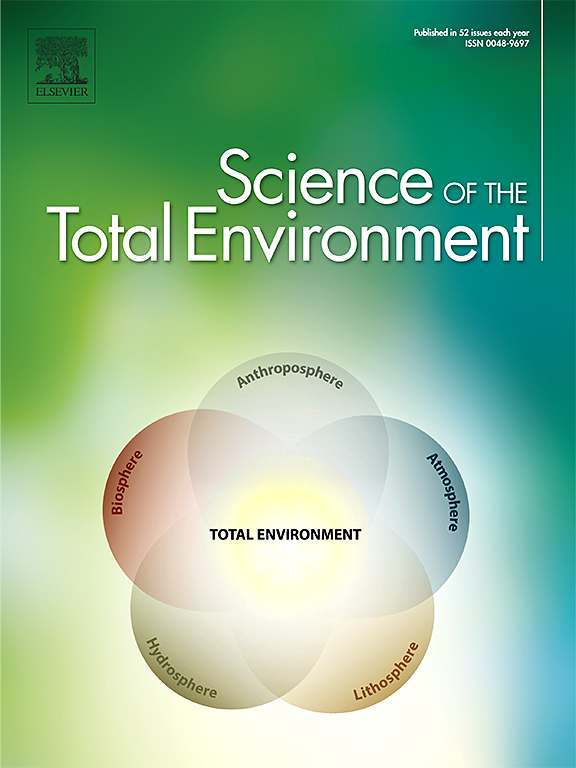
The Science of the Total Environment is an international journal dedicated to scientific research on the environment and its interaction with humanity. It covers a wide range of disciplines and seeks to publish innovative, hypothesis-driven, and impactful research that explores the entire environment, including the atmosphere, lithosphere, hydrosphere, biosphere, and anthroposphere.
The journal's updated Aims & Scope emphasizes the importance of interdisciplinary environmental research with broad impact. Priority is given to studies that advance fundamental understanding and explore the interconnectedness of multiple environmental spheres. Field studies are preferred, while laboratory experiments must demonstrate significant methodological advancements or mechanistic insights with direct relevance to the environment.




 京公网安备 11010802042870号
京ICP备2023020795号-1
京公网安备 11010802042870号
京ICP备2023020795号-1

 分享
分享
 求助内容:
求助内容: 应助结果提醒方式:
 扫码关注我们
