Zhenfang Xiao , Qiumei Huang , Wenyi Huang , Guoqiang Zhang , Dongdong Li , Zhuwei Zhang , Hao Cheng , Jun Feng , Lijun Li
{"title":"An “on-off-on” fluorescent sensor based on Sm:ZnO–NH2 QDs for hexavalent chromium detection","authors":"Zhenfang Xiao , Qiumei Huang , Wenyi Huang , Guoqiang Zhang , Dongdong Li , Zhuwei Zhang , Hao Cheng , Jun Feng , Lijun Li","doi":"10.1016/j.saa.2025.125998","DOIUrl":null,"url":null,"abstract":"<div><div>The problems of poor water solubility, poor stability, and poor selectivity encountered in the determination of hexavalent chromium (Cr(VI)) in water using ZnO QDs need to be addressed. In this study, we successfully prepared Sm-doped, –NH<sub>2</sub>-modified Sm:ZnO–NH<sub>2</sub> QDs via the sol–gel method. Sm doping was used to enhance the fluorescence intensity of ZnO QDs, while 3-aminopropyltrietoxysilane (APTEs) capping improved their water solubility and fluorescence stability. The fluorescence of Sm:ZnO–NH<sub>2</sub> quantum dots was quenched after the addition of Cr(VI) due to the internal filtration effect(IFE), and was restored after the addition of ascorbic acid due to the redox reaction between ascorbic acid (AA) and Cr(VI). Leveraging the fluorescence response patterns of the Sm:ZnO–NH<sub>2</sub> QDs system when exposed to Cr(VI) and AA, we developed an ’’on-off-on’’ fluorescent sensor that can specifically detect Cr(VI) and AA without interference from Cu2<sup>+</sup> ions. The “on-off-on” fluorescent sensor exhibited a linear response to Cr(VI) concentrations ranging from 0.05 to 1.5 μg/mL, with a limit of detection (LOD) of 6.15 ng/mL. It exhibited excellent selectivity and repeatability. Furthermore, the Sm:ZnO–NH<sub>2</sub> QDs fluorescent sensor was effectively utilized for detecting Cr(VI) in tap water, offering a new method for heavy metal detection via an “on-off-on” fluorescence switching mechanism.</div></div>","PeriodicalId":433,"journal":{"name":"Spectrochimica Acta Part A: Molecular and Biomolecular Spectroscopy","volume":"335 ","pages":"Article 125998"},"PeriodicalIF":4.6000,"publicationDate":"2025-03-05","publicationTypes":"Journal Article","fieldsOfStudy":null,"isOpenAccess":false,"openAccessPdf":"","citationCount":"0","resultStr":null,"platform":"Semanticscholar","paperid":null,"PeriodicalName":"Spectrochimica Acta Part A: Molecular and Biomolecular Spectroscopy","FirstCategoryId":"92","ListUrlMain":"https://www.sciencedirect.com/science/article/pii/S138614252500304X","RegionNum":2,"RegionCategory":"化学","ArticlePicture":[],"TitleCN":null,"AbstractTextCN":null,"PMCID":null,"EPubDate":"","PubModel":"","JCR":"Q1","JCRName":"SPECTROSCOPY","Score":null,"Total":0}
引用次数: 0
Abstract
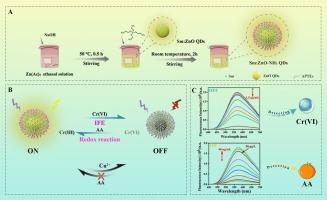
The problems of poor water solubility, poor stability, and poor selectivity encountered in the determination of hexavalent chromium (Cr(VI)) in water using ZnO QDs need to be addressed. In this study, we successfully prepared Sm-doped, –NH2-modified Sm:ZnO–NH2 QDs via the sol–gel method. Sm doping was used to enhance the fluorescence intensity of ZnO QDs, while 3-aminopropyltrietoxysilane (APTEs) capping improved their water solubility and fluorescence stability. The fluorescence of Sm:ZnO–NH2 quantum dots was quenched after the addition of Cr(VI) due to the internal filtration effect(IFE), and was restored after the addition of ascorbic acid due to the redox reaction between ascorbic acid (AA) and Cr(VI). Leveraging the fluorescence response patterns of the Sm:ZnO–NH2 QDs system when exposed to Cr(VI) and AA, we developed an ’’on-off-on’’ fluorescent sensor that can specifically detect Cr(VI) and AA without interference from Cu2+ ions. The “on-off-on” fluorescent sensor exhibited a linear response to Cr(VI) concentrations ranging from 0.05 to 1.5 μg/mL, with a limit of detection (LOD) of 6.15 ng/mL. It exhibited excellent selectivity and repeatability. Furthermore, the Sm:ZnO–NH2 QDs fluorescent sensor was effectively utilized for detecting Cr(VI) in tap water, offering a new method for heavy metal detection via an “on-off-on” fluorescence switching mechanism.
期刊介绍:
Spectrochimica Acta, Part A: Molecular and Biomolecular Spectroscopy (SAA) is an interdisciplinary journal which spans from basic to applied aspects of optical spectroscopy in chemistry, medicine, biology, and materials science.
The journal publishes original scientific papers that feature high-quality spectroscopic data and analysis. From the broad range of optical spectroscopies, the emphasis is on electronic, vibrational or rotational spectra of molecules, rather than on spectroscopy based on magnetic moments.
Criteria for publication in SAA are novelty, uniqueness, and outstanding quality. Routine applications of spectroscopic techniques and computational methods are not appropriate.
Topics of particular interest of Spectrochimica Acta Part A include, but are not limited to:
Spectroscopy and dynamics of bioanalytical, biomedical, environmental, and atmospheric sciences,
Novel experimental techniques or instrumentation for molecular spectroscopy,
Novel theoretical and computational methods,
Novel applications in photochemistry and photobiology,
Novel interpretational approaches as well as advances in data analysis based on electronic or vibrational spectroscopy.



 京公网安备 11010802042870号
京ICP备2023020795号-1
京公网安备 11010802042870号
京ICP备2023020795号-1

 分享
分享
 求助内容:
求助内容: 应助结果提醒方式:
 扫码关注我们
