Ya-qi Huang , Ming-qian Wu , Jian-wen Yang , Xue-ming Teng , Cong Ao , Germain Kaningu Bishikwabo , Kun-feng Qiu
{"title":"Sedimentary and ore-forming characteristics of uranium mineralization in the Shizigou formation from the Southwest Qaidam Basin, Northwest China","authors":"Ya-qi Huang , Ming-qian Wu , Jian-wen Yang , Xue-ming Teng , Cong Ao , Germain Kaningu Bishikwabo , Kun-feng Qiu","doi":"10.1016/j.oregeorev.2025.106534","DOIUrl":null,"url":null,"abstract":"<div><div>The sandstone-type uranium deposits are the dominant source of uranium in China. The Qaidam Basin, the largest inland sedimentary basin from the Chinese northern Tibetan Plateau, is shaped by various tectonic processes from the surrounding East Kunlun, Altyn, and Qilian orogenic belts, and is characterized by uranium mineralization and enrichment of petroleum. The Shizigou Formation is identified as one of the U-bearing strata in the Qigequan area. We present a case study at the Qigequan area in the southwestern edge of the Qaidam Basin, to investigate the governing factors for anomalous uranium enrichment in this stratum. U-Pb dating of detrital zircon from sandstones of the Shizigou Formation reveales two age peaks at 450 Ma and 260 Ma, respectively. The zircon CL images suggest that the majority of zircon grains assessed are magmatic origin, though some show complex core-rim texture, irregular shape core with overgrowth domains, patched zoning and sector zoning, indicating a metamorphic origin. The bimodal age distribution, textures, and REE distribution of the selected detrital zircon grains all indicate that the sedimentary source of the Shizigou Formation originated from the Qimantagh area (East Kunlun). The paleoclimate proxies, namely the Sr/Cu, Sr/Ba, V/Sc, V/Cr, and Fe<sup>3+</sup>/Fe<sup>2+</sup> values, combined with the chemical index of alteration (CIA) and index of compositional variation (ICV) reveal that the Shizigou Formation was formed in a relatively arid and oxidized environment that suffered a low degree of chemical weathering, which provides condition for the transportation of U-bearing ore-forming fluids. The escaping organic matters in the underlying strata act as reducing materials that control the precipitation of uranium-complexes in ore-forming fluids. On the other hand, the surrounding strata containing the source rocks and hydrocarbon make an effective barrier for the uranium orebodies to be preserved. The source of ore-forming materials, sedimentary environment and organic matters have made significant contributions to the uranium mineralization in the southwest Qaidam Basin.</div></div>","PeriodicalId":19644,"journal":{"name":"Ore Geology Reviews","volume":"179 ","pages":"Article 106534"},"PeriodicalIF":3.6000,"publicationDate":"2025-03-05","publicationTypes":"Journal Article","fieldsOfStudy":null,"isOpenAccess":false,"openAccessPdf":"","citationCount":"0","resultStr":null,"platform":"Semanticscholar","paperid":null,"PeriodicalName":"Ore Geology Reviews","FirstCategoryId":"89","ListUrlMain":"https://www.sciencedirect.com/science/article/pii/S0169136825000940","RegionNum":2,"RegionCategory":"地球科学","ArticlePicture":[],"TitleCN":null,"AbstractTextCN":null,"PMCID":null,"EPubDate":"","PubModel":"","JCR":"Q1","JCRName":"GEOLOGY","Score":null,"Total":0}
引用次数: 0
Abstract
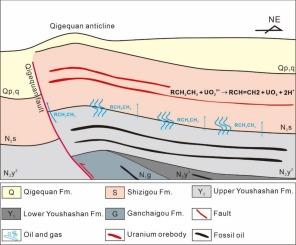
The sandstone-type uranium deposits are the dominant source of uranium in China. The Qaidam Basin, the largest inland sedimentary basin from the Chinese northern Tibetan Plateau, is shaped by various tectonic processes from the surrounding East Kunlun, Altyn, and Qilian orogenic belts, and is characterized by uranium mineralization and enrichment of petroleum. The Shizigou Formation is identified as one of the U-bearing strata in the Qigequan area. We present a case study at the Qigequan area in the southwestern edge of the Qaidam Basin, to investigate the governing factors for anomalous uranium enrichment in this stratum. U-Pb dating of detrital zircon from sandstones of the Shizigou Formation reveales two age peaks at 450 Ma and 260 Ma, respectively. The zircon CL images suggest that the majority of zircon grains assessed are magmatic origin, though some show complex core-rim texture, irregular shape core with overgrowth domains, patched zoning and sector zoning, indicating a metamorphic origin. The bimodal age distribution, textures, and REE distribution of the selected detrital zircon grains all indicate that the sedimentary source of the Shizigou Formation originated from the Qimantagh area (East Kunlun). The paleoclimate proxies, namely the Sr/Cu, Sr/Ba, V/Sc, V/Cr, and Fe3+/Fe2+ values, combined with the chemical index of alteration (CIA) and index of compositional variation (ICV) reveal that the Shizigou Formation was formed in a relatively arid and oxidized environment that suffered a low degree of chemical weathering, which provides condition for the transportation of U-bearing ore-forming fluids. The escaping organic matters in the underlying strata act as reducing materials that control the precipitation of uranium-complexes in ore-forming fluids. On the other hand, the surrounding strata containing the source rocks and hydrocarbon make an effective barrier for the uranium orebodies to be preserved. The source of ore-forming materials, sedimentary environment and organic matters have made significant contributions to the uranium mineralization in the southwest Qaidam Basin.
期刊介绍:
Ore Geology Reviews aims to familiarize all earth scientists with recent advances in a number of interconnected disciplines related to the study of, and search for, ore deposits. The reviews range from brief to longer contributions, but the journal preferentially publishes manuscripts that fill the niche between the commonly shorter journal articles and the comprehensive book coverages, and thus has a special appeal to many authors and readers.



 京公网安备 11010802042870号
京ICP备2023020795号-1
京公网安备 11010802042870号
京ICP备2023020795号-1

 分享
分享
 求助内容:
求助内容: 应助结果提醒方式:
 扫码关注我们
